
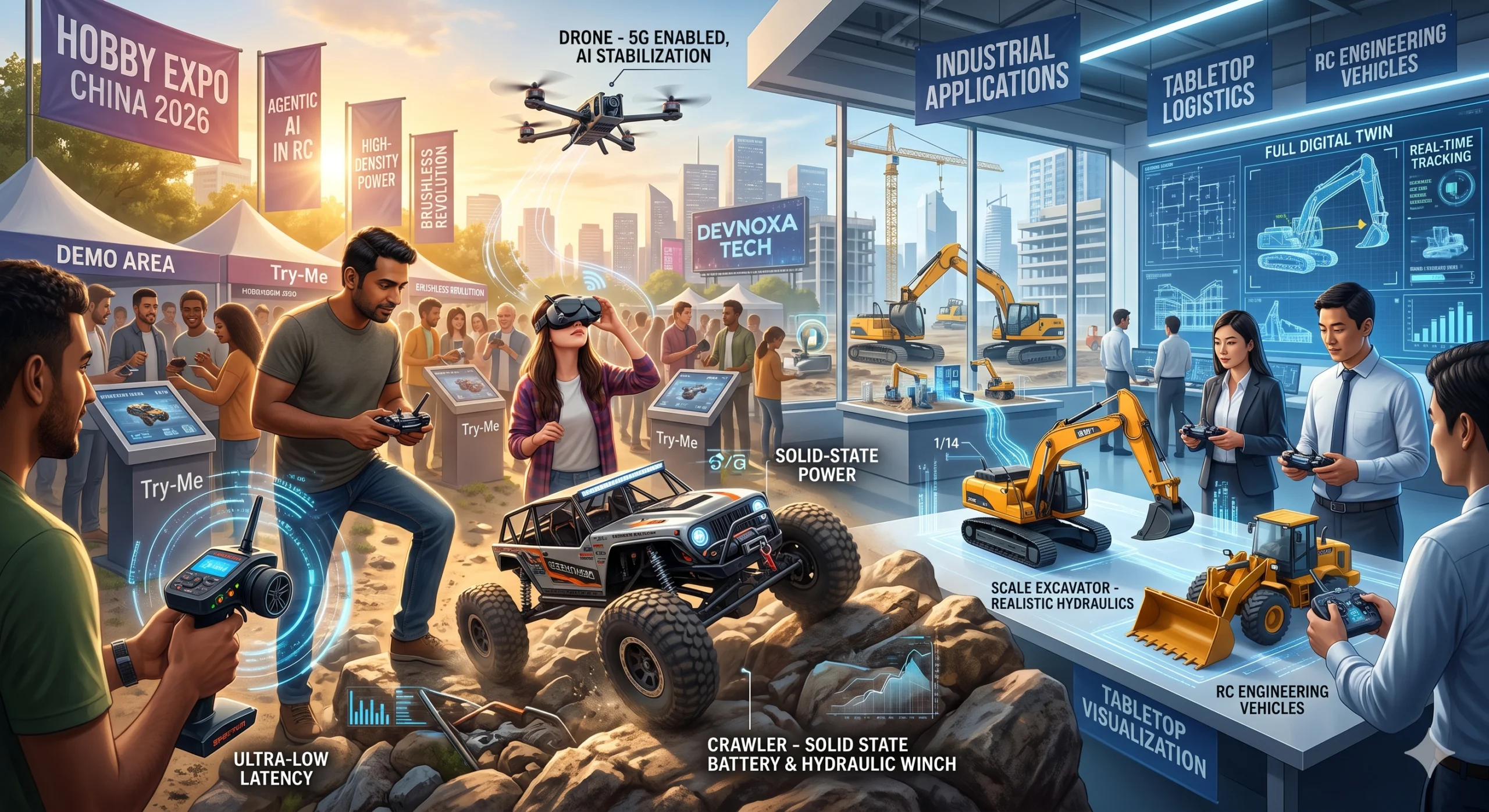

Gone are the days when radio control was limited to plastic cars with short-range antennas. Today, RC Tech represents a sophisticated frontier of engineering, encompassing everything from autonomous construction fleets to high-performance aeronautics. It is a field where hobbyist passion meets industrial utility, proving that the thrill of the “remote” is more relevant than ever.
The 2026 Evolution: From Toys to Tools
The most significant shift in RC Tech over the last few years has been the professionalization of the equipment. We are seeing a “Physical AI” revolution where miniature machines are now capable of performing complex, real-world tasks.
1. Miniature Engineering and Hydraulics
In 2026, the RC construction market has exploded. Companies are no longer just building models; they are building functional scale replicas. High-end RC excavators and loaders now feature realistic hydraulic systems, allowing them to lift significant weight and move earth with the same precision as their full-sized counterparts. This has turned the hobby into a valuable educational tool, as STEM programs and trade schools use these vehicles to teach the fundamentals of fluid dynamics and mechanical leverage.
2. High-Density Power and Brushless Motors
The transition to solid-state battery technology and high-efficiency brushless motors has redefined the performance envelope. Modern RC planes and cars can now achieve speeds and run times that were unthinkable a decade ago. In 2026, an intermediate RC airplane can stay aloft for nearly an hour on a single charge, while professional-grade racing drones utilize 5G-enabled transmitters for ultra-low latency, allowing pilots to navigate at over 100 miles per hour with pinpoint accuracy.
The “Agentic” Influence: Semi-Autonomous RC
One of the hottest buzzwords in 2026 is Agentic AI, and it has found a natural home in RC Tech. We are moving away from purely manual control toward a “pilot-as-supervisor” model.
Modern transmitters are now equipped with AI-assisted stabilization and “Return-to-Home” protocols that go far beyond simple GPS. These systems can perceive their environment using edge-processing sensors, allowing an RC crawler to “find its own line” over a rock face or a drone to automatically avoid a sudden obstacle like a bird or a power line. This technology lowers the barrier to entry for beginners while allowing seasoned pros to push the limits of what their machines can do without the constant fear of a catastrophic crash.
The Community and the “Try-Me” Culture
RC Tech is as much about the people as it is about the parts. In 2026, the global community has reached a fever pitch, with massive events like the Hobby Expo China drawing over 70,000 attendees. These expos have moved away from static displays toward interactive “Demo Areas” where the public can try their hand at drifting, rock crawling, or rally racing.
The Rise of the “Specialist” Subcultures
- RC Crawling: This has become a “zen” hobby for many. It’s not about speed, but about technical problem-solving. Enthusiasts spend hundreds of hours customizing their rigs with 3D-printed parts and weighted wheels to achieve the perfect center of gravity.
- Mini-RC Racing: In urban centers where space is at a premium, “Mini-Z” and 1/24 scale racing have become a dominant trend. These tiny, highly detailed cars allow for competitive racing on living room floors or specialized indoor tracks.
- FPV Aeronautics: Using virtual reality goggles, pilots can now experience the “cockpit view” of their aircraft. This has created a surge in RC airplane clubs, as the immersive experience makes users feel like they are truly soaring through the clouds.
Industrial Applications: RC in the Boardroom
While the hobbyist side is thriving, the “Tech” in RC is also making its mark in the business world. Architectural firms and construction giants are increasingly using RC engineering vehicles for project visualization.
Instead of showing a client a 2D blueprint or a 3D render on a screen, firms are now using scale models to demonstrate safety protocols and site layouts. An RC excavator can simulate the exact path of a dig, helping stakeholders identify potential logistical bottlenecks before a single full-sized machine is ever moved to the site. This “tabletop logistics” is saving companies millions of dollars in planning time and risk mitigation.
The Future of RC Tech: Looking Toward 2030
As we look toward the end of the 2020s, the trajectory of RC Tech is leaning toward Full Digital Twins. We are reaching a point where every move made by an RC vehicle can be recorded and mapped into a digital environment, allowing for “playback” and analysis.
We are also seeing the arrival of Universal Standards. Just as the “Open Compute Project” reshaped data centers, the RC world is moving toward interoperable frameworks. This means your Spektrum transmitter might soon seamlessly control a custom-built crawler from a different vendor without the need for complex “binding” workarounds. The goal is a plug-and-play ecosystem that prioritizes the user experience over proprietary lock-in.
Why It Matters
RC Tech is a reminder that technology is at its best when it is tangible. It provides a “tactile” break from our increasingly digital lives while simultaneously utilizing the most advanced AI and battery chemistry available. Whether it is a family bonding over a weekend “backyard bash” or a professional engineer testing a new wing design, RC Tech is the playground where the future of mobility is being tested every day.
In 2026, the “remote” is no longer just a way to stay at a distance. It is the tool we use to get closer to the mechanics of the world around us. It is a hobby that grows with you, a career path for the curious, and a testament to the enduring human desire to build, drive, and fly.
For those looking to build their own technical legacy or seeking a partner to navigate the high-stakes world of modern development and digital transformation, the journey begins with the right technical foundation. devnoxa tech