
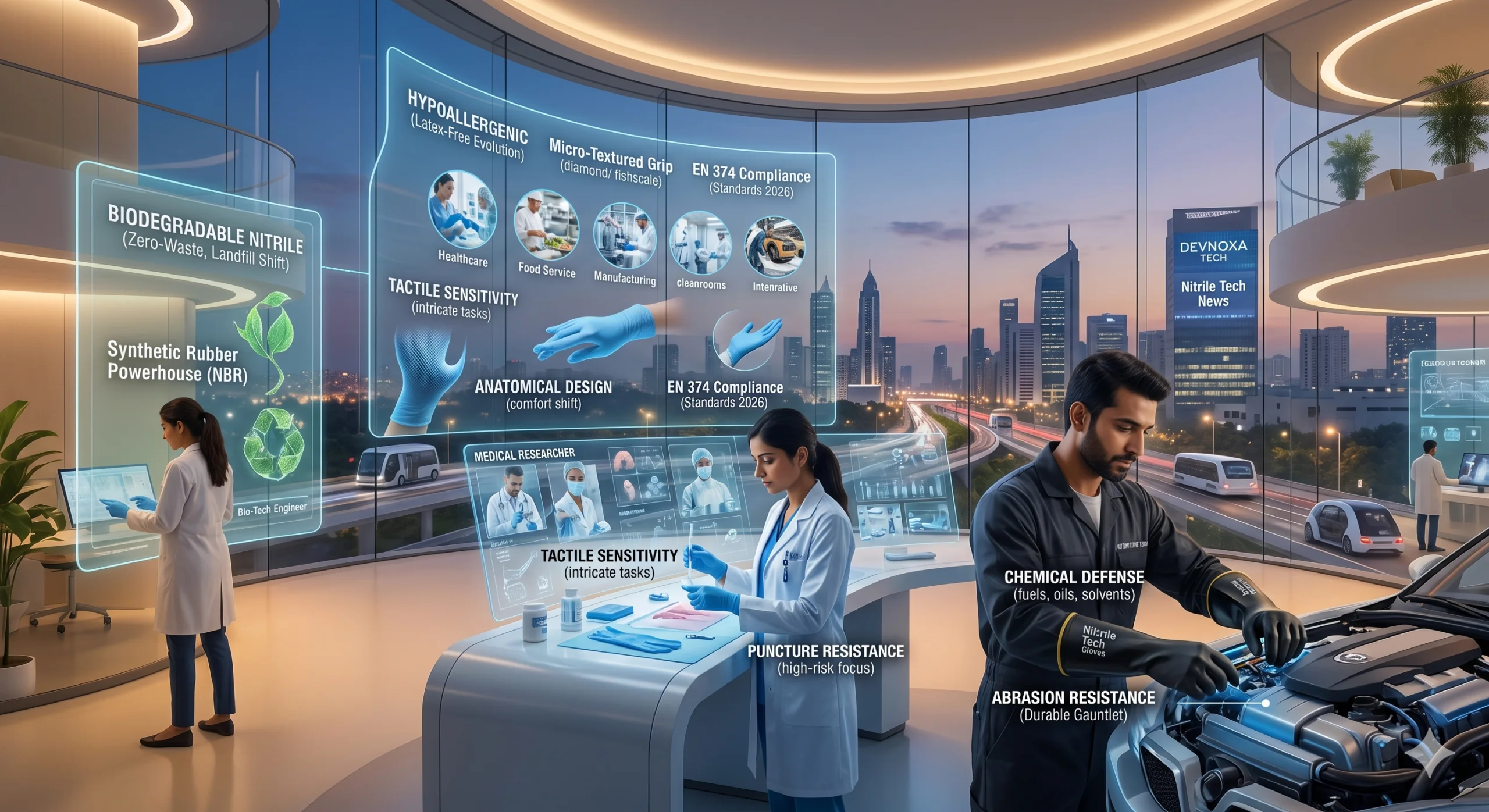

In the high-stakes world of 2026, where industrial safety meets medical precision, the humble glove has undergone a technical renaissance. Nitrile Tech have moved beyond being simple barriers; they are now sophisticated pieces of personal protective equipment (PPE) engineered to handle everything from corrosive chemicals in a laboratory to delicate surgical procedures. As global industries pivot toward higher safety standards and environmental consciousness, these synthetic rubber powerhouses have become the gold standard for hand protection.
The “nitrile revolution” is driven by a unique combination of chemical resilience, puncture resistance, and a growing emphasis on hypoallergenic materials. For professionals in healthcare, manufacturing, and even food service, the choice of a glove is no longer a minor detail—it is a strategic decision that affects both operator safety and task efficiency.
The Science of Synthetic Resilience
Nitrile gloves are manufactured from Nitrile Butadiene Rubber (NBR), a synthetic material that lacks the proteins found in natural latex. In 2026, this is a critical advantage. With nearly 17% of healthcare professionals now reporting latex sensitivities, the shift to nitrile has been a necessary evolution for workplace inclusivity and safety.
Beyond being hypoallergenic, the molecular structure of nitrile is inherently tougher than its latex or vinyl counterparts. It offers a Puncture Resistance that is three to four times higher than natural rubber. This makes Nitrile Tech gloves the primary choice for “high-risk” environments—such as emergency rooms or automotive assembly lines—where sharp tools and jagged edges are constant hazards.
Specialized Features for the 2026 Workforce
Modern Nitrile Tech gloves are a far cry from the thin, slippery disposables of the past. Today’s models feature a suite of “purposeful engineering” upgrades:
- Tactile Sensitivity: Advanced polymer blends have allowed manufacturers to create gloves that are thinner yet stronger, providing the “second skin” feel required for intricate tasks like micro-soldering or suturing.
- Micro-Textured Grip: Whether in wet, dry, or oily conditions, the diamond-pattern or “fishscale” textures found on premium Nitrile Tech gloves ensure a secure grip, reducing hand fatigue and preventing accidents.
- Chemical Defense: These gloves provide an exceptional barrier against a wide range of hazardous substances, including detergents, oils, fuels, and many solvents. In 2026, compliance with standards like EN 374 ensures that workers can handle chemicals with confidence.
- Anatomical Design: Ergonomically shaped to mimic the natural curve of the human hand, these gloves minimize the strain on the palm and thumb during extended wear, a vital feature for workers on long shifts.
Sustainability: The Green Shift
One of the most discussed “Tech Tales” in the 2026 PPE market is the rise of Biodegradable Nitrile. Traditionally, synthetic rubber was a major contributor to medical waste. However, new innovations in polymer engineering have introduced organic additives that allow gloves to decompose in landfill environments significantly faster than standard nitrile—sometimes by as much as 80% within 500 days.
This shift toward “circularity” allows large-scale institutions, like hospitals and manufacturing plants, to maintain their rigorous safety protocols while meeting their 2027 carbon reduction targets. The goal is a “Zero-Waste” safety cycle where protection does not come at the cost of the planet.
Industry-Specific Applications
In 2026, the versatility of Nitrile Tech gloves has allowed them to dominate several diverse sectors:
- Healthcare: As the primary defense against blood-borne pathogens, they are essential for everything from routine examinations to complex surgeries.
- Food Processing: Their resistance to animal fats and oils, combined with being powder-free, makes them ideal for maintaining hygiene standards without contaminating the food supply.
- Automotive and Printing: The ability to withstand harsh degreasers and inks while providing high abrasion resistance makes them a favorite for technicians who need durable, long-lasting hand protection.
- Cleanrooms: Low-linting formulations are used in the semiconductor and pharmaceutical industries to prevent the introduction of particles into sensitive environments.
Choosing the Right Grade
Not all Nitrile Tech gloves are created equal. In 2026, the market is divided into Disposable and Durable categories.
- Disposable Nitrile: Ideal for medical use and short-term tasks where cross-contamination is a primary concern. They are typically powder-free to minimize skin irritation and environmental contamination.
- Durable Nitrile (Gauntlets): These are thicker, often featuring a soft flock lining to absorb perspiration. They are designed for heavy-duty chemical handling and industrial cleaning, offering the highest levels of abrasion resistance.
Conclusion: A Renaissance of Safety
The evolution of Nitrile Tech gloves is a testament to the fact that even the most basic tools can be transformed by innovation. By combining high-strength synthetic materials with ergonomic design and sustainable manufacturing, the industry has created a product that protects both the worker and the workflow.
As we look toward the next decade of industrial growth, the focus remains clear: providing hand protection that is as smart as the technology it helps build. Whether you are navigating a medical crisis or managing a high-tech assembly line, the right pair of gloves is your first line of defense in an increasingly complex world.
For those looking to build their own technical foundations or seeking a partner to navigate the high-stakes world of digital growth and IT transformation, the journey begins with understanding the framework of the future. devnoxa tech
Follow-up Question: Are you looking for heavy-duty chemical gauntlets for industrial use, or are you more interested in the high-dexterity disposable options for medical or laboratory settings?