
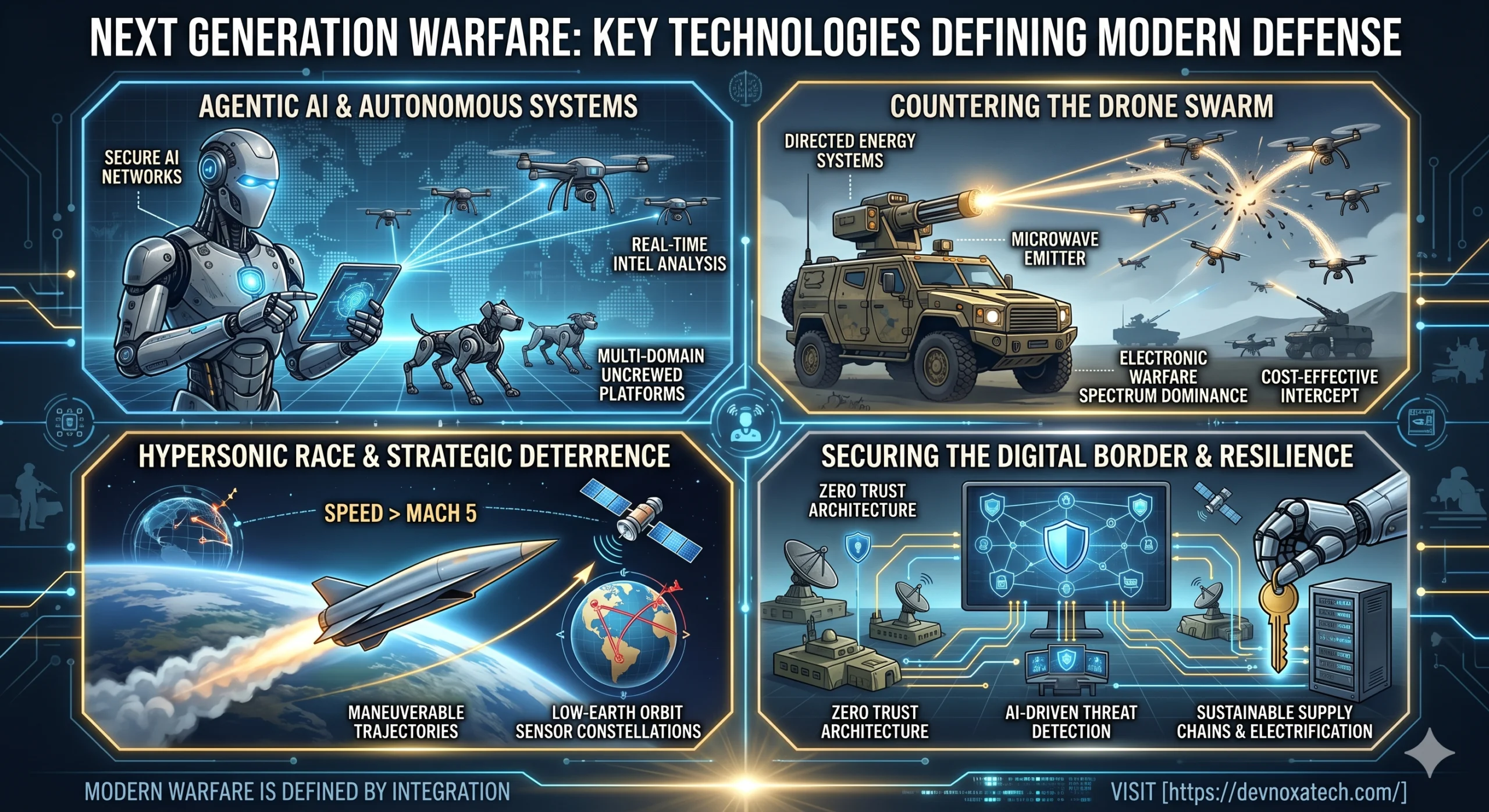

The landscape of global defense is undergoing a radical transformation. As geopolitical tensions rise, nations are shifting away from traditional reliance on pure physical numbers and heavy armor toward rapid, digitized, and highly autonomous capabilities. Modern defense priorities are increasingly defined by code, invisible frequencies, and processing power. From the depths of algorithmic command centers to the upper reaches of low-Earth orbit, the military technology emerging right now are fundamentally changing how deterrents are built and how conflicts are managed.
The Rise of Agentic AI and Autonomous Systems
Artificial intelligence has officially transitioned from an experimental backend utility to an active operational centerpiece. Militaries are deploying what engineers call agentic AI. These are systems capable of executing complex workflows, adapting to changing situations, and managing real-time logistics with minimal human oversight.
A prominent example of this is the deployment of specialized generative networks within defense frameworks, such as the introduction of custom secure language models for military installations. These platforms allow commanders and personnel to instantly sort through terabytes of intelligence data, identifying trends and operational risks in seconds rather than days.
Beyond software, physical autonomy is scaling up at an unprecedented pace. Uncrewed aerial vehicles, autonomous ground logistics units, and uncrewed maritime vessels are no longer just tools for isolated reconnaissance. They are now integrated directly into multi-domain combat networks. This shift reduces the human footprint in high-risk zones while multiplying the sensory reach of a modern fighting force.
Countering the Drone Swarm
The proliferation of inexpensive, commercially available drone technology has forced a massive recalculation in tactical defense. Because low-cost loitering munitions can overwhelm traditional, highly expensive air defense systems through sheer numbers, developing effective counter-drone capabilities has become a critical priority.
The current emphasis is on directed energy systems and electronic warfare. Rather than firing a million-dollar missile to intercept a thousand-dollar drone, modern defense units are turning to high-power microwave networks and laser systems. These technologies neutralize threats by burning out internal circuitry or disrupting communication links at a fraction of the cost per shot.
Simultaneously, electronic warfare has expanded to achieve spectrum dominance. Specialized units are working to map and jam adversary communication channels while ensuring that friendly networks remain resilient. The integration of 5G connectivity and the Internet of Military Things allows disparate sensors on the battlefield to share data seamlessly, creating an adaptive web that can detect and react to oncoming aerial threats in real time.
The Hypersonic Race and Strategic Deterrence
Speed and maneuverability dominate the strategic conversation when it comes to long-range strike capabilities. Traditional ballistic missiles follow predictable orbital paths, making them easier to track and intercept. Hypersonic weapons, which travel at speeds greater than Mach 5 while maintaining the ability to maneuver within the atmosphere, completely bypass classic radar detection timelines.
Developing these vehicles requires overcoming intense physical hurdles, specifically around thermal management and advanced propulsion systems. In response, modern defense procurement models are focusing on rapid prototyping and flexible acquisition strategies. The goal is to compress the timeline between laboratory testing and active field deployment.
To balance this offensive leap, investments are pouring into advanced missile defense architectures. Nations are building space-situational awareness networks utilizing vast constellations of low-Earth orbit satellites. These sensors provide continuous, high-definition tracking of hypersonic signatures, creating a defensive blanket capable of identifying rapid threats early enough to coordinate an active intercept.
Securing the Digital Border via Zero Trust
Every physical weapon system, communications array, and surveillance platform deployed today depends heavily on software. This digital reliance creates a massive surface area for cyber warfare, making cybersecurity just as vital as physical armor.
Militaries are systematically replacing older perimeter-based security systems with strict zero-trust architectures. Under a zero-trust model, no device, user, or network segment is assumed to be safe by default. Continuous validation is required for every single data transaction across the command structure.
AI-driven threat detection platforms are being embedded directly into defense networks to monitor anomalies. These algorithms can identify the subtle signatures of an ongoing cyber attack, isolate infected systems, and reroute critical tactical communications before human operators even realize a breach has occurred. This convergence of cyber defense and automated resilience ensures that command-and-control loops remain unbroken, even under sustained electronic and digital pressure.
Sustainability and Local Production Resilience
Modern defense planning has revealed that technological dominance is meaningless without a highly resilient supply chain. Global logistical bottlenecks and resource scarcity have pushed military planners to focus heavily on industrial self-reliance and environmental sustainability.
Militaries are investing in dual-use microelectronics and sustainable manufacturing practices to protect supply chains from external shocks. For example, some labs are using green chemical processes to break down used synthetic fibers, transforming discarded tactical equipment back into high-performance materials without relying on raw, imported resources.
On the mobility front, electrification is making major inroads. Hybrid tactical platforms, portable hydrogen fuel cells, and compact solar setups are actively reducing field reliance on heavy fuel supply lines. By utilizing renewable energy harvesting and smart charging grids in remote locations, forward operating bases are significantly lowering their logistical footprints. This makes them far less vulnerable to ambush or interdiction while giving them the power needed to operate advanced sensors and automated defense systems independently.
The current trajectory of defense technology highlights a clear truth: the future of strategic security is defined by integration. The forces that successfully combine AI agility, resilient networks, and flexible manufacturing will hold the operational advantage on the modern stage.
For further details on technical integrations and digital modernization strategies, visit Devnoxa Tech.