

Artificial intelligence is no longer a futuristic concept reserved for science fiction. It is here, and it is completely reshaping how brands connect with their audiences. At the center of this revolution is AI marketing automation—a powerful combination of machine learning, data analytics, and automated workflows that allows businesses to scale their efforts without losing the human touch.
For years, ai marketing automation meant setting up simple, rigid rules. If a customer signed up for a newsletter, the system sent a generic welcome email three days later. While useful, these systems were inherently blind to context, emotion, and shifting behaviors. AI has changed the game by introducing intuition and adaptability to the equation. Instead of following strict scripts, modern automation learns from every click, purchase, and scroll, optimizing campaigns in real time.
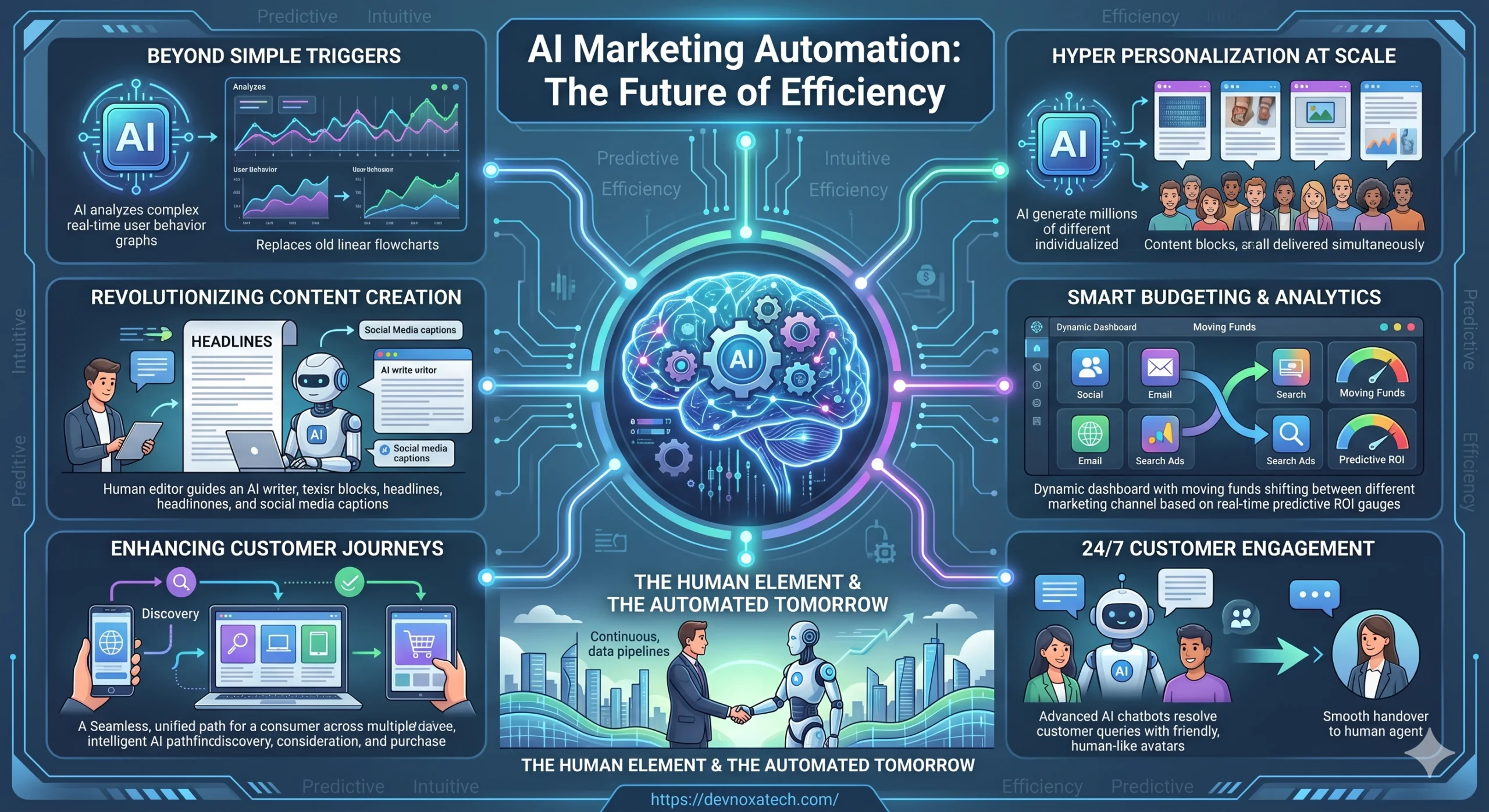
Moving Beyond Simple Triggers
Traditional marketing automation relies heavily on human guesswork. Marketers have to predict every possible customer journey and manually build branching logic trees. This approach is not only time-consuming but also limited by human capacity. We simply cannot analyze millions of data points across thousands of users simultaneously.
AI marketing automation eliminates this bottleneck. By processing massive datasets instantly, AI detects subtle patterns that a human observer would likely miss. It looks at when a specific user is most active, what types of language trigger a response, and which products align with their current life stage. The result is a shift from reactive marketing to predictive marketing. Instead of reacting to what a customer did last week, brands can anticipate what they will want next hour.
Hyper Personalization at Scale
The ultimate goal of marketing has always been to deliver the right message to the right person at the right time. In the past, achieving this level of personalization required deep manual effort, making it impossible to scale. You could write a highly tailored email for a top tier client, but you could not do it for half a million subscribers.
AI bridges this gap effortlessly. Through dynamic content generation, AI can alter the text, imagery, and offers inside an email or on a website based on who is viewing it. If a customer frequently purchases eco-friendly products, the homepage automatically highlights sustainability initiatives. If another customer is highly price-sensitive, the system prioritizes discounts and clearance items. This happens instantly, for every single visitor, creating a unique experience for every individual.
Revolutionizing Content Creation
One of the biggest hurdles in modern marketing is the sheer volume of content required to stay relevant. Between blogs, social media posts, email newsletters, and ad copy, creative teams are often stretched to their limits. AI marketing automation acts as a force multiplier for content creators.
Tools driven by generative AI can draft initial ad copy variations, suggest engaging email subject lines, and even generate social media captions tailored to specific platforms. This does not mean replacing human writers. Rather, it frees them from mundane drafting tasks. Marketers can spend less time staring at a blank page and more time refining strategy, injection brand voice, and ensuring emotional resonance. AI handles the heavy lifting of volume, while humans focus on creative direction.
Predictive Analytics and Smart Budgeting
Every marketer has wondered which half of their advertising budget is being wasted. AI marketing automation takes the guesswork out of ad spend by utilizing predictive analytics. By analyzing historical campaign performance alongside real-time market trends, AI can forecast which channels and campaigns will yield the highest return on investment.
Instead of waiting for a monthly review to adjust budgets, AI systems can automatically reallocate funds on the fly. If a Facebook ad campaign is underperforming while a LinkedIn campaign is seeing a surge in engagement, the automation system can shift resources instantly. This ensures that every dollar spent is optimized for maximum impact, drastically reducing waste and improving overall efficiency.
Enhancing Customer Journeys
The customer journey is rarely linear. A consumer might discover a brand on Instagram, read a blog post on their laptop, abandon a shopping cart on their phone, and finally make a purchase after receiving an SMS discount code. Tracking and nurturing this fractured journey manually is a logistical nightmare.
AI automation unifies these disconnected touchpoints into a single, cohesive narrative. It tracks user behavior across multiple devices and platforms, ensuring that communication remains consistent. If a user abandons a cart, the AI does not just blast them with generic reminders. It analyzes why they might have left—perhaps by looking at their past price sensitivity—and sends a tailored follow-up that addresses that specific barrier, whether it is a free shipping offer or a testimonial video answering product FAQs.
24 7 Customer Engagement
In a global economy, consumers expect instant gratification. If a potential buyer asks a question at midnight, waiting until morning for a response can mean losing that sale to a competitor. AI-powered chatbots and virtual assistants have evolved far beyond the frustrating, robotic systems of the past.
Today’s conversational AI understands natural language, context, and intent. It can resolve complex customer queries, recommend products, track orders, and even process returns without human intervention. When a query requires actual human empathy or complex problem-solving, the AI seamlessly hands the conversation over to a live agent, complete with a full summary of the interaction so the customer never has to repeat themselves.
The Human Element in an AI World
With all the talk of algorithms and automation, it is easy to worry that marketing will lose its soul. However, the true power of AI lies not in replacing human creativity, but in liberating it. When marketers are no longer buried under spreadsheet analysis, manual email scheduling, and repetitive copy updates, they can return to what they do best: storytelling.
AI provides the data, the infrastructure, and the speed. Humans provide the empathy, the ethical oversight, and the overarching vision. The most successful marketing strategies of tomorrow will not be entirely run by machines, nor will they be purely manual. They will be driven by a collaborative partnership where technology amplifies human ingenuity.
Embracing the Automated Tomorrow
The transition to AI marketing automation is no longer a luxury reserved for tech giants with massive budgets. Accessible, user-friendly tools are now available for businesses of all sizes, leveling the playing field. Staying competitive in a crowded digital landscape requires a willingness to adapt and evolve.
By adopting AI-driven systems, brands can build deeper connections with their audience, optimize their resources, and drive sustainable growth. The future of marketing is intelligent, automated, and deeply personal. Taking the step to integrate these technologies today ensures your business remains relevant, agile, and ready for whatever comes next.
To explore how advanced technology solutions can transform your business workflows and digital strategy, visit devnoxa tech