

Artificial intelligence has officially crossed the line from a futuristic buzzword into the engine room of modern ai and marketing. Across every industry, companies are realizing that traditional marketing methods—often reliant on broad demographics, gut feelings, and manual campaign management—are no longer enough to keep pace with changing consumer behaviors.
AI is transforming how brands interact with their audiences. By analyzing massive amounts of data in real time, automation and machine learning allow businesses to deliver hyper-personalized experiences, predict consumer trends, and optimize budgets with unprecedented accuracy.
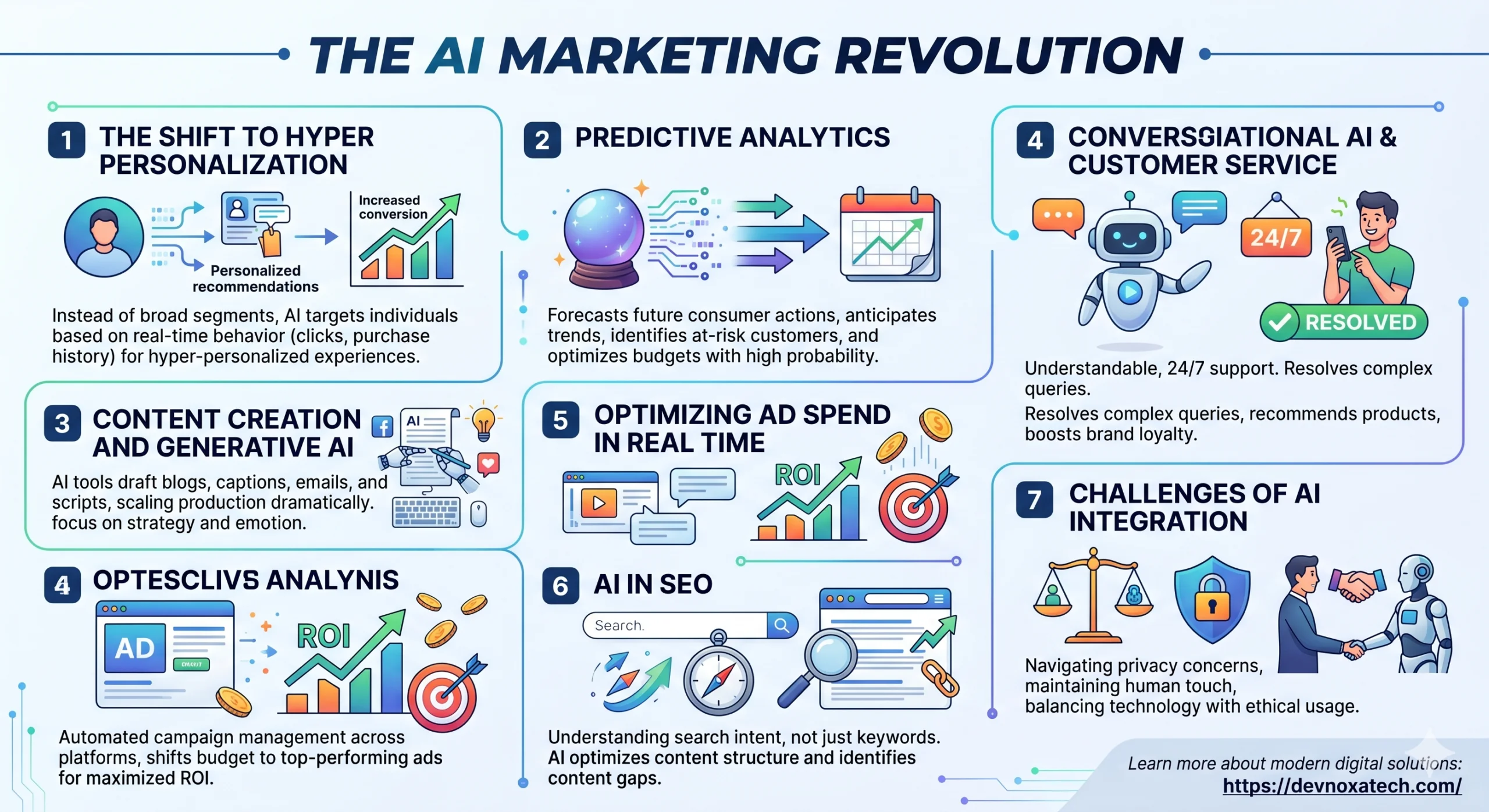
The Shift From Mass Marketing to Hyper Personalization
For decades, marketers relied on broad segmentation. They grouped consumers by age, gender, or geographic location and delivered messages that they hoped would appeal to the majority. AI has completely changed this approach by enabling hyper-personalization.
Instead of targeting categories of people, AI allows brands to target individuals based on their unique, real-time behaviors. Every click, scroll, purchase, and pause creates a data footprint. Machine learning algorithms analyze these footprints to understand a user’s specific preferences, mood, and intent.
When you log into a streaming service or an e-commerce platform and see a list of recommendations tailored exactly to your tastes, you are experiencing AI-driven marketing. This level of personalization makes consumers feel understood, which significantly increases engagement, brand loyalty, and conversion rates.
Predictive Analytics and Forecasting Consumer Behavior
One of the most powerful capabilities of AI in marketing is its ability to look into the future. Predictive analytics uses historical data, machine learning, and statistical algorithms to forecast future consumer actions.
Instead of reacting to trends after they happen, marketers can now anticipate them. Predictive AI can identify which customers are at risk of leaving a brand, allowing companies to launch proactive retention campaigns. It can also predict which products will be in high demand during specific seasons, helping businesses manage their inventory and tailor their advertising efforts ahead of time.
By removing the guesswork from campaign planning, predictive analytics ensures that marketing budgets are spent on strategies with the highest probability of success.
The Rise of Content Creation and Generative AI
Content remains the foundation of digital marketing, but creating high-quality content consistently requires immense time and resources. Generative AI tools have fundamentally altered this workflow by acting as a force multiplier for creative teams.
AI assistants can draft blog posts, generate social media captions, write email subject lines, and even create digital artwork or video scripts in seconds. This does not mean human creativity is obsolete. Instead, the role of the marketer is shifting from content creator to content editor and strategist.
Humans provide the emotional depth, brand voice, and cultural context, while AI handles the heavy lifting of initial drafting, brainstorming, and variations. This collaboration allows marketing departments to scale their content production dramatically without sacrificing quality.
Revolutionizing Customer Service With Conversational AI
Customer service and marketing are deeply intertwined. A poor support experience can ruin an expensive marketing campaign, while a seamless interaction can turn a casual buyer into a brand advocate.
Conversational AI, powered by advanced natural language processing, has evolved far beyond the rigid, frustrating chatbots of the past. Today’s AI assistants can understand context, tone, and intent. They provide instant, 24/7 support, answering complex customer queries, recommending products, and resolving issues without human intervention.
When a customer receives an immediate, helpful response to a question at midnight, their trust in the brand grows. This instantaneous engagement keeps potential buyers in the sales funnel and directly boosts conversions.
Optimizing Ad Spend in Real Time
Managing digital advertising campaigns across multiple platforms like Google, Meta, and LinkedIn used to require constant manual adjustments. Marketers had to continually monitor bids, tweak targeting options, and test different creative assets to see what worked best.
AI has automated this entire optimization process through programmatic advertising and smart bidding algorithms. AI systems can analyze millions of data points across the internet in milliseconds to determine the absolute best time, place, and price to display an ad to a specific user.
If a particular ad creative is underperforming, the AI can automatically shift budget to a variation that is yielding better results. This real-time optimization minimizes wasted ad spend and ensures the highest possible return on investment.
Search Engine Optimization in the Age of AI
Search engine optimization is undergoing its biggest disruption since the inception of Google. Search engines are increasingly using AI to understand the meaning behind user searches rather than just matching keywords. At the same time, consumers are using AI-powered search tools to get direct, conversational answers instead of clicking through lists of links.
To stay visible, marketers are using AI tools to conduct deeper keyword research, analyze competitor strategies, and identify content gaps. AI helps optimize website architecture and content structure so that search engines can easily understand and rank the information. The focus of SEO has shifted from gaming the algorithm to creating genuinely valuable, comprehensive content that answers the user’s ultimate intent.
Navigating the Challenges of AI Integration
While the benefits of AI in marketing are clear, the transition is not without its hurdles. Privacy concerns are at an all-time high, with consumers and regulators demanding greater transparency over how data is collected and utilized. Marketers must ensure that their AI strategies comply with global data protection laws and prioritize ethical data usage.
There is also the risk of over-reliance on automation. Brands that rely too heavily on AI-generated content or completely automated customer interactions risk losing their human touch. Authenticity, emotional connection, and storytelling are uniquely human traits that AI cannot genuinely replicate. The most successful brands will be those that find the perfect balance between technological efficiency and human empathy.
The Path Forward
The integration of artificial intelligence into marketing is no longer optional for businesses that want to remain competitive. AI provides the tools needed to understand consumers on a deeper level, automate repetitive tasks, and make data-driven decisions at a scale that was once impossible.
As technology continues to advance, the gap between companies utilizing AI and those relying on traditional methods will only widen. By embracing AI as a collaborative partner, marketers can unlock new levels of creativity and efficiency, driving sustainable growth in an increasingly digital world.
To learn more about leveraging modern digital solutions for business growth, visit Devnoxa Tech.