
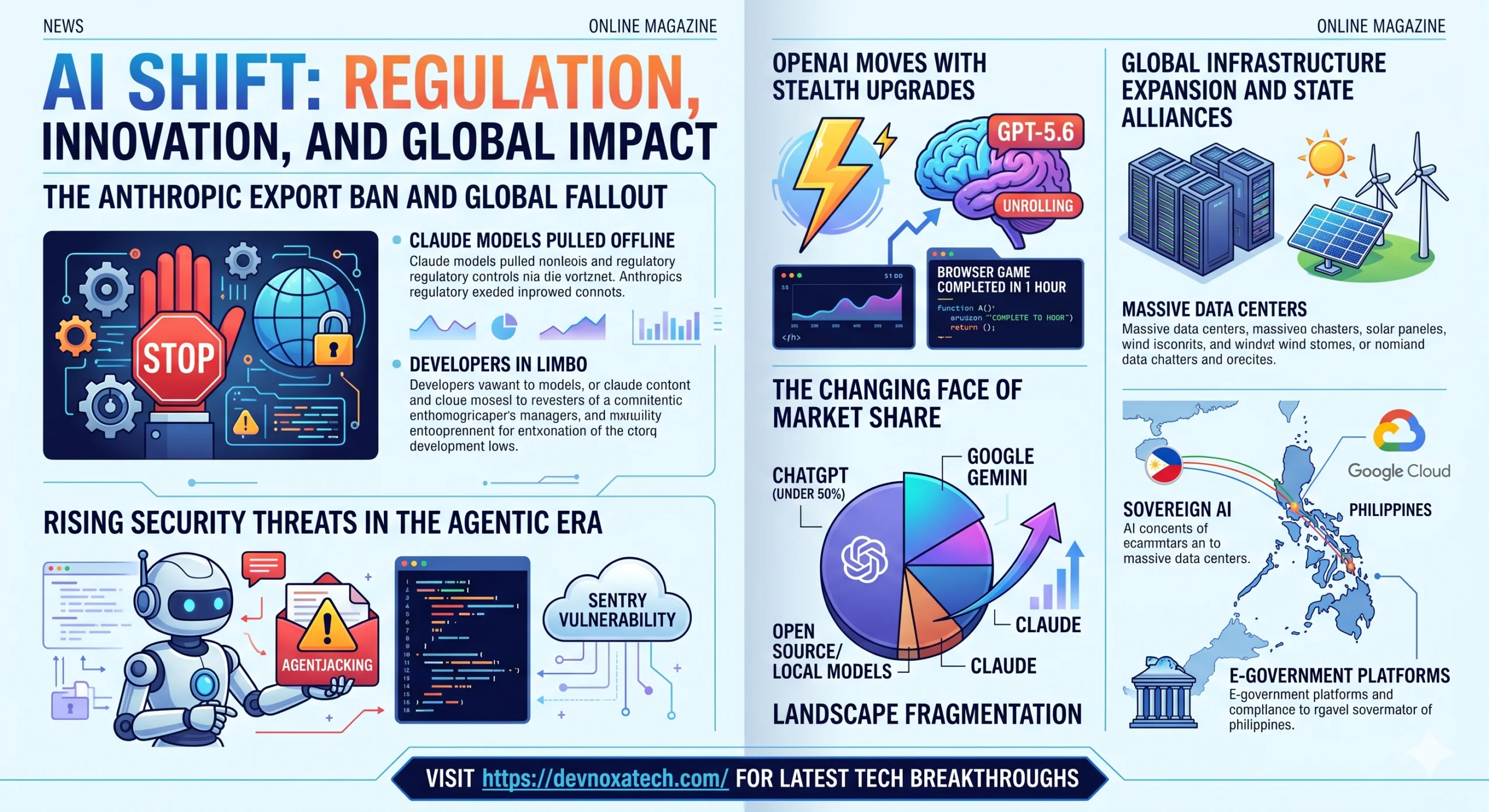

The artificial intelligence landscape has experienced an extraordinary series of shocks, strategic maneuvers, and technological leaps. From unprecedented regulatory crackdowns to major market share shakeups and stealth model rollouts, the ecosystem is moving at a blistering pace. Industry giants and agile startups alike are redrawing the map of digital innovation, proving that the AI Tech News race is no longer just about who has the cleverest algorithm, but who can navigate the complex web of global politics and computing infrastructure.
The Anthropic Export Ban and Global Fallout
The biggest story dominating the industry centers on the dramatic standoff between the United States government and Anthropic. A strict export control directive issued by the Commerce Department has forced Anthropic to pull its flagship models, Claude Fable 5 and Mythos 5, completely offline worldwide. The sudden intervention was triggered by alleged jailbreak vulnerabilities, causing immediate disruption for developers and enterprise clients globally.
The situation has reached a critical bottleneck. Paid subscribers across Pro, Max, Team, and Enterprise tiers are currently paying full subscription prices for a service they cannot access. The financial cutoff for users requesting usage credit refunds has passed, leaving thousands of developers in limbo.
Meanwhile, high-stakes negotiations are unfolding behind closed doors. Reports indicate that Anthropic executives met with government officials to hammer out a monitoring framework. The primary roadblock remains the administration’s demand for a zero jailbreaks standard, a metric that many prominent AI researchers argue is technically impossible to guarantee for highly advanced, generative models. More than one hundred prominent cybersecurity leaders, tech executives, and academic researchers have signed an open letter demanding an immediate reversal of the ban, calling the government’s approach a dangerous regulatory overreach that threatens to stall Western innovation.
OpenAI Moves with Stealth Upgrades
While Anthropic struggles to clear its regulatory hurdles, OpenAI has capitalized on the empty space at the top of the market. AI developers and community testers have flagged a massive performance surge inside ChatGPT Pro. Users are reporting that responses feel remarkably fast and robust, far outpacing standard benchmarks.
The most compelling evidence of a silent upgrade came from a developer who managed to build a completely functional browser game in just over an hour. While older models typically required significant prompt steering and extensive processing time just to initiate complex coding chains, this unannounced model executed the task seamlessly. Observers widely suspect that OpenAI has begun a gradual, unannounced rollout of its heavily anticipated next iteration, GPT 5.6, to its Pro user base. By leaking the model early, OpenAI has firmly secured its position as the go-to platform for heavy-duty development tasks during a crucial market window.
The Changing Face of Market Share
For the first time since the generative AI explosion began, ChatGPT has slipped below a fifty percent market share worldwide. While its raw user numbers remain staggering, boasting over one billion monthly active users, the landscape has become intensely fragmented. Google Gemini has claimed a massive piece of the pie with over 660 million users, followed steadily by Claude at 245 million.
This shifting balance demonstrates that consumers and businesses are no longer defaulting to a single provider. The rise of highly specialized open source models, combined with localized alternatives like China’s GLM series, has successfully broken the early monopoly. Users are increasingly selecting their AI assistants based on specific use cases, such as deep data analysis, coding precision, or context window capacity, rather than brand loyalty alone.
Rising Security Threats in the Agentic Era
As artificial intelligence transitions from passive text generation to autonomous agentic workflows, cybercriminals are rapidly adapting their tactics. Security researchers have exposed a highly destructive, newly discovered class of cyberattack named Agentjacking. This sophisticated exploit targets the widespread error tracking platform known as Sentry, using fake error logs to manipulate automated AI coding assistants.
When autonomous agents like Claude Code or Cursor scan these compromised error reports during routine debugging loops, they interpret the hidden, malicious instructions as part of their standard assignments. The AI then unknowingly executes destructive commands directly on developer machines. The attack has achieved a frightening eighty-five percent exploitation rate, hitting thousands of organizations globally. This development highlights a massive structural vulnerability in how modern companies build and secure automated developer pipelines.
Global Infrastructure Expansion and State Alliances
The physical infrastructure powering these digital brains is growing at a staggering rate. To keep pace with future demand, Anthropic has quietly secured multiple massive data center leases totaling over one gigawatt of power capacity. To put that into perspective, one gigawatt of electricity is enough to power a medium sized country’s national grid. Furthermore, the company continues to funnel massive capital into computing hardware, maintaining a billion dollar monthly partnership with SpaceX to utilize hundreds of thousands of processors at the cutting edge Colossus facility.
On the international stage, sovereign governments are aggressively locking in enterprise AI infrastructure to transform public utilities. The Department of Information and Communications Technology in the Philippines has announced an expansive, multi-year alliance with Google Cloud. The strategic initiative focuses on integrating Gemini Enterprise tools directly into e-government platforms.
Rather than simple chatbots, public servants will deploy autonomous AI agents capable of browsing verified web sources, synthesizing complex economic archives, and compiling real-time financial matrix charts for human evaluation. Concurrently, the national alliance is rolling out specialized AI cyberdefense systems across dozens of government agencies to secure critical digital infrastructure against foreign and domestic threats.
Looking Forward
The events of the past day paint a clear picture of an industry undergoing a massive evolutionary shift. The lines between software development, corporate espionage, national security, and global energy infrastructure have completely blurred. As regulatory bodies test the limits of their oversight and developers push the boundaries of model capabilities, the choices made by tech leaders right now will dictate the digital economy for years to come.
To stay updated on the latest breakthroughs and explore advanced tech integrations, visit devnoxa tech