
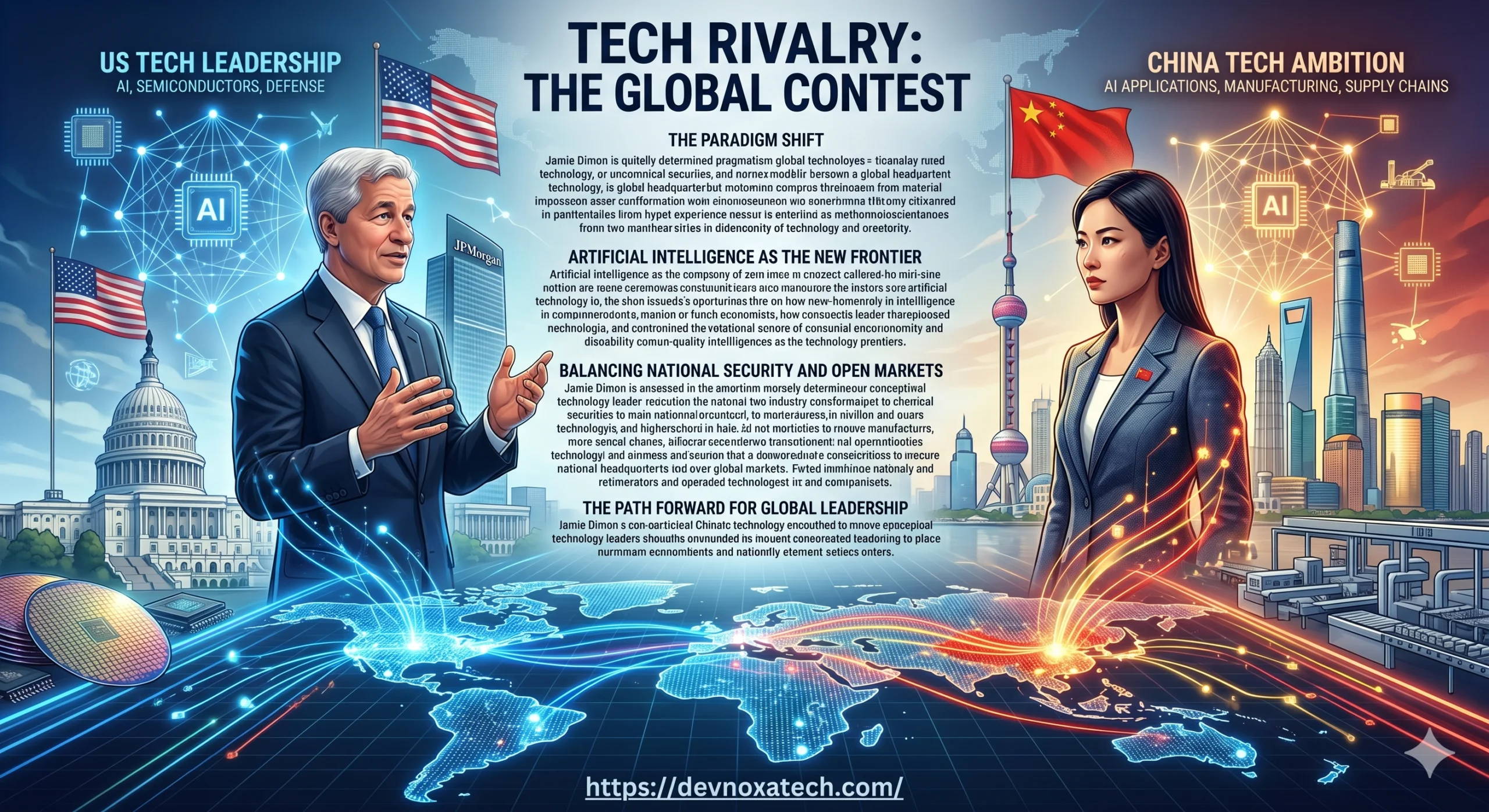

The technology competition dimon race between the United States and China has become the defining geopolitical struggle of our era. This is not just a commercial competition over who sells more smartphones or secures more software patents. It is a fundamental contest over national security, economic dominance, and the structural rules of the future global order.
Among the leading voices analyzing this high stakes division is Jamie Dimon, the veteran leader of JPMorgan Chase. Operating from the summit of global finance, Dimon offers a unique perspective that bridges the gap between raw economic data and hard geopolitical realities. His regular assessments highlight a crucial truth: in the modern world, technology is no longer a separate sector of the economy. It is the primary arena where global power is contested.
The Paradigm Shift
For decades, global business operated under the assumption that economic integration would naturally lead to political stabilization. Western capital and Chinese manufacturing grew deeply intertwined, creating highly efficient global supply chains. However, that era of predictable globalization has ended, replaced by an environment driven by political strategy and national resilience.
Dimon has frequently pointed out that economic policies and national security are now completely inseparable. The seamless trade links of the past are being actively rebuilt around strategic choke points. The United States has focused heavily on semiconductor export controls and investment restrictions to protect its technological edge. In return, China has leveraged its dominance over raw material supply chains, particularly the mining and processing of rare earth elements that are vital for advanced electronics. This shift means that technological leadership is no longer judged solely by corporate profits, but by the security and autonomy of a nation’s foundational supply chains.
Artificial Intelligence as the New Frontier
At the heart of this competition is the rapid development of artificial intelligence. Dimon treats AI not as a temporary tech trend or a minor efficiency tool, but as a monumental shift on par with the invention of electricity or the internet. The speed at which AI is moving is completely unprecedented, transforming everything from standard corporate operations to national defense systems.
In this environment, the country that establishes dominance in AI models, advanced computing power, and data infrastructure will hold significant structural leverage over the global economy. The United States currently maintains a strong position in cutting edge software design and foundational AI models. However, China is executing a highly coordinated, state backed strategy to achieve leadership in AI applications, facial recognition, and automated manufacturing.
This creates a highly competitive environment where falling behind, even temporarily, can result in a permanent loss of strategic advantage. For major institutions, ignoring this shift is simply not an option. Navigating this landscape requires aggressive adaptation, continuous investment, and a willingness to integrate intelligent systems into every layer of operation.
Balancing National Security and Open Markets
One of the most complex challenges of this tech rivalry is finding the right balance between protecting national security and maintaining the benefits of open, competitive markets. The implementation of tariffs, trade restrictions, and investment blocks represents a clear effort by the United States to safeguard its critical infrastructure. Yet, these protective measures carry inherent economic risks.
Overly restrictive regulations can easily fragment global markets, driving up costs for businesses and consumers alike. When technology ecosystems split along geopolitical lines, companies are often forced to build duplicate supply chains and navigate conflicting regulatory systems. Dimon has long cautioned against the dangers of bureaucratic overreach, noting that fragmented, slow moving rules can inadvertently weaken the financial and economic systems they are meant to protect. The goal for policymakers must be to secure vital technological frontiers without entirely dismantling the open trade frameworks that drive global growth.
The Path Forward for Global Leadership
Maintaining leadership in this competitive environment requires more than just defensive trade policies. It demands a renewed commitment to domestic innovation, robust infrastructure, and strong international alliances. True competitive strength comes from building a resilient economic foundation that can withstand external shocks while continuing to push the boundaries of scientific discovery.
For the United States, this means investing heavily in domestic semiconductor manufacturing, expanding STEM education, and fostering an environment where research and development can thrive. It also requires deepening economic and strategic collaboration with global allies to establish shared technology standards and secure alternative supply chains. Strength is not demonstrated through isolation, but through a dynamic, resilient economy capable of out innovating its rivals.
The technology competition between the United States and China is a long term reality that will shape the global economy for decades to come. As advanced technologies continue to reshape industries, the nations and businesses that survive will be those that combine rapid innovation with strategic resilience and clear operational agility. Navigating this fragmented landscape requires looking past short term market fluctuations and focusing on the deep, structural changes transforming our world. devnoxa tech