
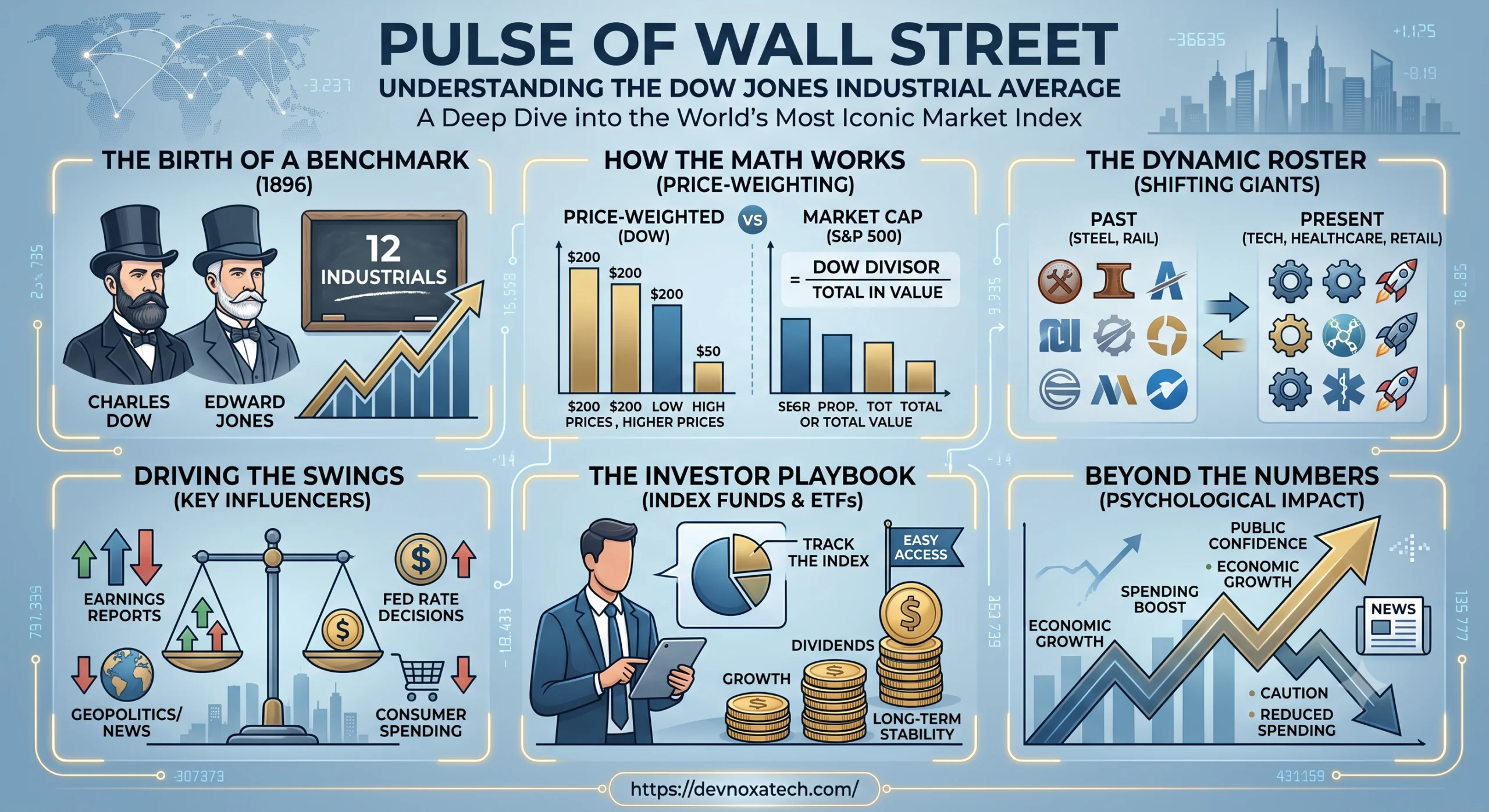

The financial landscape can often feel like a dizzying maze of numbers, charts, and rapid fire commentary. Yet, amidst the daily noise of the financial world, one name stands out as the ultimate symbol of market health: the Dow Jones Industrial Average. Known simply as the Dow, this index has served as the definitive baseline of the American economy for generations. Understanding how it operates, why it moves, and what it represents is essential for anyone looking to make sense of the modern Dow Jones stock markets.
The Birth of a Benchmark
To appreciate the weight of the Dow, it helps to look backward. Created in the late nineteenth century by financial journalists Charles Dow and Edward Jones, the index originally tracked just twelve industrial companies. In an era when information moved slowly and tracking corporate health was a guessing game, Charles Dow wanted a simple way to answer a complex question: Is the stock market going up or down today?
Over many decades, that small collection of industrial giants expanded. Today, the index is composed of thirty massive, publicly traded blue chip corporations. While the word industrial remains in the title, the modern index spans technology, healthcare, entertainment, and financial services. It has transformed from a narrow snapshot of smoky factories into a diverse reflection of American commerce.
How the Math Works
One of the most peculiar aspects of the Dow is how it calculates its value. Most modern stock market indexes, like the S&P 500, are market capitalization weighted. This means that larger companies, based on their total market value, exert a greater pull on the index. The Dow operates on a fundamentally different logic known as price weighting.
In a price weighted index, the actual dollar cost of a single share determines how much influence a company holds. A stock trading at two hundred dollars per share will impact the Dow far more than a stock trading at fifty dollars, even if the fifty dollar company is technically larger in terms of total net worth. To keep stock splits and corporate changes from distorting the index, a special mathematical denominator is used to clean up the final total. While critics argue this methodology is antiquated, the index remains remarkably accurate at matching the broader trends of the general market.
The Dynamic Roster
The thirty companies that make up the Dow are not permanent fixtures. A special committee handles the roster, quietly adding and removing firms to ensure the index accurately mirrors the shifting sands of the corporate world. When a legacy giant falls into decline, it is replaced by an emerging industry leader.
This shifting mechanism keeps the index relevant. Over the years, old rail and steel companies have made way for global retail operations, massive healthcare providers, and silicon valley software powerhouses. Because the list is limited to just thirty firms, getting added to the index is considered a badge of honor, signaling that a corporation has truly arrived at the pinnacle of stability and influence.
Driving the Swings
What makes the stock market move? For the Dow, the answers boil down to a mix of hard corporate data and raw human psychology. Every quarter, the thirty component companies release their earnings reports. If these businesses report strong revenue and optimistic outlooks, the index climbs. If they miss expectations, the index can stumble.
Beyond corporate fundamentals, broader economic indicators dictate the daily swings. Decisions by the Federal Reserve regarding interest rates, shifts in employment data, and updates on consumer spending all ripples through the market instantly. Geopolitical events, trade policies, and unexpected supply chain disruptions also play a major role in shaping investor sentiment. When uncertainty spikes, investors often retreat to the safety of these thirty trusted companies, stabilizing the index compared to more volatile sectors.
The Investor Playbook
For everyday individuals looking to build wealth, the Dow offers a direct pathway to market participation. While you cannot buy a direct share of an index itself, financial institutions have created highly accessible tools called index funds and exchange traded funds. These financial products perfectly mirror the holdings of the Dow.
By purchasing shares in a fund that tracks the index, an investor instantly buys a small piece of thirty of the most successful businesses in the world. This approach removes the guesswork of trying to pick individual winning stocks. It embraces a philosophy of steady, long term growth, allowing individuals to compound their savings alongside the broader expansion of the global economy.
Beyond the Numbers
It is easy to get caught up in the daily point gains and losses broadcasted on the news, but the true value of the Dow lies in its narrative power. It serves as a psychological mirror for the business community. When the index hits historic milestones, it builds public confidence, encouraging consumer spending and corporate expansion.
Conversely, a sustained drop can signal a need for caution, prompting businesses to tighten budgets and investors to reassess their risk. While it represents only a small slice of the thousands of stocks available to trade, its historical legacy and concentration of corporate power ensure that when the Dow speaks, the entire financial world listens.
To explore more about digital innovation and modern financial perspectives, visit devnoxa tech