
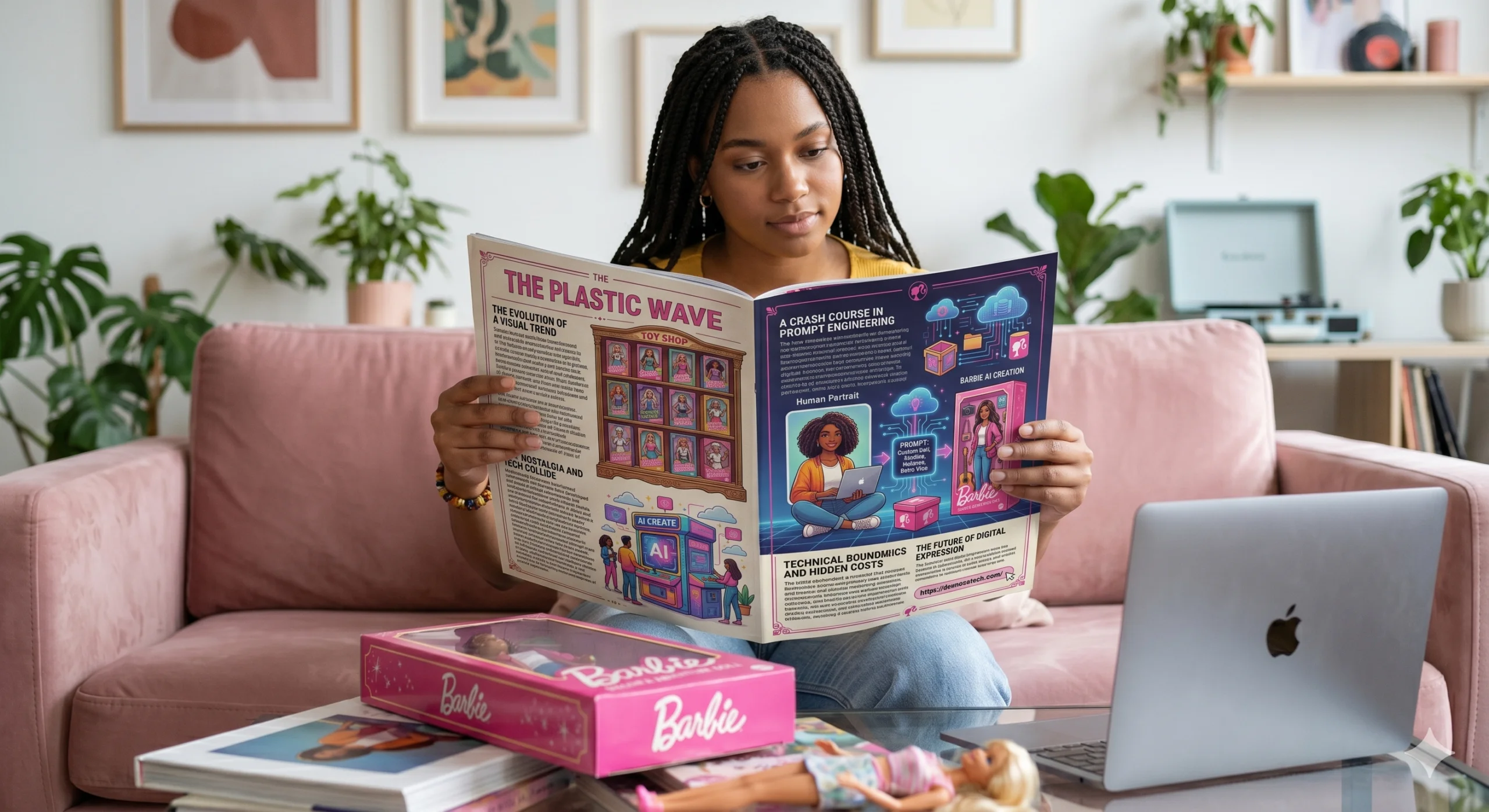

Social media feeds have transformed into a vibrant sea of hot pink, pastel gradients, and glossy plastic textures. What started as a wave of movie nostalgia has evolved into a viral digital movement: the Barbie AI trend. Millions of people are using generative artificial intelligence to transform their standard selfies into hyper-realistic, collector-edition dolls complete with custom toy boxes and specific lifestyle accessories. This cultural phenomenon highlights how regular internet users interact with advanced creative technology.
The Evolution of a Visual Trend
The fascination with recreating a digital doll identity began with simpler face-swapping web tools. Over time, the movement shifted toward comprehensive prompt-engineering frameworks utilizing large language models and advanced image generators like ChatGPT and Midjourney. Instead of merely pasting a face onto a cartoon body, people now direct artificial intelligence to interpret their actual clothing, ethnicity, and hair texture into a polished vinyl aesthetic.
The recent evolution of this phenomenon centers around the Barbie Box challenge. Participants upload a high-resolution portrait and instruct the generator to construct a detailed toy box. The digital packaging often includes customized typography, bold slogans, brand names, and distinct accessories tailored to the individual’s real-life hobbies. For example, a photographer might be reimagined as a doll carrying a tiny vintage camera inside a glossy box labeled with their own name, turning a simple internet challenge into an act of personal branding.
Why Nostalgia and Tech Collide
The massive appeal of this trend relies heavily on the psychological comfort of nostalgia paired with the immediate gratification of modern technology. Culturally, the iconic doll imagery represents a shared childhood memory across generations. By merging this nostalgic symbol with advanced image synthesis, creators build a bridge between the physical past and the digital future.
This artistic crossover allows individuals to participate in creative storytelling without requiring professional graphic design skills. Users enjoy seeing an idealized, stylized version of themselves packaged as a collectible item. The process offers a form of lighthearted escapism, allowing everyday creators, influencers, and even high-profile public figures to playfully view themselves through the lens of pop culture history.
A Crash Course in Prompt Engineering
Beyond the entertainment factor, the trend has served as an unexpected mass training ground for digital literacy. To achieve a high-quality output that avoids distorted details, users must learn how to communicate effectively with machine learning models.
An unrefined instruction like “make me a doll” often yields strange proportions or inaccurate features. To counter this, social media communities have become collaborative hubs for sharing precise, structured instructions. Creators actively trade detailed text formulas specifying lighting styles, box dimensions, plastic textures, and exact color palettes. This collaborative sharing has introduced the fundamental mechanics of prompt design to the general public, teaching people how to refine variable inputs to achieve specific visual outcomes.
Technical Boundaries and Hidden Costs
While the results are visually impressive, the trend highlights the current technical limitations of generative image engines. Users frequently report issues such as incorrect eye colors, distorted finger counts, or age discrepancies where adult faces are rendered with overly youthful or robotic features. Achieving a balanced image often requires multiple iterations and precise descriptive corrections.
Furthermore, the viral movement has sparked conversations regarding data privacy, intellectual property, and environmental sustainability. Uploading clear personal portraits to public generators raises valid questions about data storage practices and user consent. Additionally, industry observers note that running millions of complex graphic processes for entertainment demands significant computational energy. This has ignited a broader discussion about how data centers allocate resources, balancing the massive electricity required for viral trends against more urgent global scientific computations.
The Future of Digital Expression
The Barbie AI movement demonstrates how quickly a pop culture aesthetic can become an immersive digital experience when powered by accessible creation software. It serves as a blueprint for the future of interactive social media, where audiences are no longer content with just viewing content; they want to actively write themselves into the narrative. As generative systems grow more precise and deeply integrated into mainstream platforms, personalized avatars will likely expand far beyond the toy box into virtual environments, gaming, and professional digital spaces.
To explore more about emerging technologies and digital development trends, visit Devnoxa Tech.