
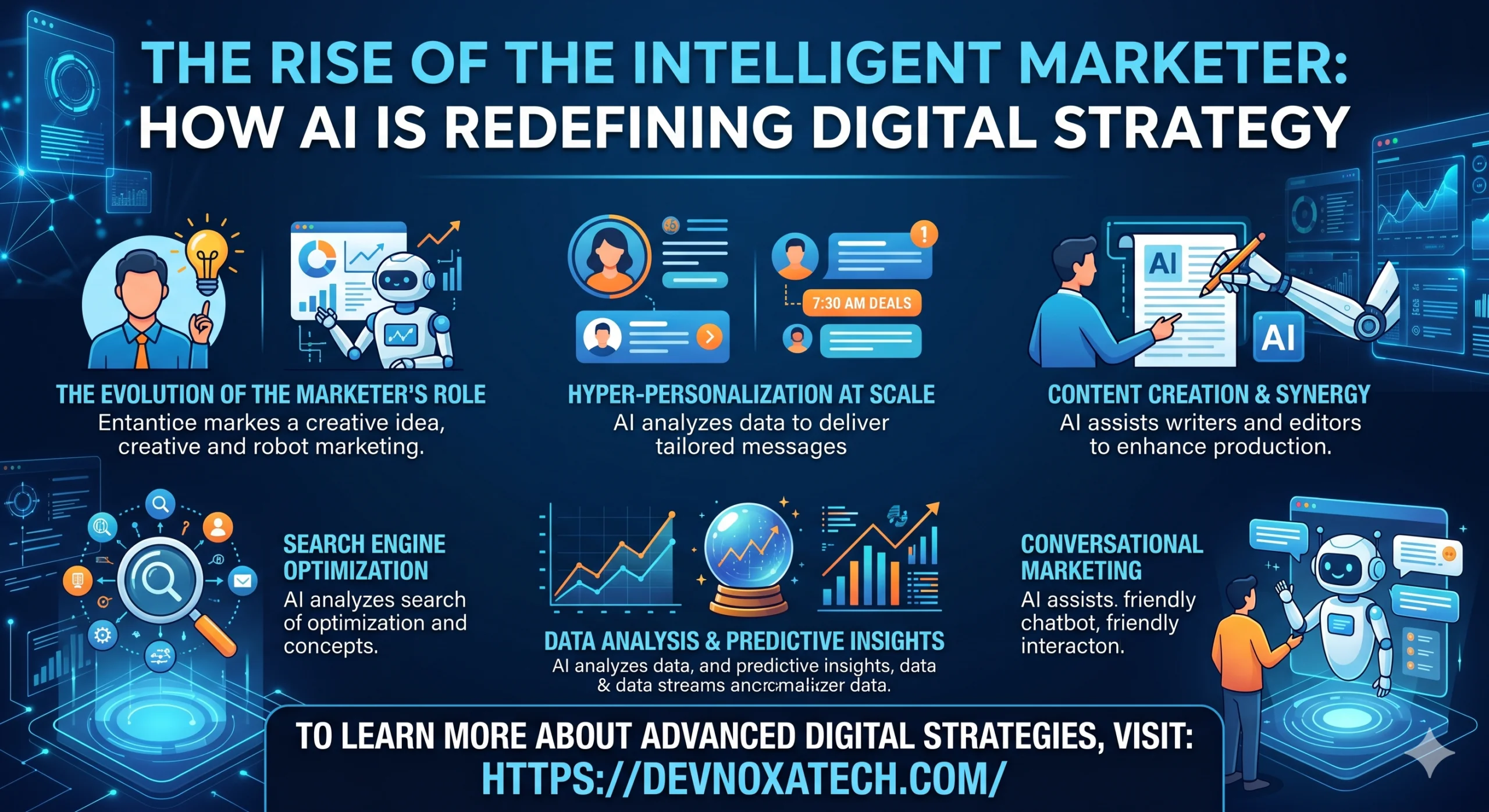

The digital marketing landscape has always moved at a breakneck pace. From the early days of simple banner ads to the complex world of search engine algorithms and social media trends, marketers have constantly had to adapt. Today, we are witnessing the biggest shift yet. Artificial intelligence is no longer just a futuristic concept or a tool for automated email replies. It has become an active collaborator, reshaping how brands connect with their audiences.
The modern digital marketer ai is no longer just a person staring at spreadsheets. Instead, the future belongs to the hybrid professional: the digital marketer powered by AI.
The Evolution of the Marketer’s Role
For years, digital marketing required balancing two distinct skill sets: creative storytelling and analytical tracking. Marketers spent hours writing copy, designing graphics, analyzing traffic reports, and manually A/B testing ad variations. While these tasks are essential, they often left little room for high-level strategy.
AI changes this dynamic entirely. By taking over repetitive, data-heavy tasks, intelligent software allows professionals to focus on empathy, brand identity, and long-term vision. The role is shifting from execution to orchestration. Instead of writing fifty individual ad headlines, a marketer now inputs parameters into an AI tool, reviews a hundred generated options, and selects the ones that truly resonate with human emotion.
Hyper Personalization at Scale
One of the greatest challenges in traditional marketing was personalization. Everyone knows that personalized messages perform better, but creating unique content for thousands of different consumers was physically impossible for human teams.
AI solves this problem through predictive analytics and machine learning. Algorithms can analyze a user’s past browsing behavior, purchase history, time of activity, and even local weather conditions to deliver a tailored message in real time. If a customer typically buys coffee beans on Tuesday mornings, an AI system can trigger a personalized discount notification at exactly 8:00 AM on that day. This level of precision builds deeper relationships between brands and consumers without requiring constant manual oversight.
Content Creation and the Creative Synergy
There is a common fear that AI will replace writers, designers, and video editors. However, the reality is far more collaborative. AI serves as an incredibly efficient assistant that cures blank-page syndrome.
In content creation, tools can generate blog outlines, suggest catchy social media captions, or even draft initial email copies based on a specific tone of voice. This speeds up the production pipeline significantly. Visual tools can generate concept art or edit product photos in seconds. The human marketer’s job is to act as the editor and curator, ensuring that the final output aligns with the brand’s ethical guidelines and emotional core. AI handles the heavy lifting, while humans provide the soul.
Search Engine Optimization in an AI World
Search engine optimization is undergoing a massive transformation. Search engines are increasingly using AI to understand the intent behind a user query rather than just matching keywords. Consequently, the way marketers optimize websites must evolve.
Intelligent marketing tools help analyze search intent, identify content gaps, and predict which topics will trend before they explode. Instead of simply stuffing keywords into a paragraph, marketers use AI to structure data so that search algorithms can easily understand it. This ensures that content provides genuine value, which is exactly what modern search engines reward.
Data Analysis and Predictive Insights
Data has been called the new oil, but raw data is useless without refinement. Digital campaigns generate millions of data points every day, from click-through rates to dwell time. For a human analyst, finding meaningful patterns in this ocean of numbers can take weeks.
AI algorithms excel at pattern recognition. They can process massive datasets instantly, identifying which audience segments are converting and which platforms are losing money. More importantly, AI offers predictive insights. It can forecast future consumer behavior, allowing marketing teams to allocate their budgets proactively rather than retroactively fixing underperforming campaigns.
The Power of Conversational Marketing
Customer service and marketing have blended into a single experience. Consumers expect immediate answers to their questions, whether it is 2:00 PM or 2:00 AM.
Advanced conversational assistants, powered by natural language processing, have moved far beyond the frustrating, rigid chatbots of the past. Today’s AI assistants can hold fluid, human-like conversations. They can guide a user through a product catalog, answer complex technical questions, resolve shipping issues, and qualify leads before passing them to a human sales representative. This round-the-clock engagement keeps potential customers inside the sales funnel.
Navigating Ethical Boundaries
With great technological power comes significant responsibility. The rise of AI in digital marketing brings critical ethical questions to the forefront. Data privacy is a primary concern. Marketers must ensure they are transparent about how consumer data is collected and utilized, adhering to global privacy regulations.
There is also the risk of algorithmic bias. If the historical data used to train an AI model contains biases, the marketing campaigns generated by that model could inadvertently exclude or alienate certain demographics. Striking the right balance between automation and human oversight is vital to maintaining consumer trust.
Embracing the Future
The integration of artificial intelligence into digital marketing is not a temporary trend. It is the new baseline for competitiveness. Companies and professionals who resist these tools risk falling behind, while those who learn to collaborate with them will unlock unprecedented levels of efficiency and growth.
The future does not belong to AI alone, nor does it belong to traditional marketing methods. It belongs to the digital marketer who knows how to leverage intelligent technology to deliver authentic, timely, and impactful human experiences.
To learn more about implementing advanced digital strategies, visit devnoxa tech