
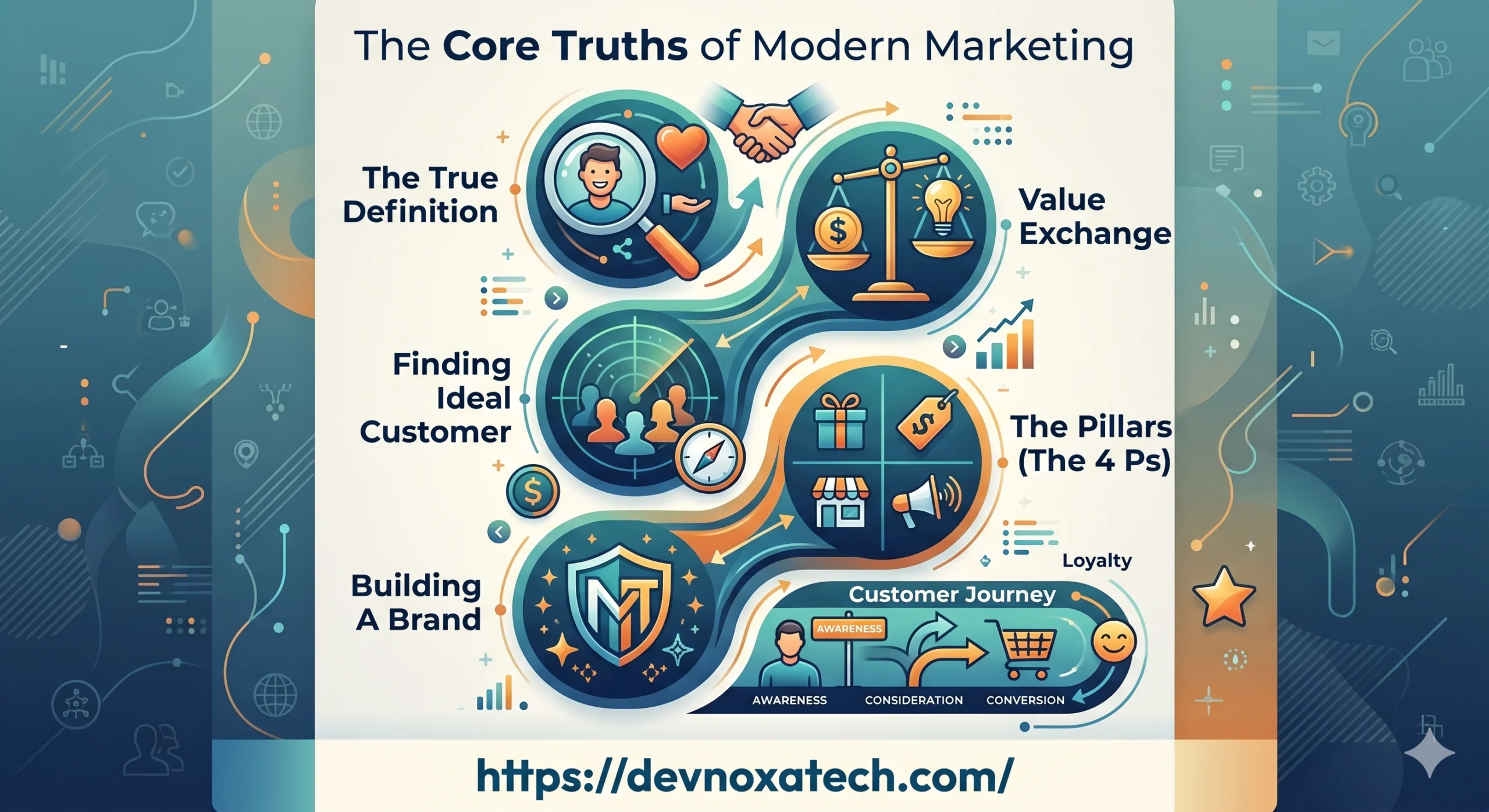

The business world changes at a breakneck pace, but the bedrock principles of marketing remain remarkably steady. While tools shift from billboards to algorithms, the underlying mission never changes: understanding what human beings need and delivering a solution that feels worth their time and money.
Stripping away the buzzwords reveals a handful of timeless marketing fundamentals that drive every successful campaign, whether you are a local storefront or a global enterprise.
The True Definition of Marketing
Many people confuse marketing with advertising, but advertising is just the loudest part of the machine. Marketing is the entire ecosystem of identifying, anticipating, and satisfying customer needs profitably.
It starts long before a product is built and continues long after a transaction is complete. At its heart, it is an exercise in empathy and communication. If you cannot look at your business through the eyes of the person opening their wallet, your marketing will fail, no matter how much money you throw at it.
Understanding the Value Exchange
Every transaction is built on a simple exchange of value. A customer gives you their hard-earned money, their limited time, or their data. In return, they expect something that makes their life easier, healthier, more entertaining, or more efficient.
The biggest trap businesses fall into is shouting about features instead of benefits. A feature is what a product is; a benefit is what the product does for the user. People do not buy a mattress because they love memory foam; they buy it because they want a deep, restorative night of sleep so they can wake up without back pain.
Finding Your Ideal Customer
You cannot market to everyone. Attempting to appeal to every single demographic usually results in a watered-down message that resonates with absolutely nobody.
Successful marketing requires dividing a massive market into specific, manageable segments. This process relies on four core pillars:
- Demographics: Basic data like age, income, education, and geographic location.
- Psychographics: Deeper traits including values, belief systems, lifestyle choices, and personal goals.
- Behavioral Data: How they interact with your brand, their brand loyalty, and their buying readiness.
- Pain Points: The specific, frustrating problems they face daily that your business can solve.
Once you map out these details, you create a vivid picture of your ideal buyer. Instead of speaking to a faceless crowd, you are talking directly to a real person.
The Pillars of Strategy
For decades, marketers have relied on a foundational framework known as the Four Ps. Even in a digital world dominant by social platforms, this structure serves as a reliable health check for any campaign.
Product
Your offering must solve a genuine problem or fulfill a real desire. If the product is fundamentally flawed, over-hyped, or irrelevant, no amount of brilliant advertising will save it over the long haul.
Price
Pricing is a direct reflection of positioning. It determines who your audience is and how they perceive your brand. A low price signals accessibility or budget constraints, while a high price signals exclusivity, luxury, or superior quality.
Place
This refers to where your product is discovered and purchased. Whether it sits on a brick and mortar shelf, thrives on a direct-to-consumer website, or utilizes a third-party marketplace, the purchasing journey must be as frictionless as possible.
Promotion
This is the umbrella for your actual outreach efforts. It includes search engine optimization, content creation, email newsletters, influencer partnerships, and paid advertisements. Promotion is how you tell the story of your product to the world.
Building a Consistent Brand
A brand is not just a logo, a color palette, or a clever slogan. Your brand is the gut feeling someone experiences when they hear your company name. It is the sum total of every single interaction they have ever had with your business.
Consistency builds trust, and trust is the ultimate currency in commerce. If your Instagram account is playful and casual, but your customer support emails are cold and legalistic, you create cognitive dissonance. Customers get confused, and confused customers walk away. Every touchpoint must sing from the same songbook.
Navigating the Customer Journey
People rarely see an ad and immediately buy a product. They move through a psychological pipeline known as the marketing funnel.
[Awareness] -> [Consideration] -> [Conversion] -> [Loyalty]
In the Awareness stage, the customer realizes they have a problem and learns your brand exists. Your goal here is simply to offer value and introduce yourself.
During Consideration, they compare you to competitors. Here, you must prove your expertise through case studies, detailed product guides, or reviews.
At the Conversion stage, they are ready to buy, meaning you need to make checkout seamless and risk-free.
Finally, the funnel turns into a loop of Loyalty, where excellent service transforms a one-time buyer into a lifelong advocate who does your marketing for you through word of mouth.
The Role of Data and Creative
Great marketing sits exactly at the intersection of art and science. The artistic side handles the storytelling, the visual design, and the emotional hook that grabs attention.
The scientific side handles the data. In the digital age, you do not have to guess if a campaign is working. You can track metrics like customer acquisition cost, conversion rates, and customer lifetime value. Data tells you exactly what your audience is doing, while creativity helps you understand why they are doing it. Balance both, and your business becomes incredibly resilient.
Cultivating Long Term Growth
True marketing is a marathon, not a sprint. Flashy tricks might yield a temporary spike in sales, but sustainable businesses are built on deep relationships and authentic communication. Focus on helping your audience first, refining your product constantly, and measuring your results honestly. When you align your business goals with the genuine needs of your audience, marketing stops feeling like a chore and starts acting as the engine for your long-term success.
To explore how innovative digital solutions and strategic engineering can elevate your brand’s presence, visit devnoxa tech