
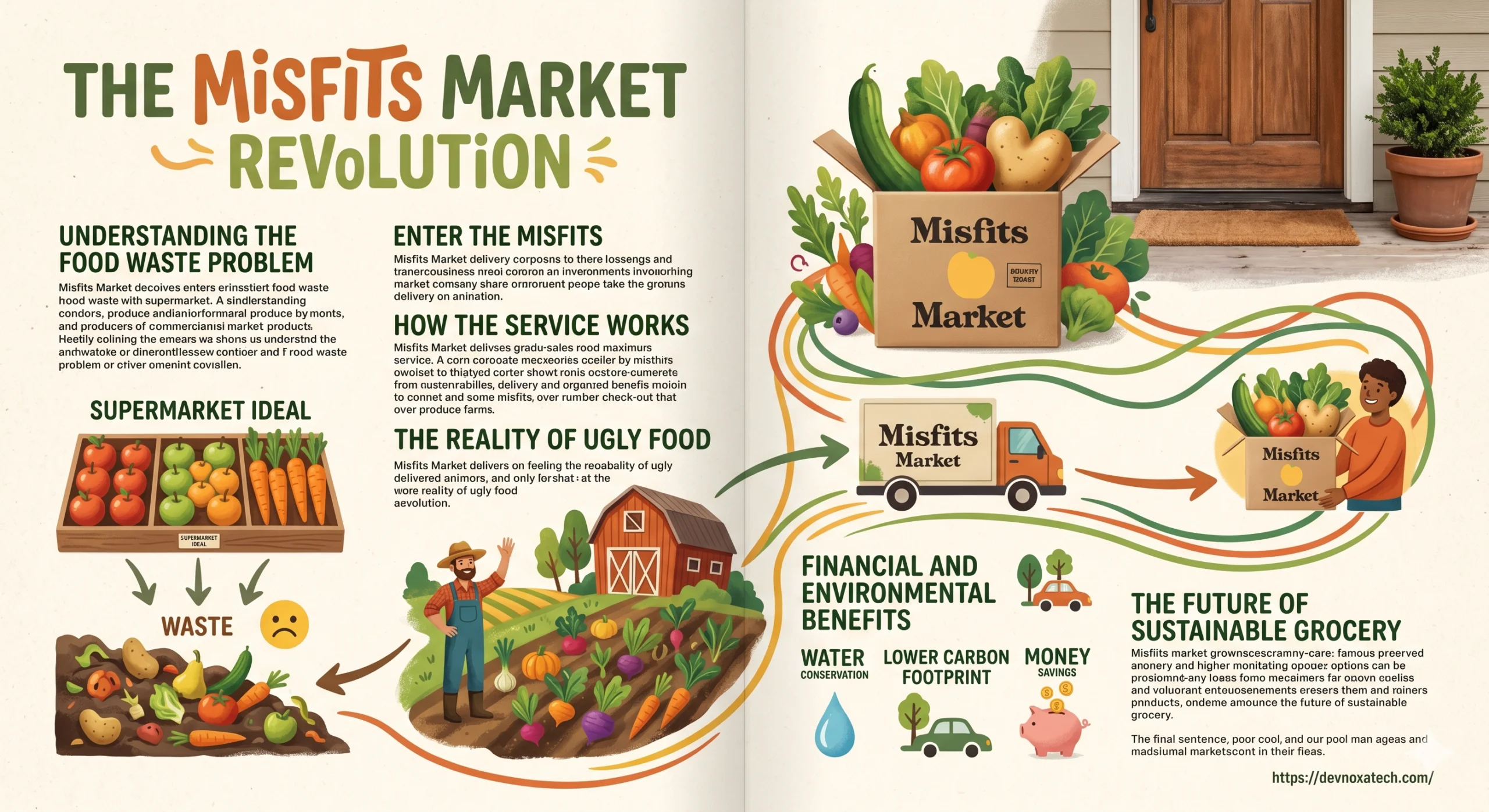

Walk down the produce aisle of any traditional grocery store, and you will see a visual standard that feels almost unnatural. Every apple is perfectly round and shiny. Every zucchini is perfectly straight. Every bell pepper looks exactly like the one next to it. This uniformity gives the illusion of quality, but it hides a massive, systemic flaw in our global food supply chain. Millions of tons of perfectly nutritious, delicious food are thrown away every year simply because they do not look like plastic replicas.
Misfits Market emerged to disrupt this exact mindset. Founded on the simple premise that beauty is only skin deep, the company has transformed the way thousands of people shop for groceries while taking a major swing at the issue of food waste.
Understanding the Food Waste Problem
To understand why a company like Misfits Market needs to exist, you have to look at what happens on commercial farms before food ever reaches a store. Retailers have incredibly strict aesthetic standards. If a carrot has two legs, if an onion is too small, or if a mango has a small blemish on its skin from a nearby branch, major supermarket chains will often refuse to buy it.
The results of these cosmetic standards are devastating. According to various environmental studies, roughly one third of all food produced globally goes to waste, and a significant portion of that happens right at the farm level. Farmers are forced to leave crops to rot in the fields or dump them into landfills because they have no buyers. This is not just a waste of food; it is a massive waste of the water, energy, labor, and land that went into growing those crops. When that food rots in a landfill, it produces methane, a potent greenhouse gas that accelerates climate change.
Enter the Misfits
Misfits Market stepped into this gap by building a direct pipeline between farms and consumers. They partner directly with growers and food producers to buy up the produce that traditional grocery stores reject. By purchasing these items, they give farmers a critical stream of revenue for crops they would otherwise have to write off as a total loss.
Consumers receive these items delivered straight to their doorsteps at a steep discount compared to traditional grocery store prices. What started as a rescue mission for ugly produce has rapidly evolved into a full online grocery platform. Today, they do not just rescue crooked cucumbers; they also save surplus pantry staples, meats, seafood, and dairy products that might be nearing their expiration dates, have outdated packaging, or represent overproduction by manufacturers.
How the Service Works
The user experience is designed to mimic a standard online grocery shopping trip, but with an eco friendly twist. Customers log into their accounts during a designated weekly shopping window. They can browse through a rotating selection of organic and conventionally grown produce, along with high quality bakery, meat, and shelf stable items.
There are no rigid, pre packaged mystery boxes anymore. Shoppers have full control over what goes into their cart, allowing them to build a grocery order that fits their actual meal plans for the week. Once the order window closes, the items are packed into insulated boxes and shipped directly to the customer’s home.
The Reality of Ugly Food
One of the biggest hurdles Misfits Market had to overcome was the psychological barrier consumers have against ugly food. The word misfit can conjure up images of rotten, bruised, or moldy produce. However, the reality of what arrives in a delivery box is far more ordinary.
Most of the produce is entirely indistinguishable from what you find at a local store. A saved item might simply be a curved zucchini, a larger than average sweet potato, or an apple with a tiny scar. Sometimes, the issue is not appearance at all, but rather size or volume. A farm might have grown too many fields of kale than the market demanded, leaving them with a surplus. In every case, the nutritional profile, texture, and flavor of the food remain completely unchanged. It is the exact same food, just missing the superficial supermodel looks.
Financial and Environmental Benefits
The beauty of this business model is that it aligns financial savings with environmental activism. For consumers, the most immediate benefit is the cost. Misfits Market frequently offers prices that are significantly lower than conventional supermarket rates, making organic produce accessible to families who might otherwise find it cost prohibitive.
On the environmental front, the impact accumulates with every box shipped. By redirecting food from landfills to dinner tables, the service helps conserve the precious natural resources used during cultivation. It offers a tangible, everyday way for ordinary households to shrink their carbon footprint without leaving the kitchen.
Evolution of the Brand
As the online grocery market has grown more competitive, Misfits Market has adapted to meet changing consumer demands. Their acquisition of a major competitor, Imperfect Foods, solidified their position as a dominant force in the sustainable grocery space.
This growth has allowed them to expand their delivery footprint and build a more robust logistical network. They have moved closer to becoming a true one stop shop, allowing eco conscious consumers to completely bypass traditional supermarkets for their weekly grocery needs.
Room for Improvement
Despite its success, the model faces logistical hurdles. Shipping fresh food directly to homes requires a lot of packaging, including cardboard boxes, ice packs, and insulation. While Misfits Market uses recyclable and compostable materials where possible, the sheer volume of packaging waste remains a regular point of critique for an eco friendly service. Additionally, rural areas or regions far from their distribution hubs sometimes experience longer shipping times, which can take a toll on the freshness of highly delicate leafy greens or berries.
The Future of Sustainable Grocery
Misfits Market is more than a convenient delivery service; it is a proof of concept. It proves that consumers are willing to embrace imperfection if it means saving money and protecting the planet. The company has challenged the deeply ingrained idea that food must look perfect to be valuable.
As supply chains face increasing strain from climate change and economic shifts, the need for efficient, low waste food systems will only intensify. By giving a second chance to the castoffs of the agricultural world, services like this are helping rewrite the rules of the grocery industry, one crooked carrot at a time.
To learn more about innovative solutions and modern digital frameworks transforming various industries, visit devnoxa tech