

If you are looking at the landscape of healthcare jobs this year, the patient care tech PCT role stands out as one of the most accessible and rewarding entry points into medicine. It is a career that offers both the stability of a growing industry and the daily satisfaction of making a tangible difference in someone’s recovery.
The 2026 Evolution: More Than Just “Assisting”
A decade ago, many people confused Patient Care Technicians with Nursing Assistants. In 2026, the distinction is crystal clear. While a CNA primarily focuses on basic living assistance, a PCT is a Multidisciplinary Specialist.
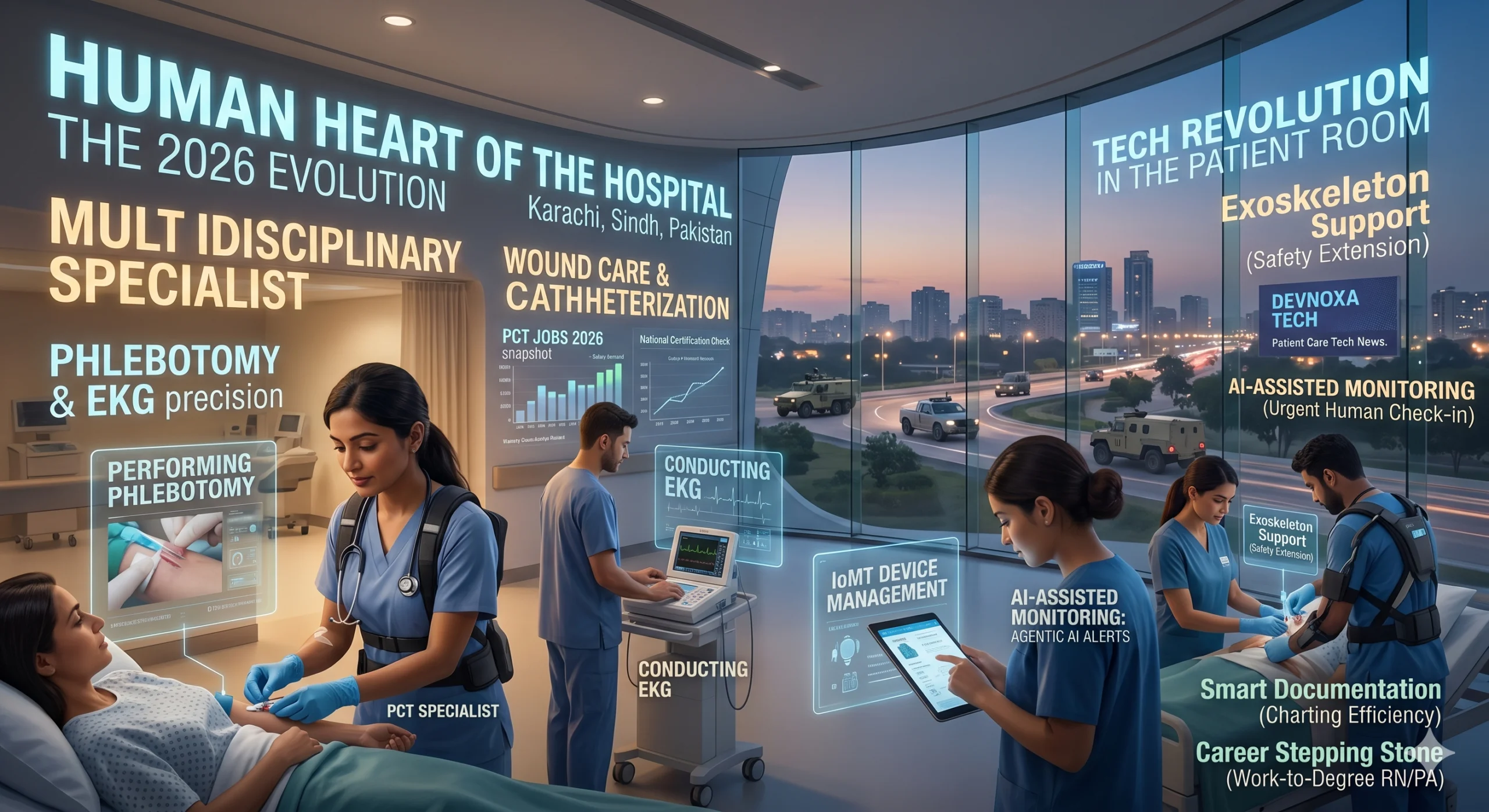
Modern PCT jobs now require a suite of technical skills that allow them to operate as true clinical partners to nurses and doctors. On any given day, a PCT might:
- Perform Phlebotomy: Drawing blood for laboratory tests with precision and care.
- Conduct EKGs: Operating electrocardiogram machines to monitor a patient’s heart rhythm.
- Manage IoMT Devices: In 2026, PCTs are the primary managers of the “Internet of Medical Things” at the bedside, ensuring that wearable sensors and smart IV pumps are correctly calibrated and transmitting data.
- Wound Care and Catheterization: Assisting with more complex clinical procedures that were once reserved strictly for licensed nurses.
The Market Pulse: Salary and Demand
The demand for PCTs in 2026 is driven by an aging global population and a healthcare system that is increasingly “hospital-at-home” and outpatient focused. Because PCTs can do so much, they are being hired at record rates in a variety of settings.
2026 Salary Snapshots
According to the latest 2026 data, the average annual salary for a Patient Care Technician ranges from $38,000 to $57,000, with specialized roles in private hospitals or government facilities reaching the higher end of that scale.
- Top Paying States: Washington, New York, and California lead the market, with hourly rates often exceeding $22 per hour.
- Shift Differentials: In 2026, many healthcare systems are offering significant “hero pay” or shift differentials for those willing to work nights or weekends, often adding an extra $3 to $5 per hour to the base wage.
Beyond the Paycheck: Job Security
The U.S. Bureau of Labor Statistics (BLS) and international health agencies continue to project steady growth for patient care roles through 2034. In a world of increasing automation, the human element of patient care is one of the few areas that remains “future-proof.” You can automate a lab test, but you cannot automate the empathy required to calm a confused patient or the physical skill required to safely transfer a post-surgical patient.
The Tech Revolution in the Patient Room
In 2026, the “Tech” in Patient Care Tech is finally living up to its name. We are seeing a “Renaissance” of purposeful engineering that makes the PCT’s job safer and more efficient.
- AI-Assisted Monitoring: PCTs now use tablets that utilize Agentic AI to prioritize their rounds. The system analyzes real-time vitals and alerts the technician to which patient needs a “human check-in” most urgently.
- Exoskeleton Support: To combat the physical strain of the job, many hospitals in 2026 are providing PCTs with lightweight, wearable exoskeletons. these “lift-assist” suits reduce the risk of back injury when moving patients, extending the career longevity of healthcare workers.
- Smart Documentation: Gone are the days of manual charting. Voice-to-text systems and smart-beds automatically record patient movements and vitals directly into the Electronic Health Record (EHR), allowing the PCT to spend more time looking at the patient and less time looking at a screen.
Path to Success: Certification and Growth
One of the most attractive aspects of the PCT career in 2026 is the speed of entry. Unlike a four-year nursing degree, a PCT certificate can often be earned in a few months through hybrid or online-led programs.
The 2026 Certification Checklist
- High School Diploma: The basic prerequisite.
- Accredited Training: Completion of a program that includes hands-on clinical externships.
- National Certification: Passing the CPCT/A (Certified Patient Care Technician/Assistant) exam. In 2026, many employers also look for “Stackable Credentials” in Phlebotomy and EKG to offer higher starting pay.
The Career Stepping Stone
For many, the PCT job is not the destination, but the launchpad. In 2026, many hospitals offer “Work-to-Degree” programs where they will pay for a PCT’s tuition to become a Registered Nurse (RN) or a Physician Assistant (PA). This makes it one of the smartest strategic moves for anyone who wants to climb the healthcare ladder without taking on massive student debt.
Conclusion: A Career of Impact
Being a Patient Care Technician in 2026 is a role of profound significance. You are the person who sees the patient most often; you are the first to notice a change in their mood or a slight shift in their vitals. You are the face of the healthcare system to the family waiting in the hallway.
It is a job that demands a strong back, a sharp mind, and a soft heart. As technology continues to change how we diagnose and treat disease, the PCT remains the essential human link that ensures “patient care” is never just a cold, digital process.
For those looking to build their own technical foundations or seeking a partner to navigate the high-stakes world of digital growth and medical innovation, the journey begins with understanding the framework of the future. devnoxa tech
Follow-up Question: Are you considering starting a PCT training program soon, or are you an experienced healthcare worker looking to transition into a more tech-heavy clinical role?