
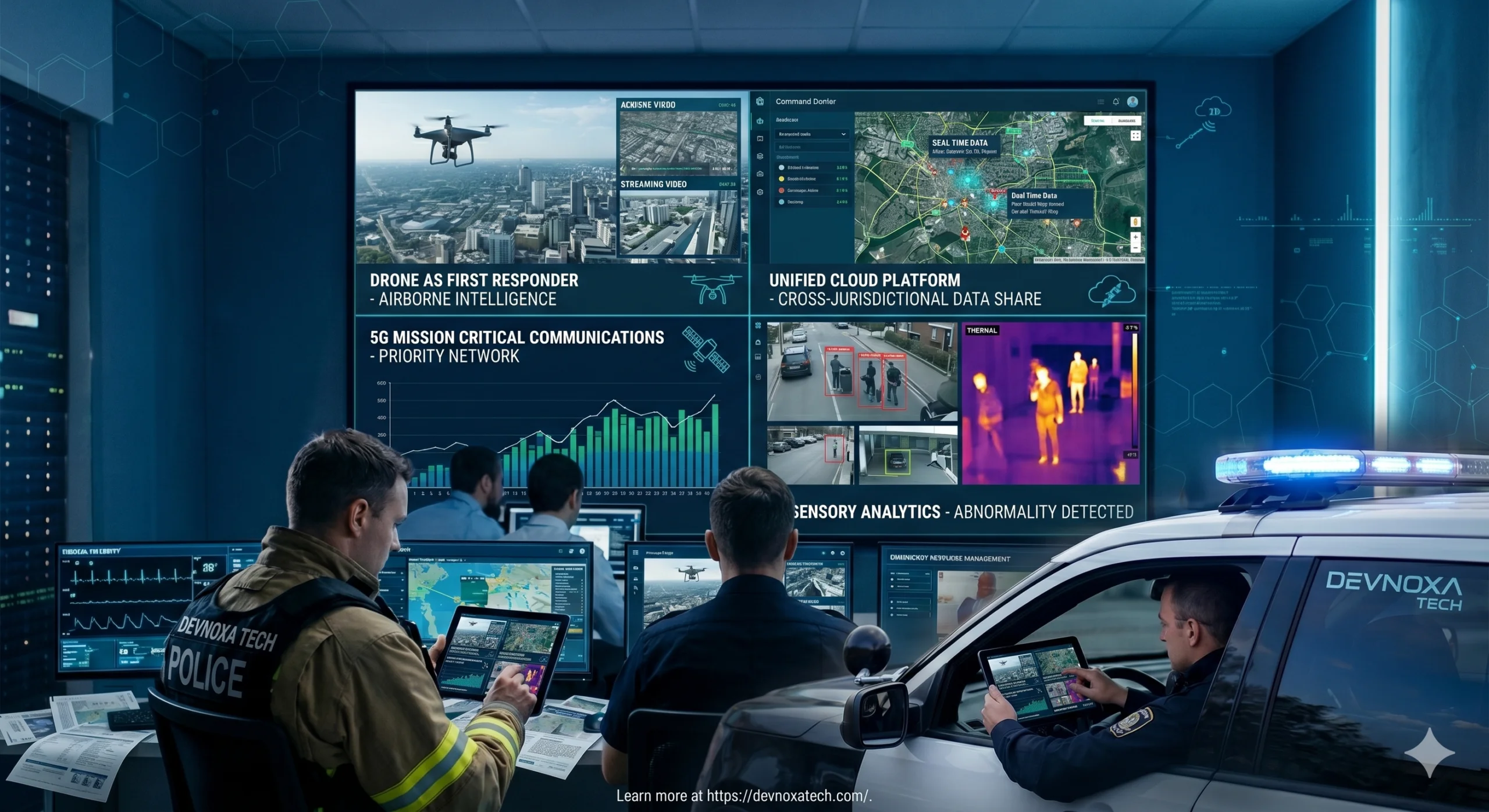

The landscape of public safety is shifting rapidly. Emergency personnel, police departments, and medical teams are facing a complex era defined by persistent staffing shortages, rising call volumes, and highly demanding operational environments. To bridge these gaps, public safety agencies are turning to advanced technology. What used to feel like science fiction is now becoming standard practice on the front lines. From airborne responders to predictive analytics, the latest innovations are designed to make communities safer while easing the heavy burden on the people who protect them.
Airborne Intelligence Arrives First
One of the most significant shifts in emergency response is the rise of Drone as First Responder programs. Historically, when an emergency call came in, dispatchers sent a cruiser or an ambulance, and responders gathered information after arriving on the scene. Today, departments are launching autonomous drones the moment a call is received, allowing the aircraft to arrive minutes before human personnel.
These drones fly beyond the visual line of sight of their operators, guided by new, streamlined regulatory approvals that have standardized how public safety agencies use airspace. When a drone hovers over an incident, it streams live, high definition video directly to command centers and the mobile devices of approaching officers or firefighters. If a caller reports a major fire, a drone can immediately confirm whether a structure is fully engulfed or identify hazardous materials before a single truck arrives. This proactive view prevents first responders from walking blindly into danger and ensures that the right amount of equipment is deployed instantly.
The Cloud Unifies Fragmented Data
For decades, public safety agencies operated on isolated, on premises servers. If a police department needed to share data with a neighboring county fire department during a natural disaster, the process was slow and cumbersome. Now, a massive migration toward cloud based infrastructure is fixing that fragmentation.
Modern public safety networks are utilizing secure cloud environments to connect disparate systems, including computer aided dispatch, records management, and real time situational awareness platforms. This deep interoperability allows multiple jurisdictions to view a single, unified operational picture during a crisis. For smaller agencies with tight budgets and minimal IT staff, the cloud removes the burden of maintaining heavy hardware. System updates happen automatically, cybersecurity protections are enforced seamlessly at the data level, and disaster recovery becomes a matter of minutes rather than days.
Cellular Infrastructure and the Move to 5G
When a massive crisis hits or thousands of people gather for a major event, traditional commercial cellular networks quickly become overloaded, dropping critical calls and slowing data transmission to a crawl. To combat this, dedicated public safety communications infrastructure has undergone an aggressive multi billion dollar upgrade to 5G.
Hundreds of new, dedicated cell sites have rolled out across rural and tribal regions, prioritizing areas near hospitals, fire stations, and courthouses. This network ensures that emergency personnel have a dedicated, priority lane for high speed data. The practical impact is immense. First responders are no longer limited to basic voice communication; they can reliably stream live video, download blueprints of burning buildings, and transmit medical telemetry from moving ambulances without fear of network congestion. For areas where physical cell towers are damaged by storms, deployment teams use portable cell sites mounted on trailers, utilizing low Earth orbit satellites to establish communication links out of thin air.
Artificial Intelligence and Sensory Analytics
Artificial intelligence has transitioned from a buzzword into a daily asset for public safety professionals. Agencies are leveraging machine learning to automate time consuming, compliance heavy administrative tasks, helping to speed up background checks for new recruits and fast track training documentation. On the streets, AI is powering advanced video and sensory analytics.
Modern surveillance cameras do not just record footage; they analyze behavior, track specific objects, and automatically flag anomalies like unattended baggage or a vehicle traveling the wrong way down a one way street. Furthermore, smart sensors are being installed in privacy sensitive areas like schools and hospital bathrooms where cameras are legally and ethically forbidden. These sensors monitor air quality and use acoustic analytics to identify physical aggression, vaping, or the distinct sound of a gunshot, instantly alerting security teams before a situation escalates.
Smart Fleets and Connected Vehicles
The modern emergency vehicle is no longer just a mode of transportation; it is a fully connected mobile workstation. Internet of Things integration allows police cruisers, fire engines, and EMS units to communicate constantly with dispatch systems and smart city infrastructure. Command centers can monitor real time vehicle diagnostics, track live GPS locations, and perform predictive maintenance before a mechanical failure happens during an emergency.
Even basic warning equipment has received an intelligent upgrade. Modern LED lightbars and sirens are programmable, adjusting their flash patterns and intensity automatically based on weather conditions, vehicle speed, or braking systems. For instance, when a cruiser pulls over on a high risk highway at night, the lights can transition to a directional pattern that guides oncoming traffic away safely, reducing the high rate of roadside accidents involving stationary emergency vehicles. Inside the cabin, modular and ergonomic layouts are designed to reduce operator fatigue during long shifts, ensuring that critical data terminals are easily accessible without distracting the driver.
Balancing Innovation with Trust
As public safety technology becomes more automated and pervasive, agencies are facing the critical challenge of maintaining public trust. The adoption of large language models and automated data analysis tools has sparked important conversations about transparency, citizen privacy, and algorithmic bias. Leading agencies are addressing these concerns by establishing strict governance frameworks, emphasizing that technology is meant to support human decision making, not replace it.
The ultimate goal of these advanced tools is to create an environment where technology manages the data heavy, repetitive, and hazardous tasks, leaving human responders free to focus on what they do best: applying empathy, critical judgment, and life saving skills when every second counts.
For more information on the latest innovations in enterprise and infrastructure solutions, visit devnoxa tech