
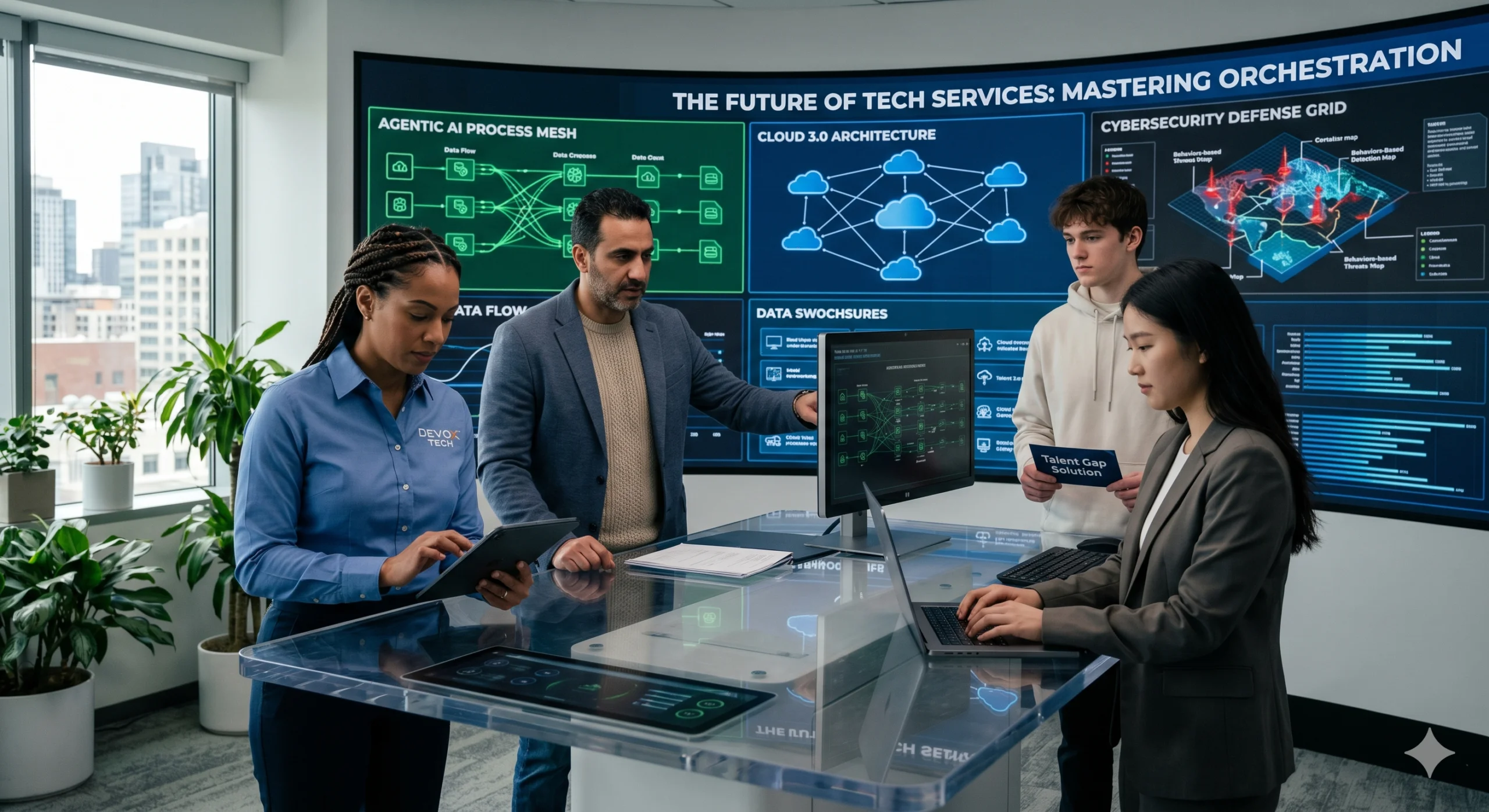

In 2026, tech services are no longer just about fixing broken laptops or resetting forgotten passwords. They are about orchestrating complex ecosystems of artificial intelligence, managing vast cloud networks, and defending against increasingly sophisticated digital threats. This article explores the current landscape of tech services and why they have become the most critical investment for any organization looking to thrive in the late 2020s.
The Year of Truth for Artificial Intelligence
By 2026, the initial hype surrounding generative artificial intelligence has finally settled, giving way to what industry experts call the year of truth. For several years, companies experimented with isolated pilots and flashy chatbots. Today, tech services are focused on making AI a coherent and governed enterprise capability.
The shift is moving from simple automation toward agentic AI. Unlike the basic bots of the past, these modern digital agents are capable of understanding intent and executing multi step workflows autonomously. Tech service providers are now tasked with building the durable foundations these agents require to operate safely. This involves creating robust governance frameworks, ensuring data privacy, and moving AI from a novelty chat interface into the deep fabric of daily business processes like finance, human resources, and supply chain management.
Moving Toward Cloud 3.0
The infrastructure supporting these advanced tools has also undergone a massive transformation. We have entered the era of Cloud 3.0. In the early days, cloud services were primarily about migration and cost efficiency. In 2026, the cloud has become an active enabler of AI driven architectures.
Tech services firms are helping organizations navigate a complex mix of public, private, and sovereign cloud models. Because many AI use cases require low latency and high data sensitivity, running everything in a distant, centralized data center is no longer realistic. Today, cloud services are focused on bringing computing power closer to the edge. This regionalized approach to IT allows businesses to comply with local data laws while ensuring their AI models can process information in real time. The focus has shifted from mere storage to Master orchestration, ensuring that data is portable, secure, and always accessible to the intelligent systems that need it.
Cybersecurity Beyond the Core
As technology becomes more powerful, the threats facing it have grown equally sophisticated. In 2026, cybersecurity is no longer just an IT function; it is a strategic enabler of growth and trust. We are seeing a landscape where AI is being weaponized by nation state actors and criminal syndicates to launch attacks at an unprecedented scale and speed.
Modern tech services in the security sector are moving toward a proactive, AI powered defense. This involves identity management systems that can detect anomalies based on behavior and automated response protocols that can patch vulnerabilities in hours rather than weeks. Tech service providers are also focusing on securing the AI pipelines themselves, protecting models against data poisoning and prompt injection. In an era where a single operational outage can cascade across global markets, the integrity of the digital supply chain has become a top priority for every board of directors.
The Rise of Intelligent Operations
Enterprise systems are undergoing a fundamental shift toward what is known as intelligent operations. In the past, business software was often monolithic and rigid, requiring humans to adapt their workflows to the technology. Today, tech services are creating living ecosystems of modular, continuously learning applications.
These intelligent operations blend human oversight with autonomous agents to turn routine processes into adaptive engines of value creation. For example, in a modern manufacturing plant, tech services might integrate real time sensors with predictive AI to anticipate equipment failure before it happens, automatically ordering the necessary parts and scheduling a technician. This level of structural resilience is what defines a successful business in 2026. It allows organizations to reinvent themselves continuously rather than just running better.
Navigating the Tech Talent Gap
Despite the rise of automation, the human element in tech services remains more important than ever. However, the nature of that work has changed. As AI begins to handle more of the manual coding and basic troubleshooting, the demand for high level architects and orchestrators has skyrocketed.
There is a significant tech talent gap in 2026. Companies are looking for specialists who can bridge the gap between business strategy and technical execution. Tech services firms play a vital role here by providing the “enterprise muscle” that many companies lack internally. They offer the skilled people, reusable tech components, and change management frameworks needed to scale new technologies across an entire organization. The competitive edge in today’s market no longer hinges on manual labor, but on the ability to master the governance and orchestration of complex digital systems.
Sustainable by Design IT
Finally, tech services in 2026 are increasingly defined by sustainability. Corporate social responsibility is no longer a peripheral concern; it is a core component of corporate governance. Tech leaders are now focusing on sustainable by design IT, where energy efficiency and carbon footprints are measured as strictly as financial profits.
This involves optimizing data centers for lower power consumption, utilizing AI to reduce waste in physical supply chains, and selecting cloud providers based on their green energy credentials. Tech services are helping businesses prove their sustainability claims through transparent, data driven reporting. In a world increasingly concerned with climate change, being a responsible digital citizen is essential for maintaining client confidence and meeting regulatory requirements.
Conclusion: Constructing Durable Foundations
The tech services landscape of 2026 is characterized by a move from experimentation to structural rebuilding. The goal is no longer to just try the latest gadget, but to construct durable foundations that will support future innovation. By mastering the integration of AI, the complexity of Cloud 3.0, and the imperatives of modern cybersecurity, tech services are enabling a more resilient and agile global economy.
In this fast moving environment, the true winners are those who can turn data into creativity, complexity into clarity, and scale into personalization. Technology is no longer in the background; it is the force driving innovation and growth for every person and every business on the planet. devnoxa tech