

Email marketing has been a digital marketing cornerstone for decades. However, the days of blasting the exact same generic newsletter to thousands of subscribers and hoping for a 2% click-through rate are over. Consumers expect hyper-personalized, timely, and relevant content delivered straight to their inboxes.
Meeting these expectations manually at scale is nearly impossible. This is where Artificial Intelligence (AI) steps in, fundamentally transforming how brands communicate with their audiences. From drafting compelling subject lines to predicting the exact minute a user will open an email, AI email marketing from a guessing game into a precise science.
Smart Personalization Beyond First Names
For years, personalization in email marketing meant using a merge tag to insert a subscriber’s first name into the subject line. While that used to be enough to catch someone’s eye, today’s consumers see right through it. Modern personalization requires understanding a subscriber’s behavior, preferences, and intent.
AI excels at processing massive datasets to create a dynamic picture of each individual on your list. Predictive analytics can track a customer’s browsing history, past purchases, and even the time they spend looking at specific products.
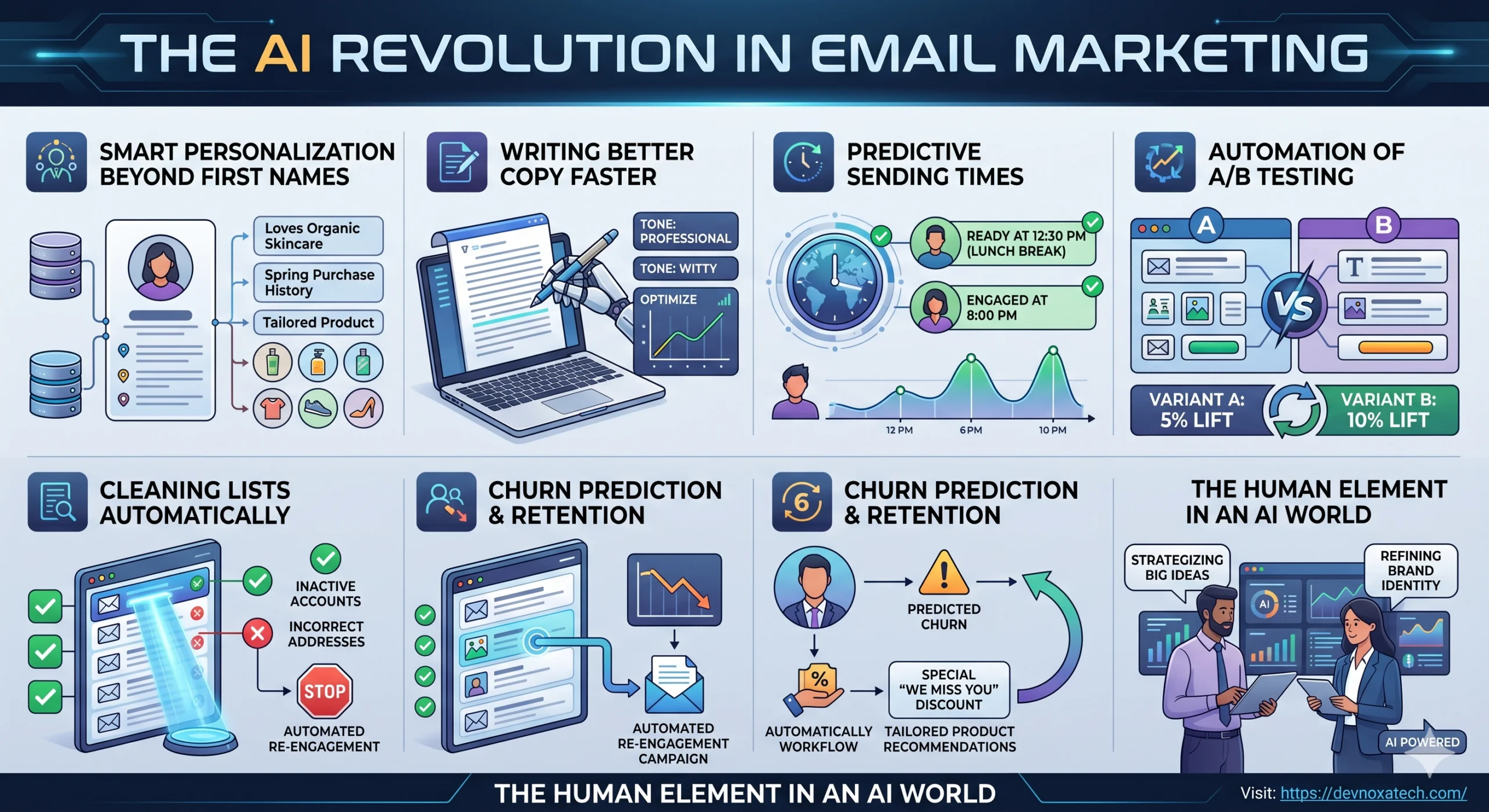
Instead of segmenting your audience into broad, static buckets like “Women aged 25 to 34,” AI allows for hyper-segmentation. It automatically clusters users based on real-time behavior. If a subscriber frequently buys organic skincare products in the spring, the AI ensures they receive tailored product recommendations right when their interest peaks, completely bypassing manual campaign setups.
Writing Better Copy Faster
Writer’s block is a common hurdle for marketers. Crafting dozens of unique subject lines, preview texts, and body paragraphs for different audience segments takes an immense amount of time. Generative AI tools have completely changed this workflow.
AI copywriting assistants do not just churn out generic text. When trained on your brand guidelines, they can adopt your specific tone of voice, whether it is professional, witty, or casual.
More importantly, AI can optimize copy for conversions. By analyzing historical performance data across millions of emails, AI tools can predict which language patterns, power words, or emotional triggers will resonate most with your audience. It can suggest multiple variations of a subject line designed to maximize open rates, allowing marketers to focus on high-level strategy rather than staring at a blank page.
Predictive Sending Times
Even the most beautifully written email will fail if it arrives when your subscriber is asleep, driving, or buried under morning meetings. Traditional email platforms allow you to send campaigns based on time zones, but this is still a one-size-fits-all approach.
AI solves this with Predictive Send-Time Optimization. Instead of sending a blast to your entire list at 10:00 AM, the AI analyzes the historical behavior of each individual subscriber.
If Subscriber A typically checks their personal email during their lunch break at 12:30 PM, and Subscriber B prefers catching up on emails at 8:00 PM, the AI schedules the delivery so the message lands at the top of each person’s inbox precisely when they are most likely to engage. This drastically reduces the chances of your email getting lost in the daily digital noise.
Automation of A/B Testing
A/B testing is vital for optimizing email campaigns, but the traditional manual process is slow and limited. Marketers usually test only two variables at a time, such as Subject Line A versus Subject Line B, wait a few days for the results, and then manually apply the winner to future campaigns.
AI turns A/B testing into a continuous, automated process known as multivariate testing. An AI system can test dozens of variations simultaneously, mixing and matching subject lines, hero images, call-to-action buttons, and body copy.
As the campaign deploys, the AI monitors performance in real time. If it notices a specific combination performing exceptionally well among a certain demographic, it automatically shifts the remaining distribution to favor that winning combination. This continuous loop ensures your campaigns are constantly self-optimizing without requiring constant human intervention.
Cleaning Lists Automatically
The size of your email list matters far less than its health. Sending emails to inactive accounts, incorrect addresses, or users who never open your messages hurts your sender reputation. If internet service providers like Gmail or Yahoo notice your emails have low engagement rates, they may start routing your messages straight to the spam folder.
AI algorithms protect your deliverability by managing list hygiene automatically. They can detect patterns that indicate a subscriber has lost interest, such as a sudden drop-off in opens over a three-month period.
Instead of waiting for a manual audit, the AI can trigger a automated re-engagement campaign. If the user still does not interact, the system automatically removes or archives the contact. This keeps your bounce rates low and ensures your marketing budget is spent only on subscribers who truly want to hear from you.
Churn Prediction and Customer Retention
Acquiring a new customer is significantly more expensive than retaining an existing one. AI provides email marketers with a crystal ball for customer retention by identifying signs of user fatigue or impending churn.
By analyzing engagement patterns, an AI model can flag when a previously loyal customer starts opening emails less frequently or stops visiting your website.
Once these red flags are raised, the system can automatically deploy targeted retention emails. This could be a special “We Miss You” discount, a feedback survey, or a curated list of new products tailored to their past preferences. By intervening at the exact moment a customer begins to drift away, brands can successfully rescue relationships before they are lost for good.
The Human Element in an AI World
With AI handling copywriting, scheduling, segmentation, and testing, it is easy to wonder if human marketers are becoming obsolete. The reality is quite the opposite. AI is an incredibly powerful assistant, but it lacks the capacity for genuine human empathy, cultural awareness, and high-level creative vision.
The role of the email marketer is shifting from execution to curation and strategy. Marketers no longer need to spend hours building lists and scheduling deployments. Instead, they can spend their time brainstorming big creative concepts, refining brand identity, and analyzing the deep insights that AI provides. The most successful email marketing campaigns of the future will not be run solely by algorithms, but by creative humans leveraging AI to its fullest potential.
To explore how advanced digital solutions can transform your business workflows, visit devnoxa tech