
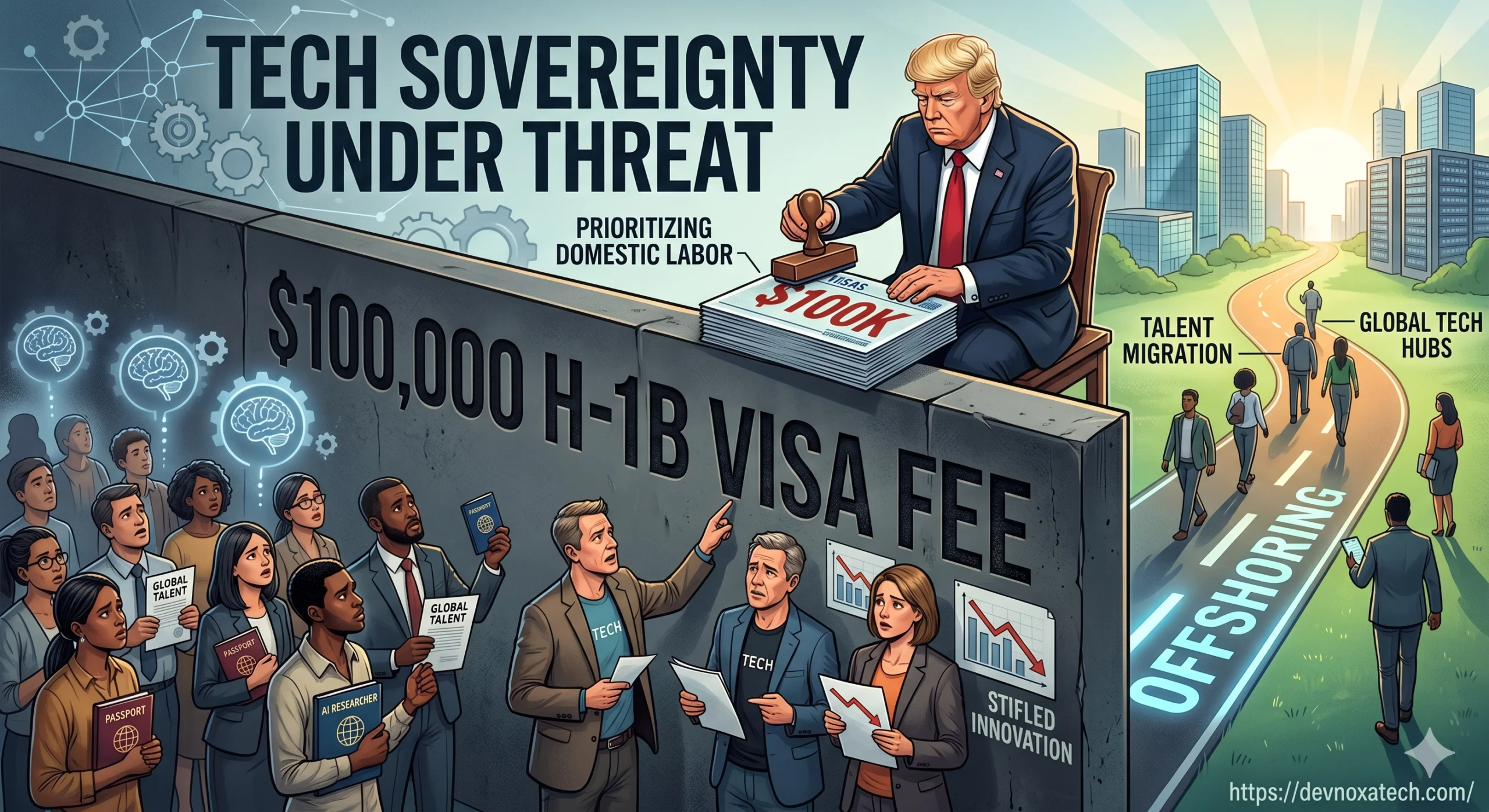

The tech companies sector operates on a simple principle: innovation chases raw talent. For decades, the United States served as the ultimate destination for global minds, largely anchored by the H-1B visa program. However, a massive shift occurred when President Donald Trump introduced a startling $100,000 supplemental fee on new H-1B visas. The decision sent shockwaves through Silicon Valley, causing artificial intelligence executives and tech leaders to scramble.
While the policy aims to prioritize domestic labor, tech companies see it as an existential threat to America’s technological edge. The staggering price hike turns what used to be an administrative process into a massive financial barrier, forcing companies to rethink their entire talent acquisition playbook.
The Talent Tax
To understand why tech leaders are alarmed, it helps to look at how dramatically the math has changed. Historically, processing a new H-1B visa cost companies between $1,700 and $4,500 in government filing fees. Even with premium processing and legal fees factored in, total expenses rarely crossed the $10,000 threshold per employee.
Adding a flat $100,000 fee on top of those standard costs completely alters corporate budgeting. This is not a marginal increase; it is a sixtyfold surge. For industry giants like Amazon, Microsoft, and Meta, who collectively secure thousands of new H-1B approvals annually, the cumulative burden easily runs into hundreds of millions of dollars each year.
Tech giants can theoretically absorb these costs, though not without adjusting their margins or cutting down on other projects. The real disaster falls on startups, mid-sized companies, and research institutions. A young AI startup trying to hire three world-class machine learning engineers from overseas suddenly faces an upfront bill of $300,000 just for the right to employ them. That is capital that would otherwise fund research, development, and basic operations.
Stifling the AI Revolution
The timing of this financial hurdle is particularly painful for the artificial intelligence ecosystem. The global AI race is moving at breakneck speed, and the bottleneck is not necessarily compute power or capital, it is human expertise. There are only a handful of researchers worldwide capable of building and optimizing foundational AI models.
Many of these top-tier researchers are international students graduating from American universities or experts working abroad. By placing a six-figure premium on their entry, the administration has made it incredibly difficult for younger, nimble AI firms to secure the niche expertise they need to compete.
Executives openly worry that this barrier will effectively freeze the talent pipeline, starving American hubs of the brilliant minds that drive breakthroughs. If small and medium-sized enterprises cannot afford to bring international innovators to US soil, the pace of domestic AI development could slow down significantly.
Pushing Innovation Beyond Borders
When companies cannot bring talent to the work, they inevitably take the work to the talent. The most alarming unintended consequence of the visa fee is the sudden incentive it creates for offshoring.
Instead of forcing tech companies to hire locally, the extreme cost is pushing them to expand their footprints in foreign tech hubs. Establishing or growing engineering centers in places like Vancouver, London, Dublin, or Bengaluru has quickly shifted from a long-term strategic option to an immediate financial necessity.
Engineering managers point out that it is far more cost-effective to set up a remote team or build a satellite office in Canada or Europe than it is to pay the hefty fee for multiple new hires in California or New York. The long-term risk for the United States is clear: a steady, permanent migration of high-paying tech jobs, intellectual property creation, and economic growth out of the country.
The Legal Tug of War
The implementation of the visa fee has triggered intense resistance, leading to a complex legal battle across federal courts. A coalition of twenty states led the charge, arguing that the massive fee severely harms public universities, healthcare staffing, and local economies.
The legal drama peaked when a federal judge in Massachusetts temporarily vacated the $100,000 fee. The court ruled that the administration had overstepped its executive authority, declaring that such an aggressive financial requirement essentially functioned as an unauthorized tax, a power reserved exclusively for Congress. The ruling also criticized the policy as arbitrary and capricious, noting that the government failed to justify the immediate economic shock.
However, the relief for tech executives was short-lived. Just days after the initial ruling, the court stayed its own decision to allow the Department of Homeland Security to pursue an emergency appeal. This leaves the entire tech industry in a painful state of limbo. Companies are forced to budget for the massive fee while navigating a volatile legal environment where rules seem to change by the week.
Looking Past the Confusion
The underlying motivation behind the policy is a desire to protect the American workforce from being underpriced by cheaper foreign labor. The administration points to historic layoffs within the tech sector as evidence that companies should focus on training and hiring domestic workers before looking overseas.
Yet tech executives counter that specialized fields like advanced AI and quantum computing do not suffer from a lack of corporate will to hire locally; they suffer from a literal shortage of qualified individuals globally. Restricting the entry of top-tier international minds does not automatically create domestic replacements with the same level of highly specific expertise.
The ultimate irony of a policy meant to protect American jobs is that it may end up exporting them. If US companies choose to bypass the H-1B system entirely by expanding their operations abroad, the domestic economy loses out on the tax revenue, consumer spending, and secondary job creation that these high earners naturally bring to American communities.
A System in Limbo
As the legal battle winds its way through the appellate courts, the tech industry remains on edge. The era of seamless global talent mobility into the United States has faced its most significant financial barrier yet. For AI executives and tech founders, the situation requires a delicate balancing act between fighting for access to global talent and adapting to an increasingly localized reality.
Whether the fee is ultimately struck down permanently or upheld by higher courts, the message to the global tech community has already been delivered: the path to Silicon Valley is no longer just highly competitive, it is extraordinarily expensive.
For businesses looking to navigate these rapidly changing technological and operational landscapes with agility, visiting Devnoxa Tech offers valuable insights into modern digital strategies.
To gain a broader perspective on how the tech sector is responding to this monumental policy shift, check out this Tech companies scramble after Trump slaps $100,000 fee on H-1B visas video, which covers the initial industry reaction and immediate fallout from the announcement. devnoxa tech