
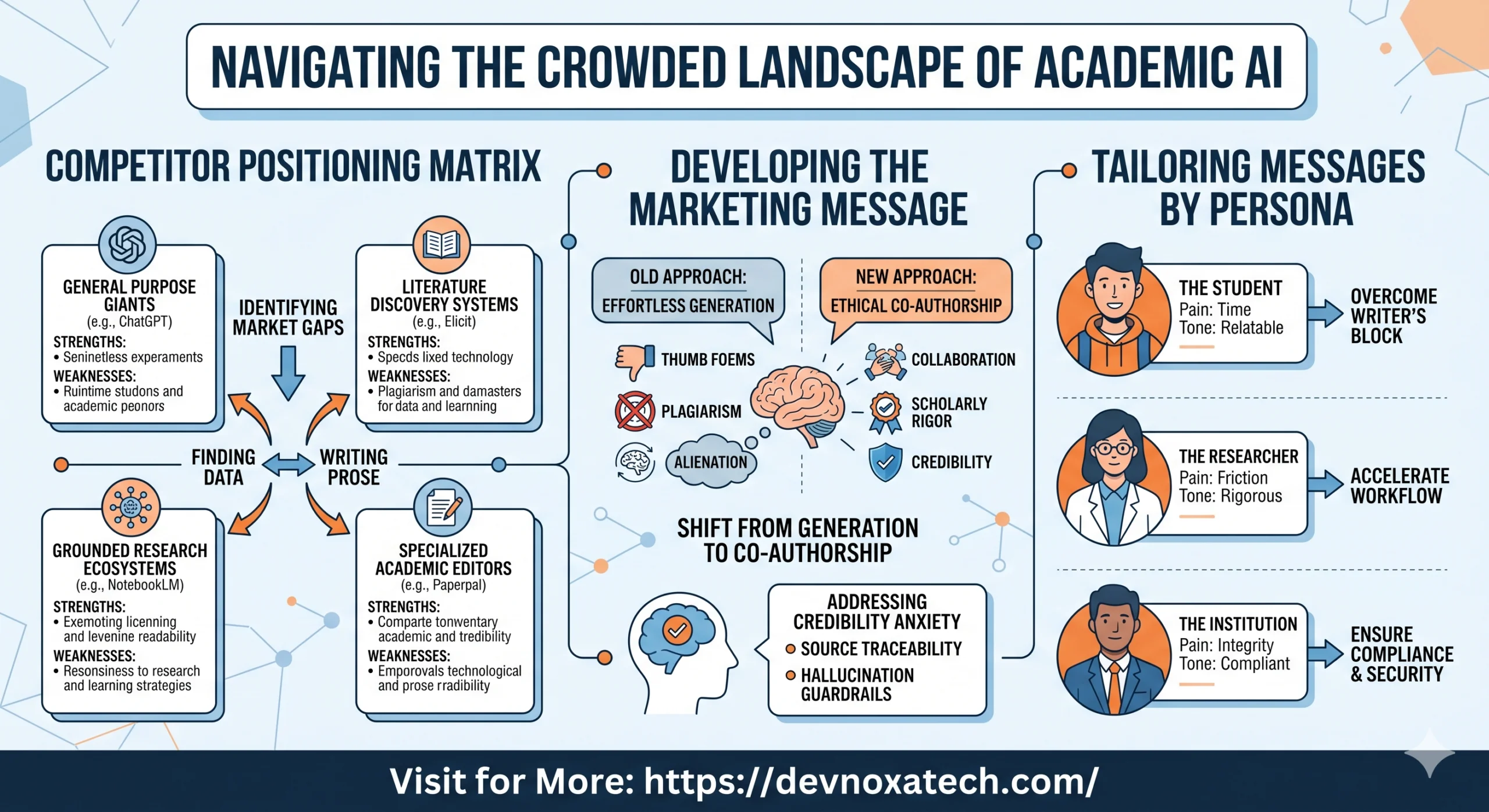

The market for artificial intelligence academic writing tools has shifted from a novel niche into an intensely contested multi-billion dollar arena. What started as basic grammar checkers and predictive text engines has evolved into deep workflow ecosystems capable of managing literature discovery, semantic citation mapping, and advanced manuscript drafting. For software developers and startup founders entering this space, the challenge is no longer just building a robust tool, it is defining a precise position in an increasingly crowded market and executing a messaging strategy that cuts through the noise.
Winning a share of this audience requires an intimate understanding of competitor positioning, the distinct anxieties of the academic user base, and how to craft product messaging that values integrity as much as efficiency.
Competitor Positioning Matrix
To carve out a distinct space, you must first understand where the dominant players have set up their fortresses. The academic AI market is split into four distinct strategic categories, each serving a unique stage of the research and writing lifecycle.
General Purpose Giants
These are the foundational large language models like ChatGPT Plus, Claude Pro, and Gemini Advanced. They dominate the market based on sheer intelligence, creative versatility, and raw natural language processing capabilities.
- Their Position: The ultimate first-draft machines and conversational brainstorming partners.
- Their Vulnerability: They lack native academic guardrails, cannot independently verify deep citation integrity, and are prone to hallucinations without heavy prompt engineering.
Literature Discovery and Synthesis Systems
Platforms like Elicit, Consensus, and Semantic Scholar do not prioritize the final writing phase. Instead, they focus entirely on the source gathering that precedes it. They index hundreds of millions of peer-reviewed papers to extract data and map citation networks.
- Their Position: Trustworthy, data-driven evidence finders that visualize the scientific consensus.
- Their Vulnerability: They are discovery engines, not prose builders. They help you find what to say, but do not help you say it beautifully.
Grounded Research Ecosystems
Google NotebookLM and data exploration apps like Powerdrill Bloom represent the localized approach. They do not search the open web; instead, they allow researchers to upload specific PDFs, notes, and datasets, acting as a conversational partner purely for those materials.
- Their Position: Source-grounded, private, and highly interactive synthesis spaces.
- Their Vulnerability: They rely entirely on the quality of user-provided uploads and lack broad external search capabilities.
Specialized Academic Editors
Tools like Paperpal and the AI integrations within legacy software like NVivo or Citavi sit at the very end of the line. They are tailored specifically for the mechanics of academic formatting, journal compliance, and technical tone alignment.
- Their Position: The final polishers ensuring your work adheres to strict publisher guidelines.
- Their Vulnerability: They lack the expansive creative brainstorming capabilities of the general-purpose giants.
Identifying Market Gaps
Looking at this matrix reveals clear white spaces for new entrants. The market is currently fragmented between tools that help you find information and tools that help you write prose.
The biggest opportunity lies in building the missing bridge: an end-to-end workspace that seamlessly transitions a researcher from discovery to structured drafting without forcing them to copy and paste data across four different browser tabs. A platform that can ingest literature, cross-reference data in real-time, and format the final manuscript under strict academic compliance is positioned to capture massive user loyalty.
Developing the Marketing Message
Marketing to academia is notoriously difficult because academics are professionally trained to be skeptics. Generic tech-startup marketing language will fail here. If your website uses phrases like “Revolutionize your writing with one click” or “Effortless essays generated in seconds,” you will alienate the entire target audience.
Universities view effortless generation as plagiarism. Researchers view one-click automation as a threat to methodology. To build a message that converts, you must align with the values of the institution.
The Shift from Generation to Co-Authorship
Your messaging should frame the tool as an intellectual companion rather than a replacement for human thought. Instead of promising to write the paper for them, promise to clear away the administrative friction of research.
- Avoid: “Let AI write your literature review.”
- Emphasize: “Synthesize a hundred papers in minutes so you can focus on the analysis.”
Addressing the Credibility Anxiety
The primary fear of any researcher using AI is the risk of accidental academic misconduct, fake citations, or diluted reasoning. Your marketing must meet this anxiety head-on by explicitly highlighting security features, source traceability, and hallucination guardrails. If your tool features inline citation tracking or verifiable evidence loops, make that the headline of your product pages.
Tailoring Messages by Persona
The academic market is not a monolith. A message that resonates with an undergraduate student will completely miss the mark for a tenured professor or an institutional buyer.
                  ┌────────────────────────────────────────┐
                  │      Academic AI Market Personas       │
                  └────────────────────────────────────────┘
                                      │
         ┌────────────────────────────┼────────────────────────────┐
         ▼                            ▼                            ▼
┌─────────────────┐          ┌─────────────────┐          ┌─────────────────┐
│  The Student    │          │  The Researcher │          │The Institution  │
├─────────────────┤          ├─────────────────┤          ├─────────────────┤
│ Pain: Time      │          │ Pain: Friction  │          │ Pain: Integrity │
│ Tone: Relatable │          │ Tone: Rigorous  │          │ Tone: Compliant │
└─────────────────┘          └─────────────────┘          └─────────────────┘
The Student
- Core Pain Point: Overwhelming assignment volume, tight deadlines, and complex language barriers for English as a Second Language (ESL) individuals.
- Messaging Angle: Focus on clarity, structural organization, and overcoming writer’s block. Use supportive, accessible language that frames the tool as a personal writing coach.
The Professional Researcher and Faculty Member
- Core Pain Point: The grueling, repetitive labor of formatting journal submissions, managing extensive bibliographies, and drafting grant proposals.
- Messaging Angle: Focus heavily on precision, compliance, and velocity. Use technical language that emphasizes data privacy, manuscript acceptance rates, and workflow acceleration.
The Institutional Buyer
- Core Pain Point: The risk of mass plagiarism, maintaining university accreditation, and ensuring equitable access to learning resources.
- Messaging Angle: Focus on compliance, data security, administrative oversight, and integrating with existing learning management systems.
Execution and Growth Strategy
Once your positioning is locked in and your messaging is tailored, execution comes down to community-led growth. Academics do not buy software because of social media advertisements; they buy it because a colleague, a peer reviewer, or a department head recommended it.
Focus on building a footprint through localized academic networks. Offer institutional trials, run workshops on ethical AI workflows for graduate schools, and partner with educational content creators who teach research methodology. By shifting your product’s narrative away from “shortcuts” and anchoring it in “scholarly rigor,” you can build a highly sticky user base in one of the fastest-growing software markets in the world.
For software development teams looking to build, scale, and correctly position highly secure platforms in complex markets like educational technology, exploring specialized development frameworks can provide a massive head start. You can learn more about building enterprise-grade software architectures by visiting devnoxa tech