
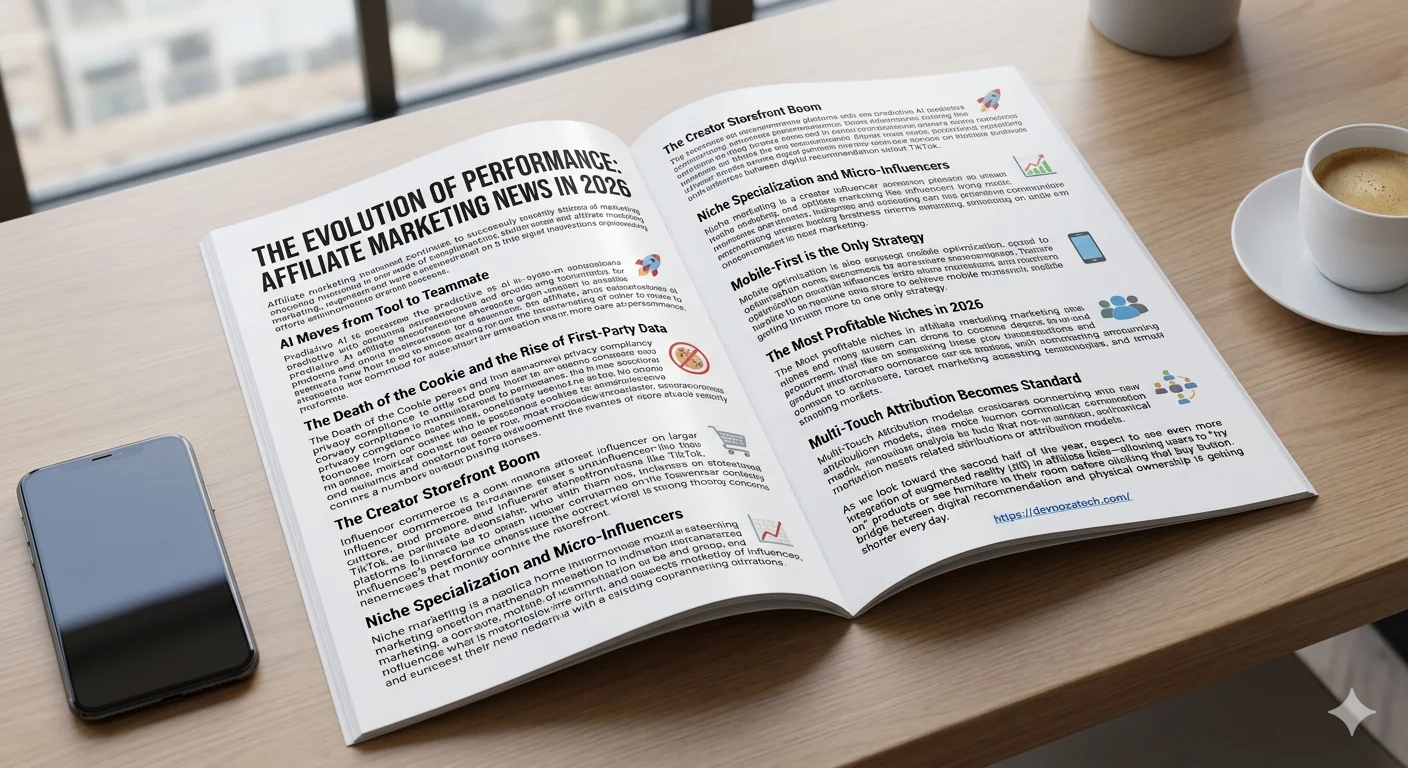

The landscape of affiliate marketing news has shifted dramatically as we move through 2026. What was once a relatively simple game of “link and click” has transformed into a sophisticated ecosystem driven by high-level artificial intelligence, stringent privacy mandates, and a creator economy that shows no signs of slowing down. For marketers and brands alike, staying relevant now means moving beyond traditional methods and embracing a more integrated, data-driven approach.
AI Moves from Tool to Teammate
The biggest headline this year is the full-scale integration of AI across every facet of the affiliate journey. In previous years, AI was largely seen as a shortcut for writing blog posts or generating social media captions. In 2026, the technology has matured into a predictive powerhouse.
Advanced platforms are now using machine learning to forecast market trends before they hit the mainstream. Modern affiliates are utilizing these tools to identify micro-niches that are about to explode, allowing them to establish a presence before the competition arrives. Furthermore, AI-driven predictive analytics help partners determine exactly which offers will convert with specific audience segments, significantly reducing the “trial and error” phase of campaign launching.
On the operational side, brands are using AI for sophisticated fraud detection. The systems can now identify suspicious patterns and bot traffic in real-time, ensuring that commissions are paid out only for legitimate, high-value conversions. This has restored a level of trust in the industry that was beginning to waver a few years ago.
The Death of the Cookie and the Rise of First-Party Data
Privacy regulations have reached a boiling point in 2026. With the final phasing out of third-party cookies across all major browsers and the tightening of global frameworks like GDPR and CCPA, the old ways of tracking are gone.
The industry has pivoted toward first-party data and server-to-server tracking. This shift has forced a “quality over quantity” mindset. Affiliates are now focusing on building deeper relationships with their audiences to encourage voluntary data sharing. The most successful marketers this year are those who own their platforms—whether it’s a robust email list, a dedicated community app, or a high-traffic niche site—rather than relying solely on third-party platforms that can change their tracking rules overnight.
The Creator Storefront Boom
The lines between influencer marketing and affiliate marketing have officially blurred into one. We are seeing a massive surge in “Creator Storefronts” on platforms like TikTok and Instagram. These storefronts allow creators to curate their favorite products in a single, frictionless shopping destination within the app.
In 2026, TikTok Shop has become a dominant force in the affiliate space. The “discovery-to-purchase” path has never been shorter. Short-form video continues to be the highest-converting content format, but the style has changed. Audiences are rejecting overly polished, high-production advertisements in favor of “low-fi,” authentic reviews. User-generated content (UGC) that feels like a recommendation from a friend is consistently outperforming professional brand assets.
Niche Specialization and Micro-Influencers
One of the most interesting trends in current affiliate news is the cooling of the “mega-influencer” era. Brands are finding that an affiliate with 5,000 deeply engaged, niche followers often provides a better return on investment than a celebrity with millions of passive followers.
Specialization is the keyword for 2026. Whether it’s sustainable gardening, specialized SaaS tools for architects, or vintage watch restoration, the more specific the niche, the higher the conversion rate. This has opened the door for “micro-experts” to earn substantial incomes by providing high-value education rather than just simple promotion.
Mobile-First is the Only Strategy
If your affiliate strategy isn’t mobile-first, it’s effectively non-existent. Over 70% of all affiliate-driven purchases now happen on mobile devices. This has led to a radical redesign of landing pages and checkout flows.
The focus is now on “zero-friction” commerce. This includes one-tap checkouts, biometric payment integration, and lightning-fast load times. Affiliates are increasingly using custom-built, mobile-optimized landing pages rather than sending traffic directly to a brand’s homepage, which can often be cluttered or slow on a smartphone.
The Most Profitable Niches in 2026
While the “Big Three” (Health, Wealth, and Relationships) remain evergreen, several new categories have risen to the top of the earnings charts this year:
- AI and Automation Tools: As every small business tries to integrate AI, the affiliates who can recommend and teach these tools are seeing record-breaking commissions.
- Renewable Energy and Home Tech: With global shifts toward sustainability, affiliate programs for home solar setups, smart energy managers, and electric vehicle accessories are booming.
- Digital Education and Re-skilling: The fast-paced job market has created a massive demand for specialized certifications and online bootcamps.
- Subscription-Based SaaS: Affiliates are prioritizing recurring revenue models over one-time payouts, leading to a focus on software-as-a-service products.
Multi-Touch Attribution Becomes Standard
The “Last Click” model is finally being retired by major affiliate networks. For years, the affiliate who drove the very last click got 100% of the credit, even if other partners did the heavy lifting of educating and warming up the customer.
In 2026, multi-touch attribution (MTA) is the standard. This model uses AI to distribute commissions across the entire customer journey. If a customer first discovered a product through a YouTube review, then clicked an email link, and finally purchased after seeing a retargeting ad, all contributing partners get a piece of the pie. This fairer distribution has encouraged more affiliates to focus on “top-of-funnel” educational content, knowing they will still be rewarded for their influence.
Looking Ahead
The theme of affiliate marketing in 2026 is “Professionalization.” The days of “get rich quick” schemes and spamming links are largely over. The survivors in this industry are those who treat affiliate marketing as a legitimate media business.
Success now requires a blend of technical SEO, data privacy compliance, and genuine community building. It’s an exciting time for those willing to adapt. The technology is more powerful than ever, the tracking is becoming more transparent, and the consumer’s willingness to buy through trusted recommendations is at an all-time high.
As we look toward the second half of the year, expect to see even more integration of augmented reality (AR) in affiliate links—allowing users to “try on” products or see furniture in their room before clicking that buy button. The bridge between digital recommendation and physical ownership is getting shorter every day.
For more insights into the evolving world of digital growth and technology, visit devnoxa tech