
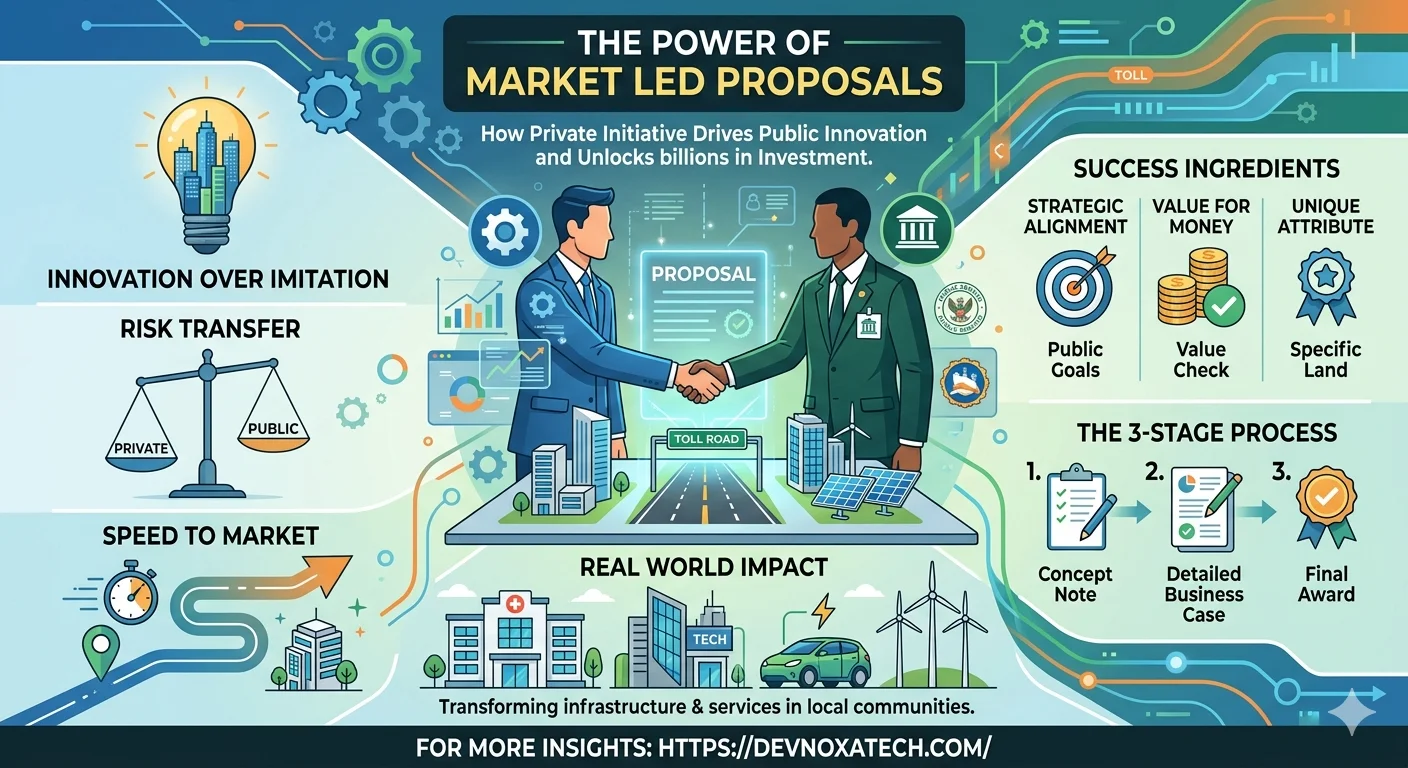

In the traditional world of public infrastructure and service delivery, the government usually identifies a problem, designs a solution, and then asks the private sector to bid on it. This process is functional, but it often misses out on the raw creativity and specialized expertise that private companies hold. Market Led Proposals (MLPs)—sometimes called unsolicited proposals—flip this script. Instead of waiting for a government tender, a private entity approaches the government with a unique idea, a specific piece of land, or a proprietary technology to solve a public need.
At its core, an MLP is a partnership built on initiative. It is a bridge between the commercial drive for innovation and the public sector’s responsibility to improve community life. When done correctly, these proposals can unlock billions in investment and deliver projects that the government might not have even realized were possible.
Why Governments Are Listening
Public budgets are rarely bottomless. In an era of rapid urbanization and aging infrastructure, governments often find themselves in a “priority bottleneck,” where they have more problems to solve than they have the staff or funds to manage. This is where the private sector steps in.
Market Led Proposals offer three distinct advantages:
- Innovation over Imitation: Private firms often have access to global research and development that government departments don’t. An MLP might introduce a carbon-neutral waste management system or a smart-transit solution that wasn’t on the official roadmap.
- Risk Transfer: In many MLPs, the private proponent takes on a significant portion of the financial and operational risk. If the project is based on a specific commercial opportunity, the private sector is often willing to put its own capital on the line to see it succeed.
- Speed to Market: Traditional procurement can take years of planning before a single shovel hits the ground. MLPs can bypass the “pre-planning” phase because the private sector has already done the heavy lifting of identifying the feasibility and the market demand.
The Core Ingredients of a Successful Proposal
Not every idea that lands on a minister’s desk is a winner. For a Market Led Proposal to move past the initial handshake, it generally needs to meet a high bar of “Uniqueness.” Governments are wary of appearing to give “handouts” or avoiding competition. Therefore, a successful MLP usually possesses:
1. Strategic Alignment
The project must actually solve a problem the government cares about. If a city is struggling with housing affordability, a proposal for a luxury golf course—no matter how well-funded—will likely be rejected. The proposal must align with long-term regional plans and public policy goals.
2. Value for Money
This is the ultimate litmus test. The government must be able to prove to taxpayers that this specific proposal provides better value than a standard competitive tender. This could be through lower costs, faster delivery, or the inclusion of private land that the government couldn’t otherwise access.
3. Unique Attribute
This is the “secret sauce.” Does the company own a specific patent? Do they own the land adjacent to a rail line? If any company could do the job, the government is legally and ethically obligated to put it out to a public tender. An MLP only survives if the proponent brings something to the table that nobody else can.
Navigating the Multi-Stage Process
Because MLPs skip the traditional bidding war, they are subjected to intense scrutiny. Most jurisdictions follow a rigorous three-stage assessment process to ensure transparency.
Stage One: The Concept Note
The private party submits a high-level summary. The government asks: “Is this interesting? Does it meet a need? Is it unique?” If the answer is yes, they move to a more formal discussion.
Stage Two: Detailed Business Case
This is where the real work happens. The proponent and the government work together (though often at the proponent’s expense) to develop a full business case. They look at environmental impacts, financial models, and social benefits. The government also performs “market testing” during this phase to ensure they aren’t being overcharged.
Stage Three: Final Negotiation and Award
If the business case holds water, the parties enter into a binding contract. At this stage, the government must be transparent about why they chose this route, often publishing a summary of the deal to maintain public trust.
The Challenges of the “Unsolicited” Path
While the benefits are clear, MLPs are not without their critics. The biggest hurdle is the perception of corruption or favoritism. When a project is awarded without a public auction, there is an inherent risk of the public feeling that “backdoor deals” are being made.
To combat this, modern MLP frameworks include “Swiss Challenge” mechanisms. If a company submits a great proposal, the government might publish the details and ask if anyone can beat it. If another company submits a better offer, the original proponent usually has the right to match it. This keeps the process competitive while still rewarding the original innovator for their idea.
Another challenge is capacity. Government departments are set up to manage tenders, not to react to incoming pitches. Evaluating a complex, multi-billion-dollar proposal requires a level of commercial expertise that some public sectors lack, often requiring them to hire external consultants to verify the private sector’s claims.
Real World Impact
We see the results of Market Led Proposals in our daily lives more than we realize. Many major toll roads, tech hubs, and renewable energy parks started as a sketch in a private boardroom rather than a government white paper.
For example, a developer might realize that a derelict piece of government land sitting next to a train station is the perfect spot for a mixed-use community hub. By proposing to build the station infrastructure in exchange for the rights to develop the air space above it, the developer creates a win-win: the government gets a modern station at a discount, and the developer gets a prime location.
The Future of Infrastructure
As we move toward 2030, the nature of MLPs is shifting toward sustainability and digital integration. We are seeing more proposals centered around “Data as Infrastructure,” where companies offer to manage city traffic flows using AI in exchange for data insights. We are also seeing a rise in “Social MLPs,” where non-profits propose innovative ways to manage social housing or healthcare delivery.
The move away from “government-knows-best” toward a collaborative model is essential. The challenges of the modern world—climate change, digital transformation, and population growth—are too complex for any one sector to solve in isolation. Market Led Proposals represent a formal recognition that some of the best solutions for the public good come from the private imagination.
Conclusion
Market Led Proposals are more than just a procurement trick; they are a mindset shift. They encourage private companies to stop being mere contractors and start being partners in nation-building. While they require a high degree of transparency and a rigorous “uniqueness” test to stay ethical, their ability to catalyze innovation is unmatched.
When the public and private sectors stop sitting on opposite sides of a rigid bidding fence and start sitting at the same table to solve problems, the entire community wins. The MLP framework ensures that great ideas don’t get lost in bureaucracy, but instead, get built. devnoxa tech