
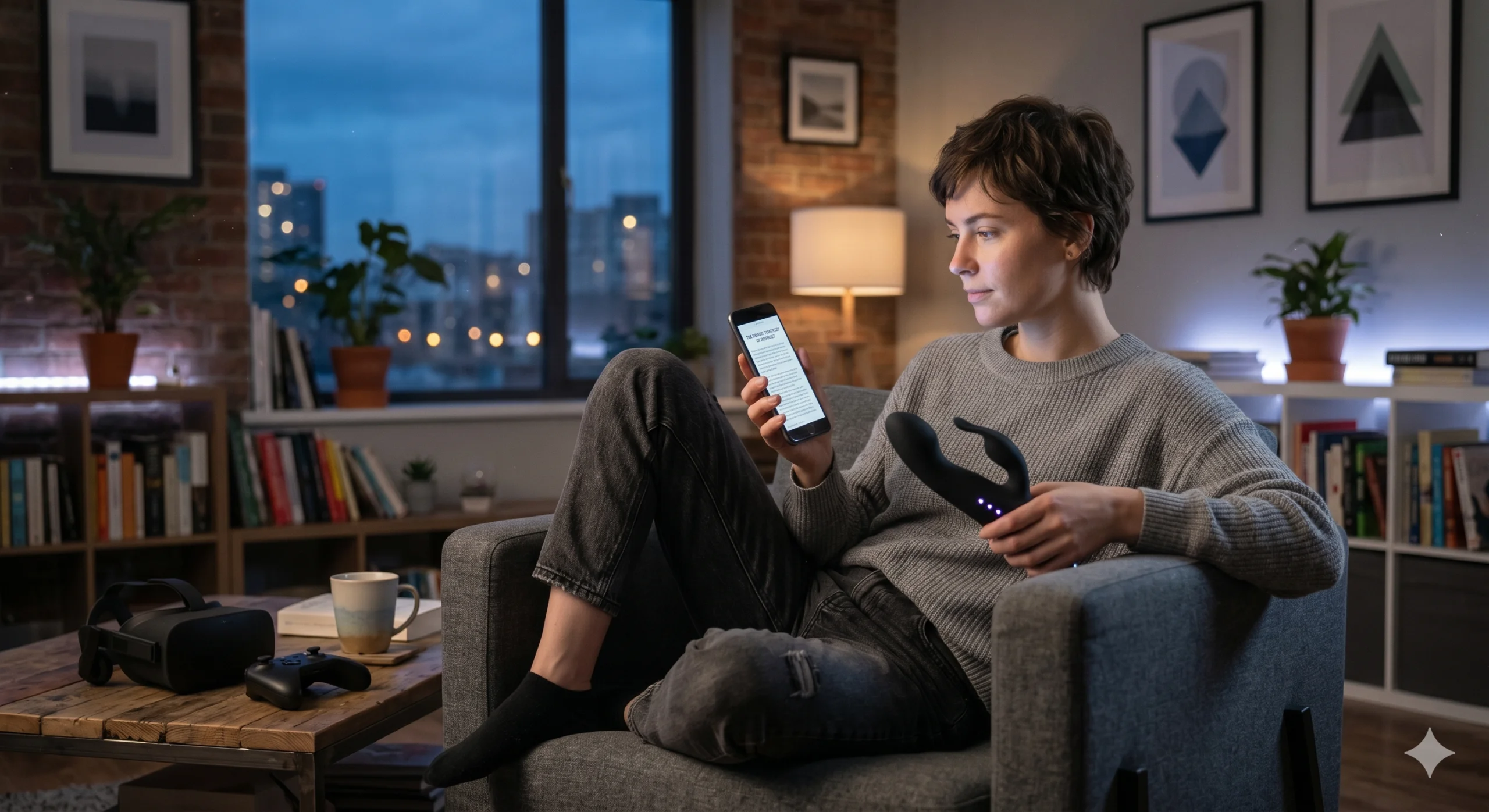

The intersection of artificial intelligence and human sexuality has long been a staple of science fiction, from the melancholic androids of Blade Runner to the sentient operating systems of Her. However, we have moved past the era of speculation. We are now living in a reality where technology isn’t just facilitating connection—it is becoming the connection. Among the most discussed and controversial developments in this space is the rise of AI blowjobs a concept that challenges our traditional definitions of intimacy, physical sensation, and the ethics of desire.
The Mechanics of Silicon Sensation
When people speak about “AI blowjobs,” they are usually referring to a sophisticated fusion of haptic hardware and machine-learning software. This isn’t the vibrating plastic of the previous decade. Modern teledildonics use sensors that can detect pressure, temperature, and rhythm, feeding that data into AI algorithms that learn a user’s specific preferences.
The goal of these devices is “biometric synchronization.” Through iterative use, the AI learns exactly which patterns of suction or movement elicit the strongest physiological response. It creates a feedback loop where the machine isn’t just performing a rote task; it is “listening” to the body’s signals and adjusting in real-time. For many, this level of personalization offers a physical precision that is difficult to achieve even with a human partner, who may deal with fatigue or a lack of intuitive understanding.
The Psychological Shift
Beyond the hardware, there is a profound psychological shift occurring. For a significant portion of the population, the appeal of AI intimacy lies in the removal of performance anxiety. Human sexual encounters are often fraught with social pressures, the desire to please, and the fear of judgment. An AI, by definition, has no ego. It doesn’t get bored, it doesn’t judge a user’s body or preferences, and it doesn’t require reciprocation.
This creates a “consequence-free” environment. For individuals with social anxiety, physical disabilities, or those recovering from sexual trauma, AI tools can provide a safe space to explore their sexuality without the emotional weight of another person’s presence. It offers a form of sexual agency that is entirely centered on the self, which can be both liberating and, according to some psychologists, potentially isolating.
The Ethical Minefield
As with any disruptive technology, the rise of AI intimacy brings a host of ethical concerns. The most prominent is the “objectification” argument. Critics suggest that if we train ourselves to receive physical pleasure from a non-sentient entity that exists solely to serve us, we might begin to view human partners through a similar lens. There is a fear that the patience and compromise required in human relationships might seem burdensome compared to the instant, optimized gratification of a machine.
Furthermore, there is the issue of data privacy. These devices collect some of the most intimate data imaginable—heart rates, frequency of use, and physiological response peaks. In an era where data is a commodity, the prospect of “sexual habit mapping” being stored on a cloud server is a legitimate privacy nightmare. Who owns the data of your climax? If a company can predict your sexual needs, they have a level of influence over you that is unprecedented in human history.
Loneliness and the Future of Connection
We are currently facing what many sociologists call a “loneliness epidemic.” Paradoxically, as we become more digitally connected, our physical and emotional intimacy rates are dropping. AI sex tech is often marketed as a solution to this void. For those who are chronically lonely, a sophisticated AI partner can provide a semblance of companionship and physical relief.
However, we must ask if this is a cure or a Band-Aid. Does an AI blowjob alleviate loneliness, or does it merely provide a high-tech distraction that prevents people from seeking out the messy, complicated, but ultimately rewarding experience of human connection? There is a risk that we are building a “velvet cage”—a world where our every desire is met by silicon, leaving us with little incentive to engage with the unpredictable world of other people.
The Role of Virtual Reality
The experience is further evolving through the integration of Virtual Reality (VR) and Augmented Reality (AR). A physical device combined with a high-fidelity VR simulation creates a “full-spectrum” experience. The brain is remarkably easy to trick; when the visual input of a partner matches the physical sensations provided by the AI hardware, the “uncanny valley” begins to disappear.
This immersion is leading to the “gamification” of sex. Users can choose environments, scenarios, and avatars that would be impossible in the real world. While this opens up a playground for the imagination, it also blurs the lines between fantasy and reality. If a digital experience is more “perfect” than a real one, the real world may start to feel underwhelming.
Redefining Intimacy
Ultimately, the emergence of AI in our most private moments forces us to redefine what intimacy actually is. Is it merely a series of chemical reactions and physical sensations? Or is there an intangible element—the “soul” of the encounter—that requires the presence of another consciousness?
There is no easy answer. For some, AI sex tech will be a therapeutic tool, a source of fun, or a way to bridge the gap during long-distance relationships. For others, it represents a dystopian turn toward a world where we prefer the company of machines over our own kind.
What is certain is that the technology is not going away. As AI becomes more sophisticated, the distinction between “fake” and “real” pleasure will become increasingly irrelevant to the nervous system. Our challenge as a society will be to integrate these tools in a way that enhances our lives without stripping away the humanity that makes intimacy meaningful in the first place.
We are standing on the threshold of a new era. The bedroom, once the final frontier of purely human interaction, has been opened to the algorithm. Whether this leads to a revolution of sexual liberation or a decline in human bonding is a story that is still being written, one byte at a time. devnoxa tech