

Not too long ago ,ai in marketing was a game of educated guesses. Creative teams would huddle in boardrooms, draft campaigns based on broad demographic data, launch them into the world, and cross their fingers. Success was measured in hindsight, often weeks or months after the budget had been spent.
Today, that approach feels like ancient history. The rise of Artificial Intelligence (AI) has transformed marketing from a subjective art form into a predictive, data-driven science. AI isn’t just a tool for automation; it is an intelligent collaborator capable of analyzing billions of data points in real time, predicting consumer behavior, and crafting hyper-personalized experiences at a scale that was previously unimaginable.
For brands looking to survive in a crowded digital landscape, understanding and embracing AI is no longer optional. It is the definitive engine driving modern business growth.
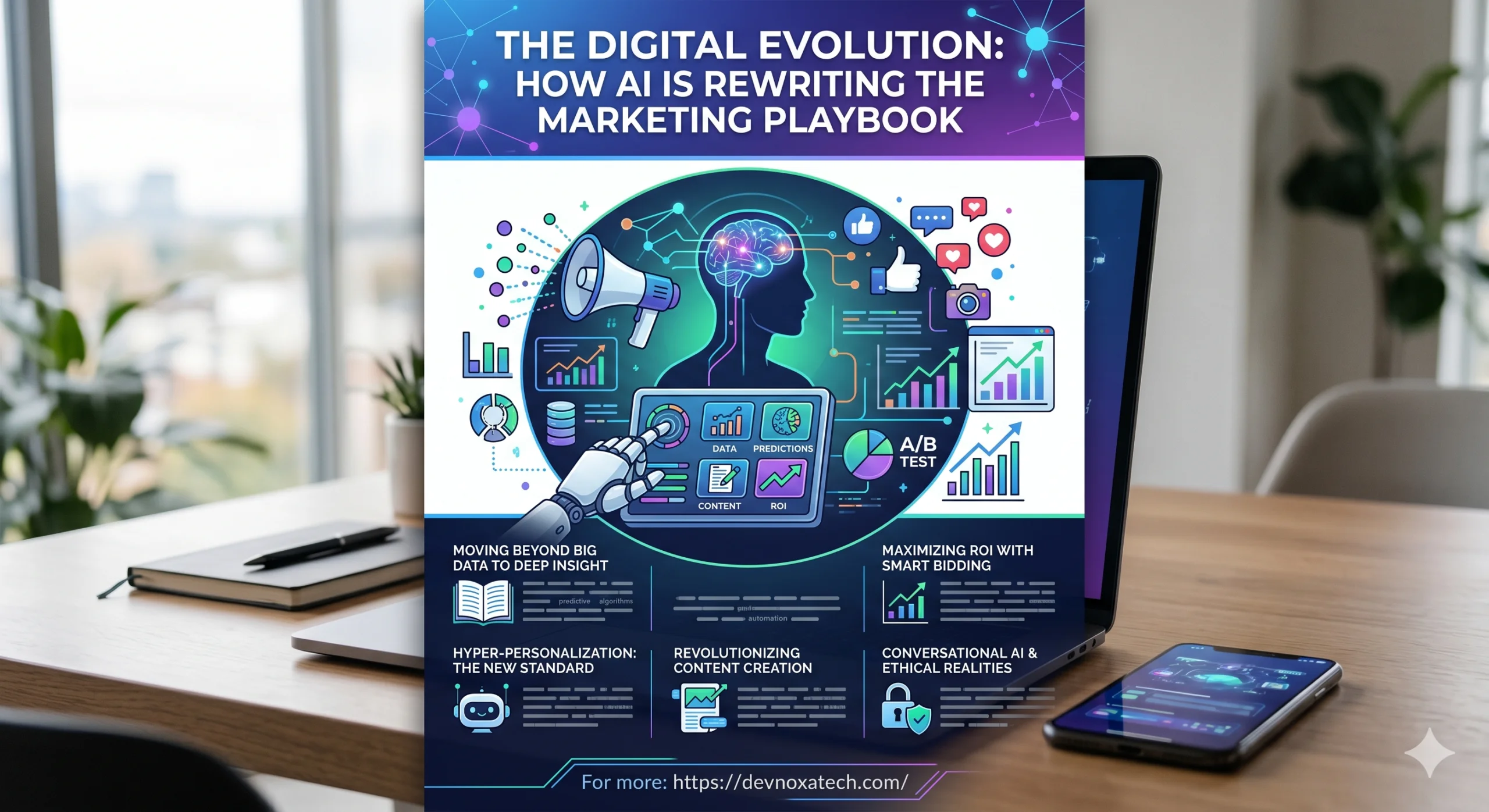
Moving Beyond Big Data to Deep Insight
We live in an era of data saturation. Every click, scroll, purchase, and social media like leaves a digital footprint. However, raw data is useless without interpretation. Humans simply do not have the cognitive bandwidth to process the sheer volume of information generated by modern consumers.
This is where AI steps in. Through machine learning algorithms, AI can sift through massive, unstructured datasets to identify patterns, anomalies, and trends. Instead of looking at generic buckets—like “women aged 25 to 34″—AI allows marketers to understand the micro-behaviors of individual users.
By analyzing past purchase history, browsing habits, and even the time of day a user is most active, AI builds dynamic consumer profiles. This deep insight shifts the marketing paradigm from reactive to proactive. Marketers no longer have to wait for a trend to emerge; they can anticipate what consumers will want next.
Hyper-Personalization: The New Standard
Consumers no longer just prefer personalization; they demand it. A generic email blast or a one-size-fits-all advertisement is quickly dismissed as digital noise. AI has elevated personalization from simply inserting a customer’s first name into an email subject line to delivering entirely tailored digital experiences.
Predictive engines analyze a user’s current intent and historical data to serve up exact product recommendations, personalized website layouts, and targeted promotions. Streaming giants and e-commerce leaders have mastered this, using proprietary algorithms to keep users engaged by predicting exactly what movie they want to watch or what item they are likely to buy next.
When a brand can meet a consumer at their exact point of need with a relevant solution, conversion rates skyrocket. AI makes every customer feel like the brand is speaking directly to them, fostering deeper loyalty and trust.
Revolutionizing Content Creation and Copywriting
The creative side of marketing is undergoing a massive shift thanks to generative AI. While the human touch remains irreplaceable for strategic branding and emotional resonance, AI tools have become invaluable assets for scaling content production.
Generative AI can draft social media copy, generate blog outlines, write email variations, and even create digital artwork in seconds. This allows creative teams to bypass the dreaded blank-page syndrome and move straight into editing, refining, and polishing.
Furthermore, AI can optimize content for search engines (SEO) by analyzing keyword density, readability, and search intent in real time. It can run multivariate A/B testing on ad copy simultaneously, instantly identifying which phrasing, tone, or call-to-action yields the highest engagement. By handling the heavy lifting of content generation, AI frees up human creators to focus on high-level strategy and storytelling.
Revolutionizing Customer Service with Conversational AI
Customer experience is a vital pillar of modern marketing. If a consumer encounters friction or can’t get their questions answered quickly, they will take their business elsewhere.
Conversational AI, driven by advanced Natural Language Processing (NLP), has turned traditional customer service upside down. The rigid, frustrating chatbots of the past have been replaced by intelligent virtual assistants capable of understanding context, sentiment, and nuance.
These AI assistants operate 24/7, providing instant responses to customer inquiries, guiding users through product selections, and resolving issues without human intervention. When a query is too complex, the AI seamlessly hands the conversation over to a human agent, along with a summary of the interaction. This ensures that customers receive immediate support, reducing friction in the buyer’s journey and significantly boosting brand satisfaction.
Maximizing ROI with Smart Predictive Ad Bidding
Digital advertising can be an incredibly expensive guessing game if it is not optimized. AI has brought unprecedented efficiency to paid media through programmatic advertising and predictive bidding.
AI algorithms can analyze ad performance across multiple platforms—such as Google, Meta, and LinkedIn—in milliseconds. They automatically adjust bidding strategies, reallocate budgets to the highest-performing campaigns, and pause underperforming ads.
By identifying which audiences are converting at the lowest cost, AI ensures that every dollar of a marketing budget is spent effectively. This level of real-time optimization is impossible for human media buyers to replicate manually, resulting in significantly higher return on investment (ROI) and lower customer acquisition costs.
Navigating the Ethical Realities of AI
While the benefits of AI in marketing are undeniable, businesses must navigate this new frontier with a strong sense of responsibility. The reliance on massive amounts of consumer data raises valid concerns regarding privacy, data security, and ethical usage.
Marketers must ensure strict compliance with global data protection regulations and maintain transparent policies about how consumer data is collected and utilized. Furthermore, there is the risk of algorithmic bias, where AI models might inadvertently perpetuate stereotypes based on historical data.
Brands that prioritize ethical AI practices, data transparency, and consumer privacy will earn long-term trust, while those that misuse data risk severe reputational damage. The goal should always be to use AI to enhance the consumer experience, not to exploit it.
The Symbiosis of Human Creativity and Machine Intelligence
The rapid rise of AI has naturally sparked fears that machines will completely replace human marketers. However, the future of marketing does not belong to AI alone; it belongs to the marketers who know how to collaborate with AI.
AI excels at processing data, recognizing patterns, automating repetitive tasks, and optimizing workflows at incredible speeds. What it lacks is empathy, emotional intelligence, cultural nuance, and the capability for true abstract thought—qualities that are fundamentally human.
The most successful marketing campaigns of the future will be born from a symbiosis of both worlds. AI provides the empirical foundation and analytical horsepower, while human marketers provide the strategic vision, creative spark, and ethical oversight. By offloading routine data analysis and administrative tasks to intelligent systems, marketers can spend more time doing what they do best: connecting with people on a human level.
To explore how advanced digital solutions can transform your business strategy and elevate your brand, visit devnoxa tech