
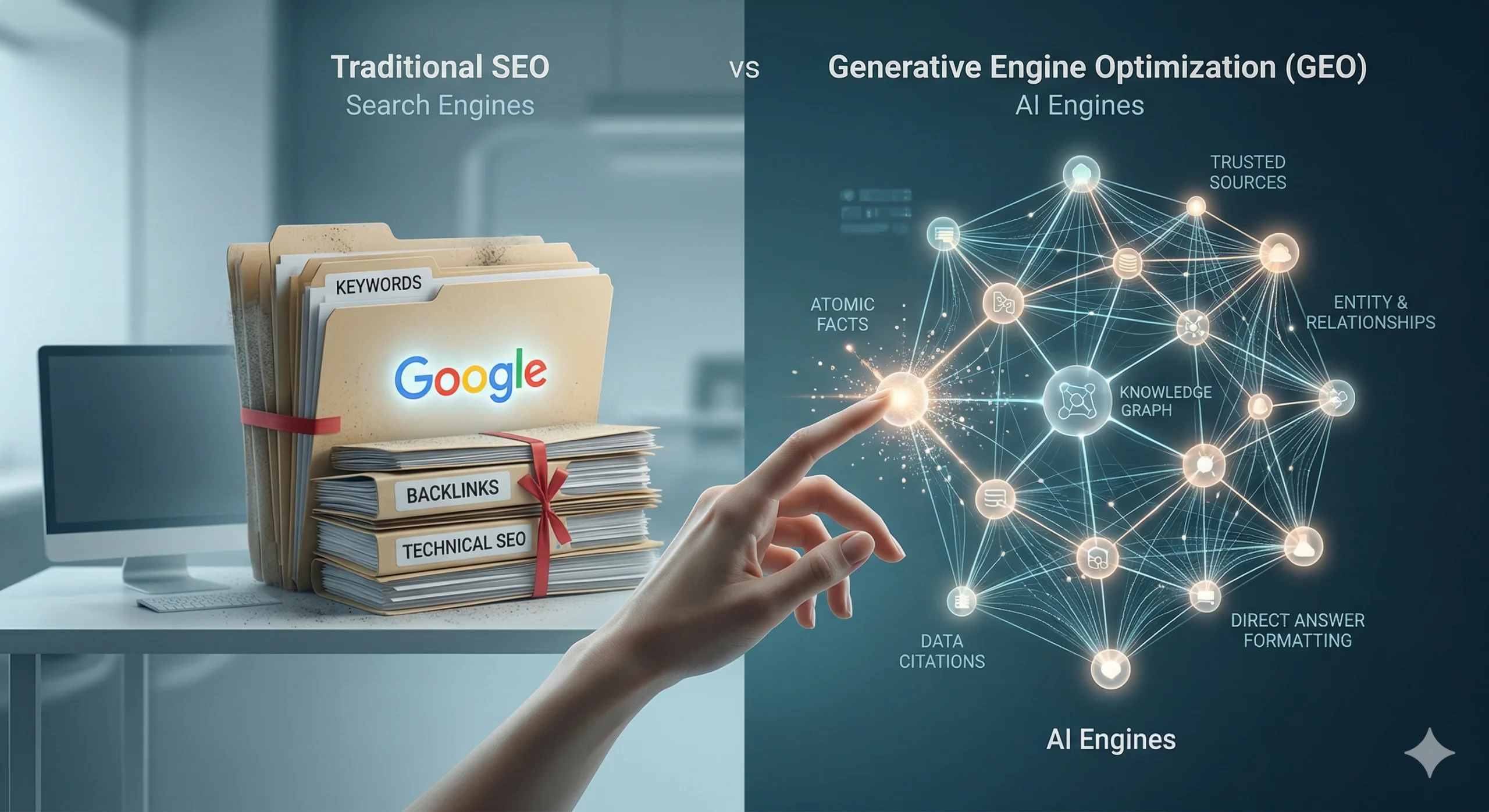

For over two decades, the recipe for digital visibility was simple, if not always easy: keywords, backlinks, and technical SEO. You optimized for a search engine that provided a list of options. But in 2026, the game has fundamentally changed. We aren’t just optimizing for search engines anymore; we are optimizing for Generative Engines.
If you’ve noticed your organic traffic dipping while your brand mentions in AI summaries are rising, you’ve felt the shift. This is the era of Generative Engine Optimization (GEO), and it’s rewriting the playbook for every website on the planet.
What is GEO? (And Why Your Current SEO Isn’t Enough)
Generative Engine Optimization is the process of making your content “consumable” and “citeable” by AI models like Gemini, GPT-5, and Perplexity. Traditional SEO was about ranking #1. GEO is about being the source that the AI uses to construct its answer.
In the old world, a user might click three different sites to compare the “best CRM for startups.” Today, the AI reads those three sites (and fifty others) and provides a synthesized paragraph. If your site isn’t structured to be part of that synthesis, you don’t just lose the click—you lose the existence.
The New Ranking Factors: Trust, Stats, and “Atomic Facts”
In 2026, the AI doesn’t just look for keywords; it looks for entities and evidence. To rank in a generative response, your content needs to move beyond generic fluff. Here are the three pillars of a successful GEO strategy:
1. The Power of “Atomic Facts” AI models prefer content that is broken down into clear, indisputable statements. Instead of writing long, flowing paragraphs, modern high-ranking articles use “Atomic Facts”—sentences that stand alone as a piece of information. This makes it easier for an LLM (Large Language Model) to extract your data and credit you as the source.
2. Credible Citations and Unique Data AI models are increasingly wary of “hallucinations.” They prioritize sources that include original data, specific statistics, and expert quotes. If you cite a study, don’t just link to it—summarize the key finding in a way that the AI can easily lift. Original research is now the most powerful “backlink” you can have.
3. Direct-Answer Formatting The “Inverted Pyramid” style of journalism has made a massive comeback. You must answer the user’s primary question in the very first paragraph. Generative engines scan the beginning of sections to find the “direct hit.” If you make the AI work too hard to find the answer, it will simply move on to a competitor’s site that gets straight to the point.
Navigating the “Zero-Click” Reality
The elephant in the room is the “Zero-Click” search. If the AI answers the question, why would the user click through to devnoxatech.com?
The secret lies in Experience-Based Content (E-E-A-T). An AI can summarize a technical spec sheet, but it cannot replicate a human’s experience of using that technology in a high-stakes environment. To drive clicks in 2026, your content must offer what the AI cannot: a perspective, a case study, or a “lesson learned” from the front lines of tech.
We are moving away from providing information and toward providing insight. Information is a commodity; insight is a destination.
Technical Requirements for the GEO Era
While the tone of your content must be human, the skeleton must be machine-readable. Schema markup has transitioned from “nice to have” to “mandatory.”
Using Organization Schema, FAQ Schema, and Article Schema tells the generative engine exactly who you are and what you’re saying. It’s the difference between a person reading a book and a person having a conversation with the author. Schema allows the AI to “talk” to your data.
The Survival of the Most Cited
In this new landscape, the goal is no longer just to be “visible”—it is to be “authoritative.” AI engines have a “Share of Model” (SoM). This is the percentage of time a specific brand or website is cited in responses related to a particular topic.
Monitoring your SoM is the new way to track brand health. If the AI is talking about “Top Tech Innovations” and isn’t mentioning your insights, your traditional SEO rankings won’t save you. You need to become an entity that the model trusts.
Conclusion: Embracing the Hybrid Future
The transition from SEO to GEO isn’t an overnight revolution; it’s an evolution. Traditional search isn’t dead—people still use it for navigation and deep research—but the “discovery” phase of the internet now belongs to the machines.
By focusing on atomic facts, structured data, and high-value human insights, you can ensure that your site doesn’t just survive the AI shift but leads it. The future of search isn’t about being one of ten links; it’s about being the one answer that matters.
Stay Ahead of the Tech Curve
The digital landscape moves fast, and staying informed is your only competitive advantage. Whether you’re looking for the latest in SEO strategies, AI implementation, or technical deep dives, you need a hub that speaks the language of tomorrow.
The intersection of human creativity and technical precision is where the next great digital success stories will be written. Don’t just watch the future happen—build it.
For more technical insights and the latest in digital evolution, visit: https://devnoxatech.com