

The automotive world is undergoing its most significant transformation since the assembly line first rolled out. Electric vehicle technology has crossed the threshold from an expensive environmental alternative into a mainstream powerhouse. Today, the focus is no longer just about removing the tailpipe. It is about redefining how energy is stored, how cars think, and how vehicles integrate into our everyday homes and electrical grids. Understanding this shift requires a look at the massive engineering breakthroughs happening beneath the chassis and behind the dashboard.
Power Reimagined
The heart of any electric vehicle is its battery pack. For over a decade, traditional lithium-ion chemistry carried the industry forward. While effective, these liquid-electrolyte systems are reaching their physical limits in terms of energy density and weight. Enter the next era of energy storage, headlined by semi-solid and all-solid-state designs.
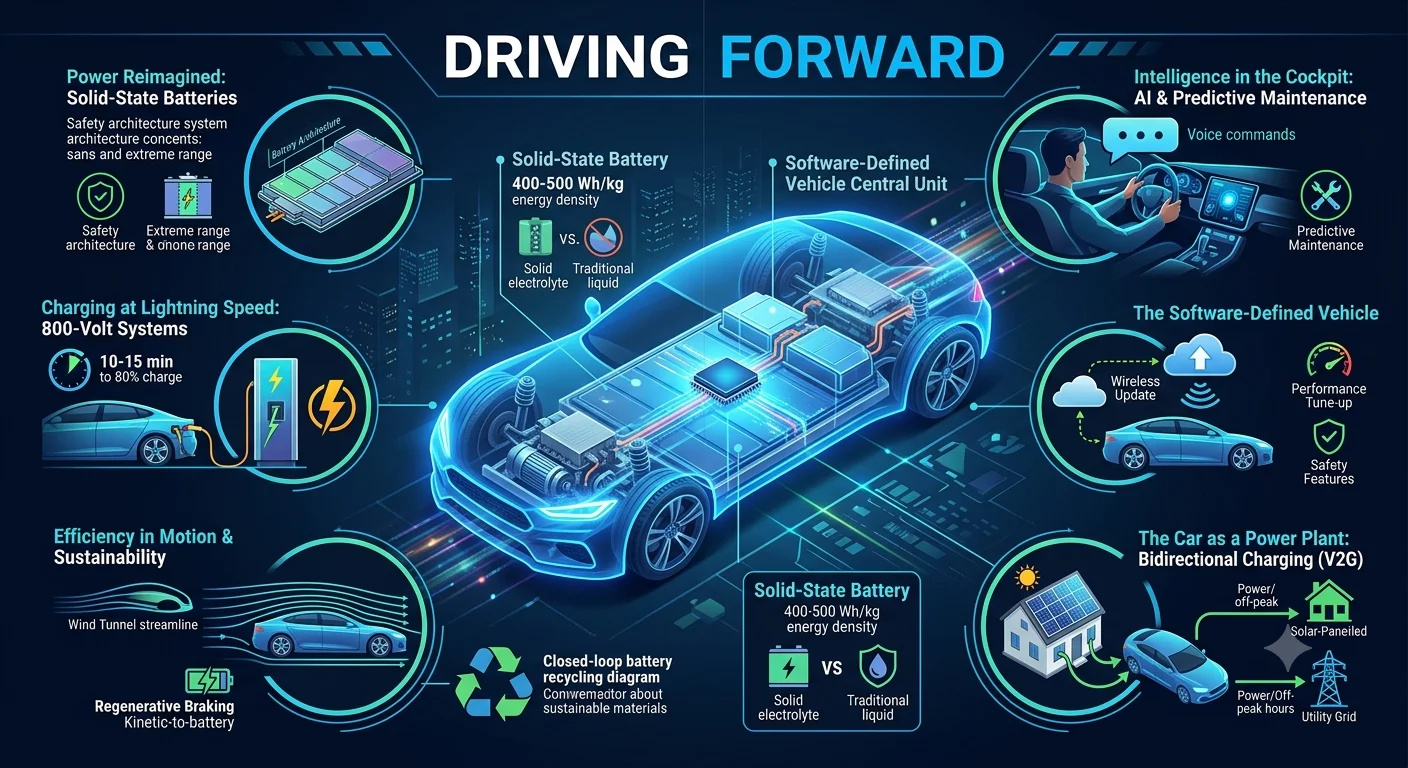
Solid-state technology replaces the flammable liquid electrolyte inside a battery with a solid material, such as ceramic or sulfide glass. By doing this, engineers can use lithium-metal anodes instead of standard graphite. The results are striking. This shift pushes energy densities toward 400 to 500 watt-hours per kilogram, which translates to passenger vehicles capable of traveling over 1000 kilometers on a single charge. Beyond pure range, removing the liquid elements practically eliminates the risk of thermal runaway and battery fires. This makes the next generation of cars fundamentally safer.
Charging at Lightning Speed
Range anxiety is quickly being replaced by charging anxiety, but technology is tackling this head-on. The industry is moving away from older 400-volt architectures to advanced 800-volt electrical systems. By doubling the voltage, vehicles can accept much higher charging currents without generating excessive heat.
For drivers, this means high-powered DC fast chargers can replenish up to 80% of a battery in just ten to fifteen minutes. Furthermore, thermal management systems have evolved. Modern cars use intelligent pre-conditioning, using software to heat or cool the battery to the exact optimal temperature while driving toward a charging station. This ensures that the moment the plug clicks into place, the vehicle absorbs energy at the maximum possible rate, even in freezing weather.
The Software Defined Vehicle
An electric vehicle is essentially a high-performance computer wrapped in steel and aluminum. The mechanical complexity of traditional internal combustion engines, which require thousands of moving parts, has been replaced by simpler electric motors and complex code. This has given rise to the software-defined vehicle.
In these modern machines, a centralized computing unit governs everything from braking regeneration to cabin climate. Instead of taking a car to a mechanic for a performance tune-up, manufacturers now deploy over-the-air software updates. These updates can wirelessly optimize motor efficiency, unlock faster charging profiles, tweak suspension settings, or introduce advanced driver-assistance features overnight. The car you drive home from the dealership actually improves over time.
Intelligence in the Cockpit
Inside the cabin, artificial intelligence has moved past basic voice commands to become a proactive co-pilot. Automakers are integrating domain-specific language models directly into the vehicle’s local edge-computing hardware. This allows the car to process voice requests and monitor driver awareness without relying on a slow cloud connection.
These systems learn driver habits. If you typically commute to work at a certain time, the car prepares the cabin temperature and calculates the most energy-efficient route based on real-time traffic and terrain elevations. It can predict maintenance needs before a component fails by analyzing subtle vibrations in the electric drivetrain. It can also balance your entertainment needs with strict energy management to ensure you reach your destination safely.
The Car as a Power Plant
One of the most revolutionary concepts taking hold is everything-to-grid energy tracking. Electric vehicles are no longer viewed as mere energy consumers. Because they spend a large portion of the day parked idle, their massive battery packs represent a highly distributed, underused energy storage network.
Through bidirectional charging technology, an electric vehicle can act as a mobile power plant for your home or the entire electrical grid. During peak evening hours when energy demand spikes and solar generation drops, a plugged-in vehicle can feed electricity back into your household or sell power back to the utility company. When demand plummets late at night, the car safely recharges at lower, off-peak rates. This bidirectional flow stabilizes the wider electrical grid and turns a personal vehicle into an active financial asset.
Efficiency in Motion
Getting the absolute most out of a battery pack requires extreme attention to aerodynamics and mechanical efficiency. Electric motors are inherently efficient, converting over 90% of their electrical energy into forward motion, compared to less than 40% for gas engines. However, pushing through the air still takes a toll.
Modern electric designs utilize flat floorboards, hidden door handles, and active aerodynamic flaps that close when cooling needs are low. This reduces drag significantly. Additionally, advanced regenerative braking systems have become incredibly precise. When a driver lifts their foot off the accelerator, the electric motor reverses direction, acting as a generator that slows the vehicle down while funneling that kinetic energy straight back into the battery pack. In heavy city traffic, this single-pedal driving style can recapture enough energy to extend a vehicle’s range by miles.
A Sustainable Horizon
As production scales globally, the focus is expanding beyond the tailpipe to encompass the entire lifecycle of the vehicle. Heavy investments are pouring into direct lithium extraction methods that bypass traditional, water-intensive evaporation ponds. This radically speeds up raw material sourcing while protecting local ecosystems. Simultaneously, closed-loop recycling facilities are opening around the world. These plants can dismantle old battery packs and recover over 95% of critical materials like cobalt, nickel, and lithium, ensuring that the clean energy transition does not rely entirely on continuous mining.
Electric vehicle technology is rewriting the rules of transportation. By combining breakthroughs in solid-state chemistry, high-voltage charging, artificial intelligence, and grid integration, the automotive industry is delivering vehicles that are cleaner, smarter, safer, and completely integrated into our digital lives. devnoxa tech