
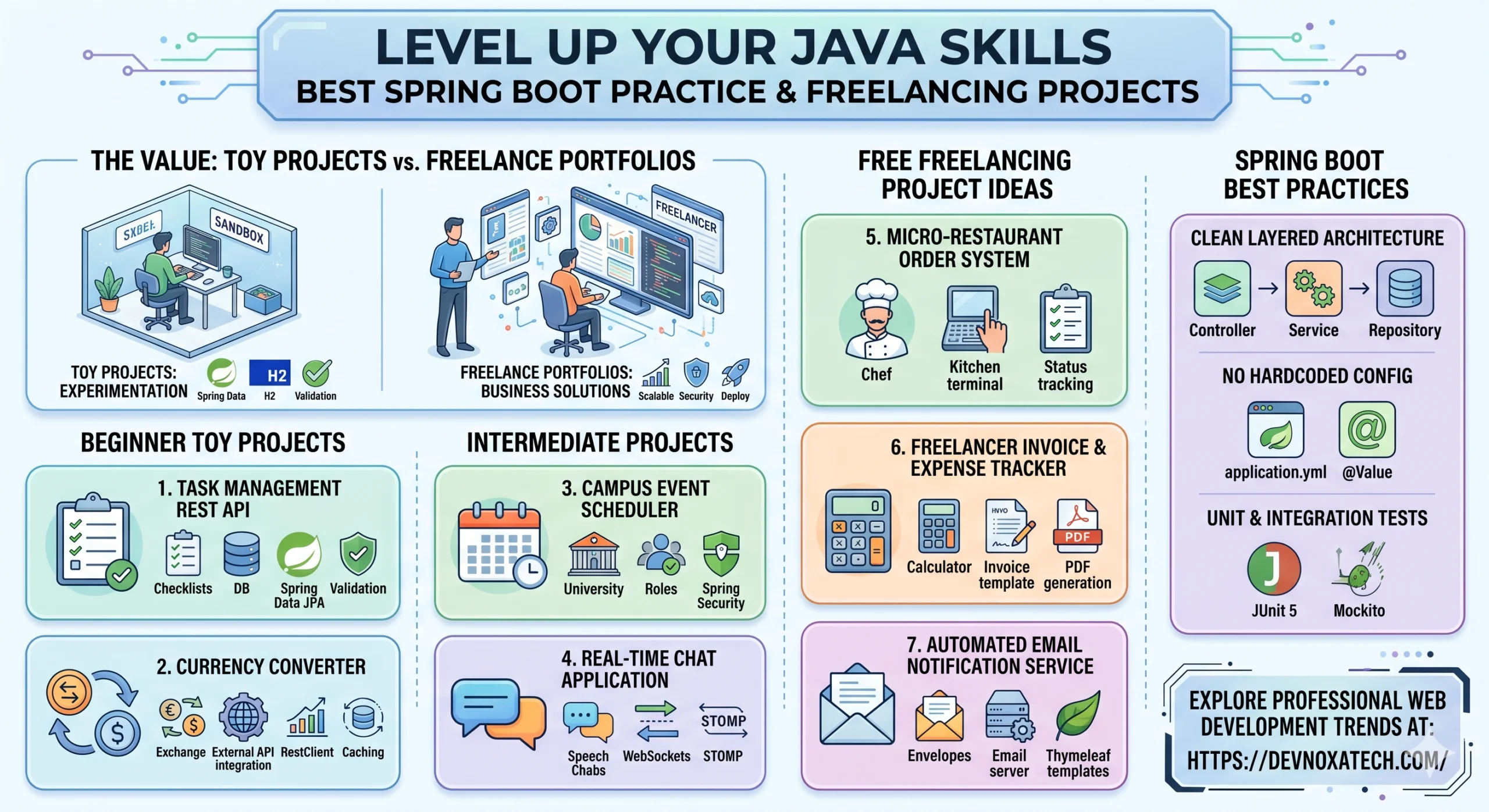

Mastering Spring Boot is one of the most valuable moves you can make as a Java developer. The framework dominates the enterprise world because it removes the boilerplate friction of standard Spring, allowing you to build production-ready applications fast. However, there is a massive gap between watching tutorials and writing code that actually survives in the wildTo bridge that gap, you need freelancing projects. Whether you are building “toy” applications to experiment with core concepts or looking for free project ideas to pitch to real clients as a freelancer, working on practical examples is the best way to sharpen your teeth.
The Value of Toy Projects vs. Freelance Portfolios
Before diving into the code, it is essential to understand the dual approach to learning Spring Boot.
Toy projects are your sandbox. They are intentionally small, hyper-focused applications designed to help you fail fast and learn specific tools. In a toy project, you do not worry about a flawless user interface or complex business logic. Instead, you focus on how Spring Security handles a specific token or how Spring Data JPA manages database relationships.
Freelancing projects are the exact opposite. They are solutions to real-world business problems. When building these, you must think about scalability, data validation, clean architecture, and deployment. These projects prove to potential clients that you do not just understand Java syntax, but you know how to build software that makes or saves them money.
Beginner Toy Projects for Core Concepts
If you are just getting started, skip the complex architectures and focus on the fundamentals of the Spring ecosystem.
Task Management REST API
A simple Todo app might sound cliché, but it is the ultimate rite of passage for backend developers. Instead of making it a simple memory-based application, connect it to an H2 in-memory database using Spring Data JPA.
Focus on creating proper REST endpoints for creating, reading, updating, and deleting tasks. Use Spring Boot Validation annotations like @NotNull and @Size to ensure incoming data is clean. This project teaches you the basics of HTTP methods, status codes, and how Spring maps JSON requests to Java objects.
Currency Converter with External API Integration
Modern backend development relies heavily on communicating with third-party services. Build a simple web application that takes an amount in one currency and converts it to another.
To achieve this, use Spring Boot RestClient or WebClient to fetch real-time exchange rates from a free public financial API. This project will introduce you to handling external API failures, parsing nested JSON responses, and using Spring @Scheduled tasks to cache daily exchange rates locally to save on API limits.
Intermediate Projects for Portfolio Building
Once you understand how to move data between a database and a client, it is time to tackle security, messaging, and more complex data modeling.
Campus Event Scheduler
Move away from in-memory data and connect your application to a standalone PostgreSQL or MySQL database. Build a platform where university students can view, create, and register for campus events.
Implement Spring Security with basic form-based login to separate roles between “Admins” (who can create events) and “Students” (who can only register). Focus deeply on database relationships here, specifically mapping the Many-to-Many relationship between students and the events they attend.
Real-Time Chat Application
Spring Boot is not just for traditional synchronous REST endpoints. Build a chat application that allows users to join public chat rooms and message each other instantly.
Use Spring Boot starter for WebSockets along with the STOMP protocol. This project will challenge your understanding of asynchronous communication and event handling within the Spring framework, which is a highly sought-after skill in enterprise environments.
Free Freelancing Project Ideas to Pitch to Clients
If you are ready to make money or build a portfolio that attracts high-paying clients, look for everyday business inefficiencies. Small businesses love automated, lightweight solutions.
Micro-Restaurant Order Management System
Many small, local restaurants cannot afford the steep commission fees of major food delivery apps. You can pitch a lightweight, internal order tracking system for their kitchen staff.
The backend should manage the restaurant menu, receive incoming orders from a basic frontend, and update the status of the order from “Pending” to “Cooking” to “Delivered.” Implement Spring Boot Actuator to monitor the health of the application and use a lightweight database like SQLite or MySQL. It is a highly practical, marketable product.
Freelancer Invoice and Expense Tracker
Small business owners and fellow freelancers constantly struggle to track their revenue, expenses, and pending client invoices. Build an application that automates this workflow.
The application should allow users to log expenses under categories and generate PDF invoices. You can integrate the OpenPDF or iText library into Spring Boot to dynamically generate downloadable invoice files from database records. To make it a premium portfolio piece, add a dashboard feature using Spring Data JPA aggregation queries to show monthly profit and loss metrics.
Automated Email Notification Service
Many startups have existing web platforms but lack a reliable, decoupled system to handle transactional emails like password resets, welcome messages, or weekly newsletters.
Build a specialized, standalone microservice using Spring Boot Email Starter. The service should expose a private REST endpoint that other applications can hit with a JSON payload containing the recipient, subject, and template type. Integrate it with a free SMTP server like Gmail or Mailtrap, and use Thymeleaf templates to generate beautifully styled HTML emails dynamically.
Best Practices for Spring Boot Development
To make your projects truly stand out to clients or senior developers reviewing your code, you must write idiomatic Spring Boot code.
Always implement a clean, layered architecture. Divide your code strictly into Controllers (handling HTTP requests), Services (holding the business logic), and Repositories (dealing with data access). Never let your controller talk directly to the database.
Furthermore, never hardcode configuration values like database passwords or external API keys inside your Java classes. Utilize the application.properties or application.yml files effectively, and use Spring @Value annotations or @ConfigurationProperties to inject those settings at runtime. This shows you understand production environment safety.
Finally, write unit tests. A project without tests tells a client that the code is fragile. Use Spring Boot Starter Test, which comes packed with JUnit 5 and Mockito, to test your service layer logic and verify that your endpoints return the expected status codes.
Conclusion
The secret to mastering Spring Boot is continuous iteration. Start with a tiny, ugly toy project that barely works, refine it, add security, optimize the database queries, and eventually transform it into a robust application worthy of a freelancer portfolio. By focusing on solving real business problems through code, you build tangible proof of your engineering capabilities.
If you want to explore more high-quality technical insights, industry web development trends, or professional software engineering strategies, visit devnoxa tech