

If 2024 was the year of the prompt and 2025 was the year of the assistant, then 2026 is officially the year of the Agent. We are witnessing a fundamental transformation in how we interact with technology. We are moving away from “AI as a sounding board” and toward “AI as a workforce.”
For businesses and tech enthusiasts, the phrase “Agentic AI” has become the gold standard for efficiency. But what exactly changed, and why is this the trend that will define the next decade of digital infrastructure?
The Core Difference: Reasoning vs. Response
Traditional generative AI—the kind we used to write emails or generate images—is reactive. You give it a prompt, and it gives you a response based on its training data. It’s a sophisticated mirror.
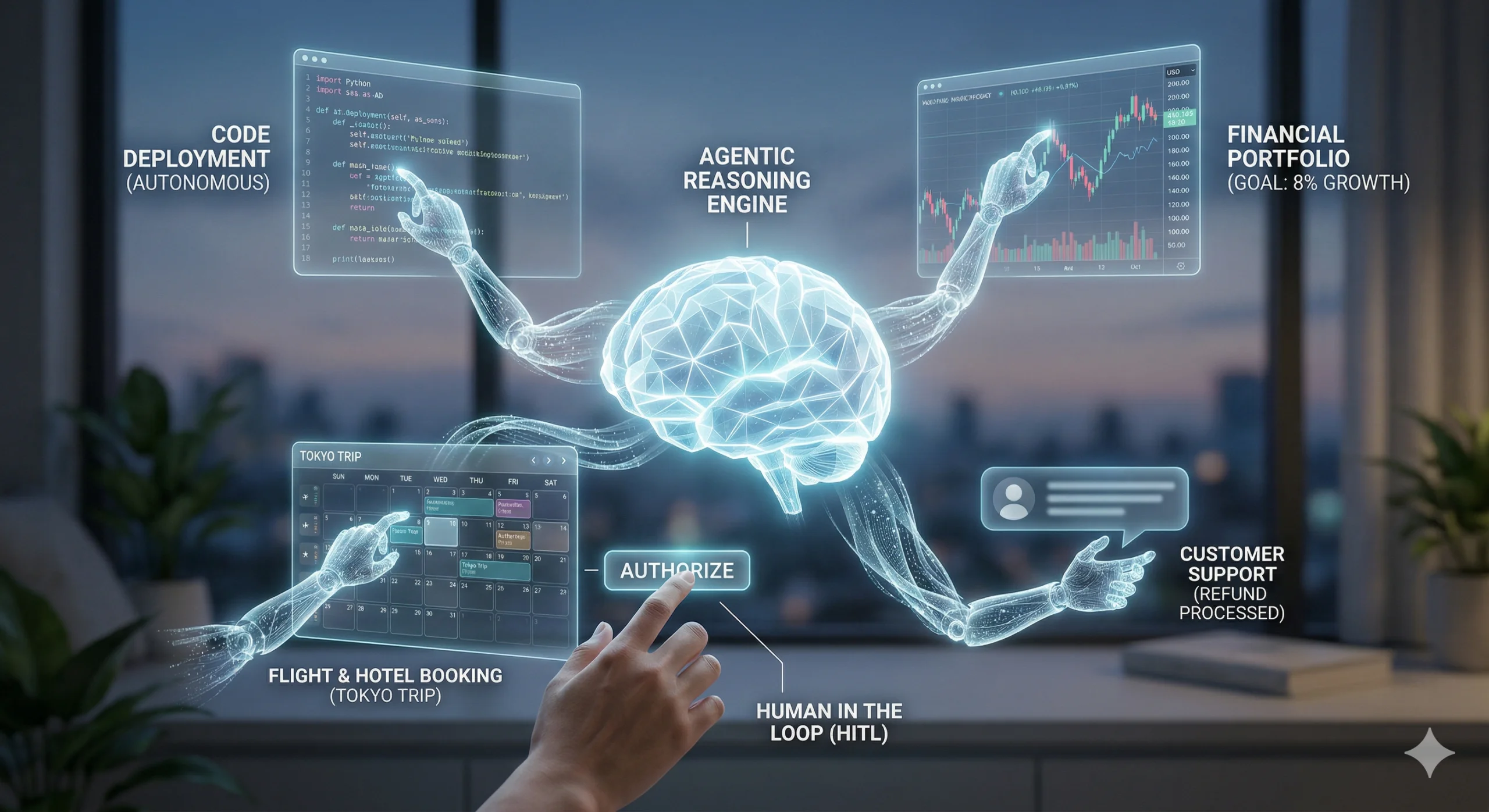
Agentic AI is proactive. Instead of just answering a question, an AI Agent is designed to achieve a goal. If you tell a traditional AI, “Plan a business trip to Tokyo,” it gives you an itinerary. If you tell an Agentic AI the same thing, it checks your calendar, negotiates with flight APIs, books the hotel within your corporate budget, and adds the meetings to your schedule—all without you clicking a single “Buy” button.
How Agentic AI Operates: The “Loop” Architecture
To understand why this is ranking as a top trend, we have to look at the architecture. Unlike a single-shot prompt, an Agent operates in a loop:
- Perception: It analyzes the environment and the task requirements.
- Reasoning: It breaks the complex goal into smaller, actionable sub-tasks.
- Action: It uses “tools” (software, APIs, or even other AI models) to execute those tasks.
- Observation: It checks the results of its actions and adjusts its plan in real-time.
The 2026 Use Cases: Real-World Impact
The reason “Agentic AI” is a high-volume search term right now is its practical application across industries:
- Software Development: “Agentic Coding” is no longer about generating snippets. Agents now manage entire repositories, identifying bugs, writing tests, and deploying patches autonomously while human developers act as high-level architects.
- Customer Operations: We’ve moved beyond “I’m sorry, I didn’t understand that.” Modern support agents have “agency” to process refunds, change shipping addresses, and troubleshoot technical issues by interacting directly with a company’s backend.
- Personal Productivity: “Hyper-Automation” is the new buzzword. Personal agents now manage our digital lives—filtering our noise, managing our finances, and even “ghostwriting” initial drafts based on our unique tone and past interactions.
The Challenges: Trust, Safety, and “The Human in the Loop”
With great agency comes great responsibility. The trending discussions in 2026 aren’t just about what Agents can do, but what they should do.
“Agentic Governance” is a massive sub-topic. How do we ensure an agent doesn’t spend $5,000 on a flight it “thought” was a good deal? The rise of Human-in-the-loop (HITL) systems is the answer. We are designing software where the AI does the legwork, but the human provides the “final click” authorization. This balance of autonomous action and human oversight is the sweet spot of 2026 tech strategy.
The SEO Angle: Why This Matters for Your Site
As an SEO-focused site like devnoxatech.com, covering Agentic AI is vital because search engines are now prioritizing Information Gain.
The web is flooded with AI-written fluff about “What is AI?” To rank in 2026, you must provide the “How-To.” Articles that explain how to build a ReAct (Reasoning and Acting) agent or how to implement Multi-Agent Systems (MAS) are seeing massive surges in traffic. The audience is no longer curious about the concept; they are hungry for the implementation.
Conclusion: Embracing the Autonomous Future
The shift to Agentic AI represents the “coming of age” of the digital era. We are no longer just using computers; we are collaborating with them. This isn’t just a trend—it’s a new layer of the global economy.
As we look toward the latter half of 2026, the companies that thrive won’t be the ones with the best prompts, but the ones with the most effective agents. The future isn’t just intelligent; it’s active.
Master the Next Wave of Tech
The transition from passive tools to active agents is happening faster than most anticipated. Staying ahead of this curve requires more than just following the news—it requires deep technical insight and a pulse on the evolving digital landscape.
Whether you’re looking to optimize your site’s technical structure for AI search or trying to understand the latest in autonomous software, having a reliable guide is essential. The future of technology is being built right now, one agent at a time.
Stay at the forefront of the autonomous revolution at: https://devnoxatech.com