

If you’re still staring at a spreadsheet of keywords with high search volume and low competition, I have some news for you: you’re optimizing for a version of the internet that no longer exists.
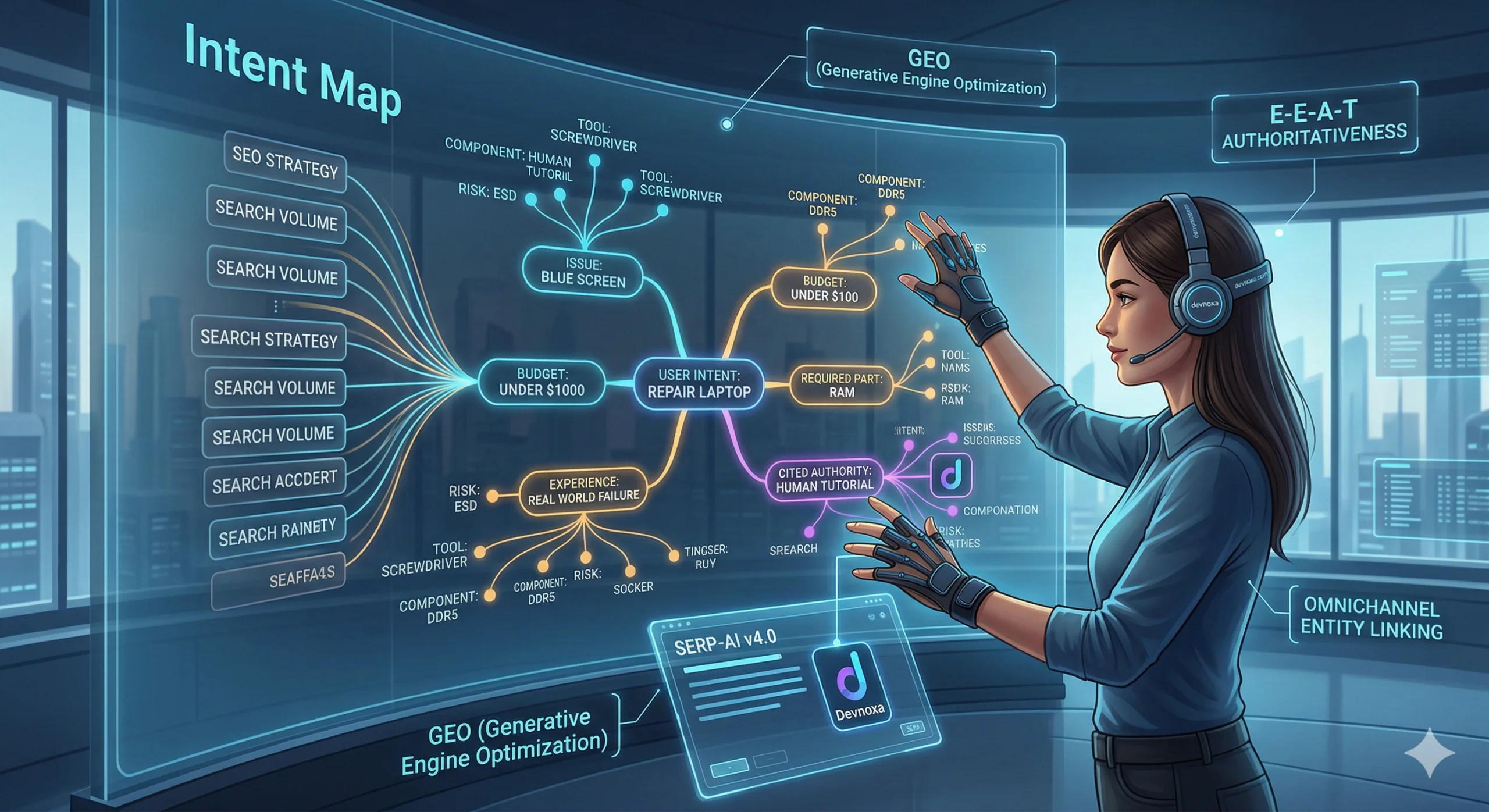
As of April 2026, the SEO landscape has undergone its most radical transformation since the invention of the backlink. We’ve moved past the era of “Search Engine Optimization” and entered the age of GEO—Generative Engine Optimization. With over a billion people now using AI-first search modes, the way we “rank” has changed from being #1 in a list of blue links to being the cited source in an AI’s answer.
Here is how you actually win the search game this year.
From Keywords to “Entities”
In 2026, search engines don’t just see words; they see Entities. An entity is a concept, a person, a place, or a thing that the AI understands in context.
For example, if you write about “best gaming laptops,” the AI isn’t just looking for that phrase. It’s looking for your relationship to entities like refresh rates, thermal throttling, GPU benchmarks, and real-world testing. If your content doesn’t demonstrate a deep “web of knowledge” around these entities, an AI assistant like Gemini or Search GPT will simply pass you over for a more authoritative source.
The 2026 Rule: Stop writing for the algorithm. Start writing to become a “Cited Authority.”
The “Zero-Click” Survival Guide
The trending concern for every site owner today is the rise of Zero-Click Searches. Why would a user click your link if the AI Overview gives them the answer right there on the results page?
The secret to ranking—and actually getting traffic—is to provide what AI cannot: Subjective Experience and Proprietary Data. AI is great at summarizing facts, but it’s terrible at describing the feeling of using a product or providing original research.
- Fact: “The iPhone 17 has a 48MP camera.” (AI handles this).
- Experience: “I took the iPhone 17 to a concert, and here is exactly why the zoom failed in low light.” (This is why they click your site).
Voice and Visual: The Silent Giants
In 2026, search is truly omnichannel. More users are asking their glasses or their cars for information than typing into a box. This means your content needs to be conversational. If your headers don’t sound like questions a real person would ask (e.g., “How do I fix my site’s speed?”), you’re missing out on the fastest-growing segment of traffic. Likewise, Visual SEO is back with a vengeance. AI models now “see” your images to understand your content. High-quality, original photography isn’t just for aesthetics anymore; it’s a ranking signal.
E-E-A-T is Your Only Shield
Google’s “Experience, Expertise, Authoritativeness, and Trustworthiness” guidelines are no longer suggestions—they are the filter. In a world flooded with generic AI content, the “E” for Experience is your most valuable asset.
If devnoxatech.com wants to dominate in 2026, every article needs to prove that a human actually did the work. Mention your specific testing process, show “behind the scenes” photos, and don’t be afraid to have a strong, even controversial, opinion. AI is programmed to be neutral; humans are allowed to be interesting.
The Bottom Line
Ranking in 2026 isn’t about gaming a system; it’s about providing the most helpful, most human answer to a specific problem. The tools have changed, but the goal remains the same: build trust, provide value, and be the expert the AI wants to quote.