
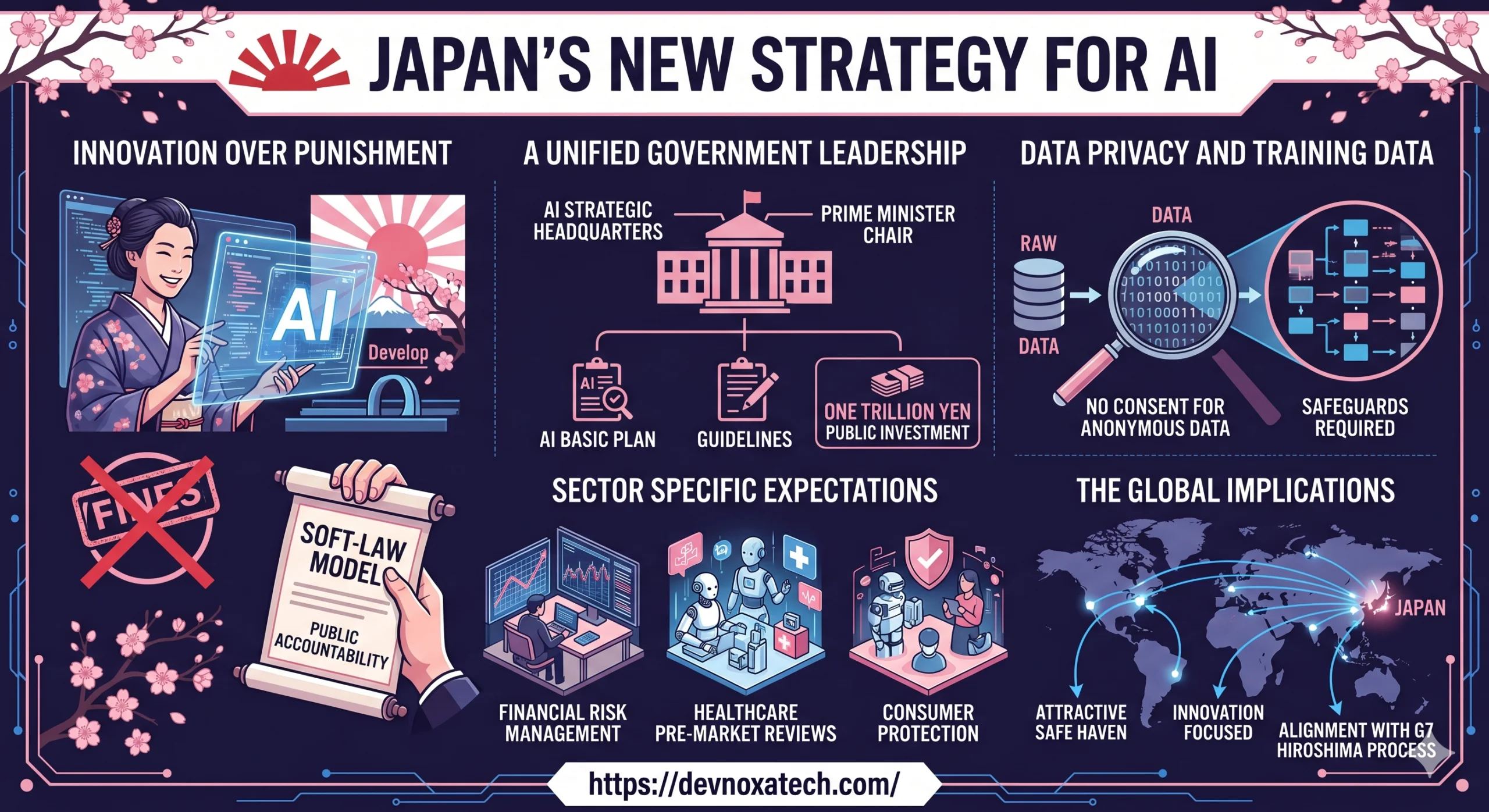

The global scramble to govern artificial intelligence has created a clear divide in regulatory philosophy. While some regions have built strict guardrails with heavy financial penalties, Japan is charting a completely different path. Tokyo has officially put into motion its first comprehensive legal framework for artificial intelligence, sending a clear message to the world: Japan AI Regulation News intends to become the most developer-friendly environment for advanced technology among major global economies.
By balancing innovation with safety, the country is rejecting rigid, punitive measures. Instead, it relies on high-level guidance, corporate responsibility, and strategic updates to its existing privacy laws. This approach offers a fascinating case study in agile governance, proving that it is possible to mitigate technological risk without stifling economic growth.
Innovation Over Punishment
At the heart of this regulatory shift is the newly enacted framework formally known as the Act on Promotion of Research and Development and Utilization of Artificial Intelligence-Related Technologies. Passed by the National Diet, the law has moved swiftly into full effect, creating an institutional foundation for the nation’s technological future.
The most striking feature of this legislation is what it lacks: direct monetary fines for non-compliance. While the European Union’s AI Act threatens companies with penalties scaling into tens of millions of euros, Japan’s law contains no financial punishments. Tokyo’s framework functions as a promotional baseline designed to pull international development, research talent, and capital into the domestic market.
Instead of heavy penalties, the government relies on a soft-law model. If an organization severely violates public trust or infringes upon citizen rights, authorities can investigate, issue guidance, or publicly disclose the organization’s name. This strategy leverages the immense weight of corporate reputation in Japanese business culture. It assumes that the threat of public accountability is enough to keep developers acting responsibly.
A Unified Government Leadership
To ensure that this voluntary system functions effectively, the framework establishes a powerful centralized body called the AI Strategic Headquarters. Chaired directly by the Prime Minister and featuring a cabinet-wide roster, this headquarters serves as the ultimate command center for national technology policy.
The structure is supported by the AI Strategy Promotion Council and an Expert Investigation Team composed of top academic minds. This ensures that tech regulation is handled through a whole-of-government approach rather than leaving individual ministries to fight over jurisdiction.
The AI Strategic Headquarters is tasked with rolling out the country’s official AI Basic Plan. This plan is backed by a massive five-year public investment commitment of one trillion yen, roughly over six billion dollars. The funding is intended to build digital infrastructure, secure computing power, and train a workforce capable of driving the next generation of automation.
To guide the private sector, the government released the Guidelines for Ensuring the Appropriateness of Research and Development and Utilization of AI-Related Technology. These guidelines instruct companies to implement a risk-based approach, actively involve stakeholders, and maintain continuous monitoring throughout the lifecycle of an AI system. Even though these rules are technically voluntary, compliance is highly encouraged. In fact, following these guidelines could serve as vital evidence of reasonable care under general civil tort law if an algorithmic system ever causes harm.
Data Privacy and Training Data
While the overarching AI framework avoids harsh penalties, Japan is not allowing a wild west environment for data harvesting. The soft-law model of the AI framework is balanced by significant changes to the Act on the Protection of Personal Information, which is the nation’s core data-privacy statute.
The Cabinet recently approved a major amendment bill that changes how data can be used to train complex models. Recognizing that obtaining explicit consent from millions of individuals for machine learning is practically impossible, the new rules offer a practical compromise.
Companies can now process personal data for statistical analysis and AI model training without individual consent, provided the data is rendered completely non-identifying. However, this exception comes with strict conditions. Businesses must implement documented safeguards, run thorough Data Protection Impact Assessments, and guarantee that no re-identification attempts will occur.
Furthermore, major digital platform operators face new transparency duties. They must disclose exactly how their recommendation algorithms utilize personal data and offer users straightforward ways to opt out. These privacy updates ensure that data collection remains ethical without putting an end to the data pipelines that modern machine learning relies on.
Sector Specific Expectations
Japan’s overarching policy is light and flexible, but individual industries are busy translating these high-level principles into mandatory expectations. The government recognizes that an automated tool used for retail recommendations does not carry the same risk as an automated tool used in healthcare or banking.
For instance, the Financial Services Agency has updated its official discussion papers to establish clear baselines for risk management and model explainability in financial institutions. In the medical field, healthcare tools remain subject to rigorous pre-market reviews under the Pharmaceutical and Medical Device Act.
At the same time, the Personal Information Protection Commission is exploring future reforms that could introduce administrative monetary penalties for severe data breaches by 2027. This reveals a highly coordinated strategy: keep the foundational AI law flexible and promotional, but use specialized agencies to protect consumers in high-risk areas.
The Global Implications
Japan’s current regulatory posture is less of a rigid compliance trap and more of a clear market signal. By aligning its core ethical principles with international standards like the G7 Hiroshima AI Process, Tokyo is demonstrating that it cares deeply about safety, transparency, and intellectual property protection. Yet, by choosing cooperation over heavy fines, it offers a refreshing alternative to Western regulatory models.
For international businesses and tech developers, Japan is successfully positioning itself as an incredibly attractive safe haven for deployment. Organizations must still catalogue their data assets, prioritize safety testing, and build clear governance frameworks to satisfy local expectations. However, they can innovate with the confidence that they will not face business-ending fines over minor bureaucratic missteps. As the global debate over technological control continues to intensify, Japan’s blend of flexible design and economic ambition may very well become the definitive global playbook for responsible innovation.
To explore how advanced engineering and strategic technological integration can transform your business workflows under modern global standards, visit devnoxa tech