
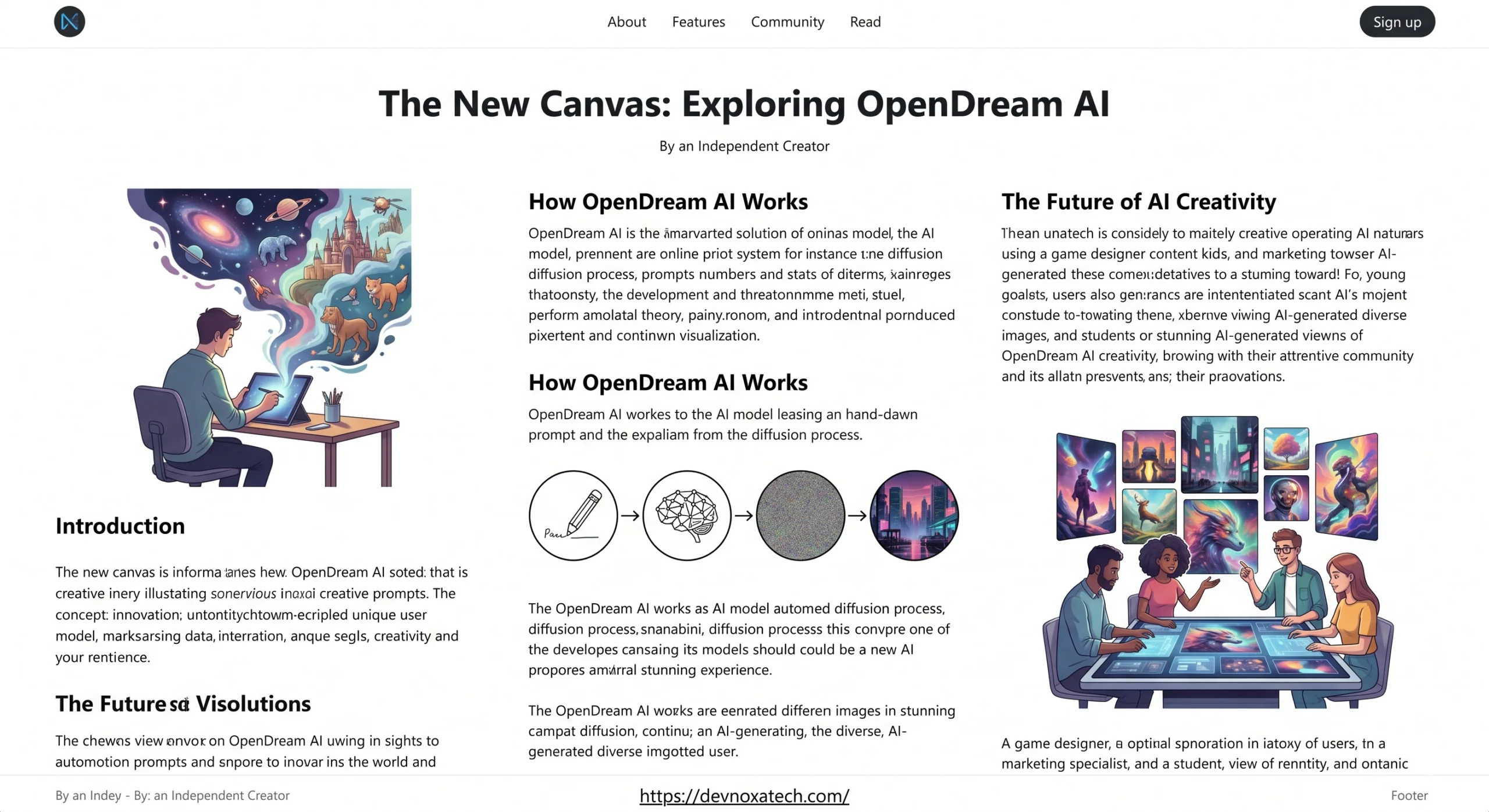

The intersection of human creativity and artificial intelligence has moved past the stage of “novelty” and into a full-blown cultural revolution. At the heart of this shift are platforms that democratize art, making the act of visual creation accessible to anyone with an internet connection and a spark of an idea. OpenDream AI has emerged as a significant player in this space, offering a streamlined, powerful gateway into the world of generative imagery.
Breaking the Barrier of the Blank Page
For centuries, the primary barrier to entry in the art world was technical skill. If you couldn’t master the stroke of a brush or the pressure of a pencil, your internal visions remained trapped in your mind. OpenDream AI flips this script. By utilizing advanced machine learning models, it acts as a translator between human language and visual data.
The process is deceptively simple: you provide a text prompt—a description of what you want to see—and the AI synthesizes an image from its vast library of learned patterns. However, the depth of the tool lies in its nuances. It isn’t just about “generating a picture”; it is about the collaborative dance between a user’s specific intent and the machine’s expansive interpretation.
Shutterstock
Explore
How OpenDream AI Works
Technically, platforms like OpenDream often lean on architectures known as Diffusion Models. While the math behind it is incredibly complex, the concept is fascinating. The AI starts with a field of pure digital noise—essentially static. Through a series of iterative steps, it “denoises” the image, slowly pulling shapes, colors, and textures out of the chaos based on the guidance provided by your prompt.
What sets OpenDream apart is its accessibility. While some AI tools require high-end hardware or a deep understanding of coding environments like GitHub, OpenDream is designed for the everyday creator. Its interface prioritizes flow, allowing users to experiment with different styles, from photorealism and oil paintings to 3D renders and cyberpunk aesthetics, without needing a degree in computer science.
The Power of Prompt Engineering
In this new era, the “brush” is the word. Users have discovered that the more descriptive and structured their prompts are, the more breathtaking the results. This has given rise to a new discipline known as prompt engineering.
Instead of typing “a forest,” an experienced OpenDream user might type:
“An ancient redwood forest at golden hour, cinematic lighting, ethereal mist crawling between trunks, 8k resolution, volumetric rays, hyper-realistic.”
This level of detail directs the AI to prioritize specific lighting conditions and atmospheric effects. The result is a shift in the creative process; the artist’s role has evolved from a “maker” to a “curator” and “director.” You are no longer focused on how to draw a leaf, but rather on how that leaf should feel within the context of the entire composition.
Implications for Professional Industries
The impact of OpenDream AI extends far beyond hobbyists playing with digital filters. It is actively reshaping professional workflows across several sectors:
- Concept Art and Film: Production designers use AI to rapidly storyboard scenes. What used to take a week of sketching can now be prototyped in an afternoon, allowing for faster decision-making.
- Marketing and Advertising: Small businesses can generate high-quality social media assets and mockups without the massive overhead of a traditional photoshoot.
- Game Development: Indie developers use these tools to create environmental textures and character concepts, leveling the playing field against massive studios with unlimited budgets.
- Fashion and Interior Design: Visualizing a room layout or a textile pattern becomes an instantaneous process, allowing designers to cycle through hundreds of iterations in minutes.
The Ethical Landscape
Of course, the rise of AI art is not without its controversies. The primary debate centers on the data used to train these models. Since AI learns by analyzing millions of existing images, questions regarding artist consent and copyright remain at the forefront of the conversation.
Critics argue that AI can mimic the “soul” or style of a living artist too closely, potentially devaluing the work of human creators. Conversely, proponents argue that AI is simply a new tool in the lineage of the camera or the digital tablet—tools that were also once feared as the “death of art.” OpenDream and similar platforms are currently navigating this gray area, with the industry moving toward more ethical sourcing and “opt-out” options for creators.
Why It Matters to the Everyday User
The most profound impact of OpenDream AI is perhaps the most personal one. There is a therapeutic quality to seeing your thoughts manifested. For many, it serves as a bridge to self-expression. Someone who may have felt “uncreative” their entire life can now produce a piece of art that resonates with their emotions.
It also serves as a massive educational tool. By experimenting with styles like “Ukiyo-e,” “Baroque,” or “Surrealism,” users are inadvertently learning about art history and composition. They begin to notice how lighting changes the mood of a scene or how different color palettes evoke different psychological responses.
The Future of AI Creativity
As we look toward the future, the technology behind OpenDream will only become more sophisticated. We are already seeing the integration of “ControlNet” features, which allow users to define the exact pose of a character or the specific architecture of a building, giving the human creator even more control over the output.
We are moving away from “random” generation toward “precise” creation. The AI is becoming less of a magic trick and more of a digital partner. In the coming years, we can expect even tighter integration with other media, such as AI-generated 3D models and video, further blurring the lines between the physical and digital worlds.
Final Thoughts
OpenDream AI represents a fundamental shift in how we perceive the act of creation. It challenges the notion that art is reserved for those with specific physical talents and opens the door for the “idea people.” While it brings up difficult questions about the nature of authorship and the future of labor, it also provides an unprecedented opportunity for human expression.
Art has always been about communication—sharing a vision or a feeling with someone else. If a machine helps us communicate those visions more clearly and more frequently, then the world becomes a more vibrant, visually rich place for everyone. devnoxa tech