

We use water every single day without thinking twice. We drink it, cook with it, and brew our morning coffee with it. Yet, the clear liquid flowing from the kitchen tap often hides a complex world of microscopic elements. While cities do their best to treat municipal water, the journey through aging pipes can introduce contaminants like heavy metals, microplastics, and dissolved salts. This is where Reverse Osmosis, or RO, steps in. Once a high-tech industrial process used by desalination plants, RO technology has scaled down to fit right under your kitchen sink. It has quickly become the gold standard for home water purification.
To truly understand why this technology is so effective, we have to look at the science of filtration, the mechanics of the RO membrane, and how these systems safeguard our long-term health.
The Core Science of Reverse Osmosis
To understand reverse osmosis, it helps to first look at how regular osmosis works in nature. Osmosis is a natural process where a weaker saline solution will migrate toward a stronger saline solution. For example, if you have a container divided by a semipermeable membrane with fresh water on one side and concentrated saltwater on the other, the fresh water will naturally flow toward the saltwater side to create a balance. This is how plant roots absorb water from the soil.
Reverse osmosis, as the name suggests, flips this natural phenomenon completely on its head. Instead of letting nature take its course, an RO system applies external pressure to the concentrated, contaminated water. This pressure forces the water molecules through the semipermeable membrane against their natural inclination, leaving the impurities trapped on one side while pure, clean water collects on the other.
The magic lies entirely in the semipermeable membrane. The pores of an RO membrane are incredibly tiny, measuring roughly 0.0001 microns. To put that into perspective, a single strand of human hair is about 70 microns wide, and a typical bacterium is around 2 microns. Because the pores are so microscopically small, only pure water molecules can squeeze through. Virtually everything else is left behind.
The Multi-Stage Purification Journey
A common misconception is that an RO water purifier relies solely on its membrane to do all the heavy lifting. In reality, a residential RO purifier is a multi-stage system designed to protect the delicate membrane and ensure the highest quality of water. Feeding raw water directly into an RO membrane would clog it almost instantly.
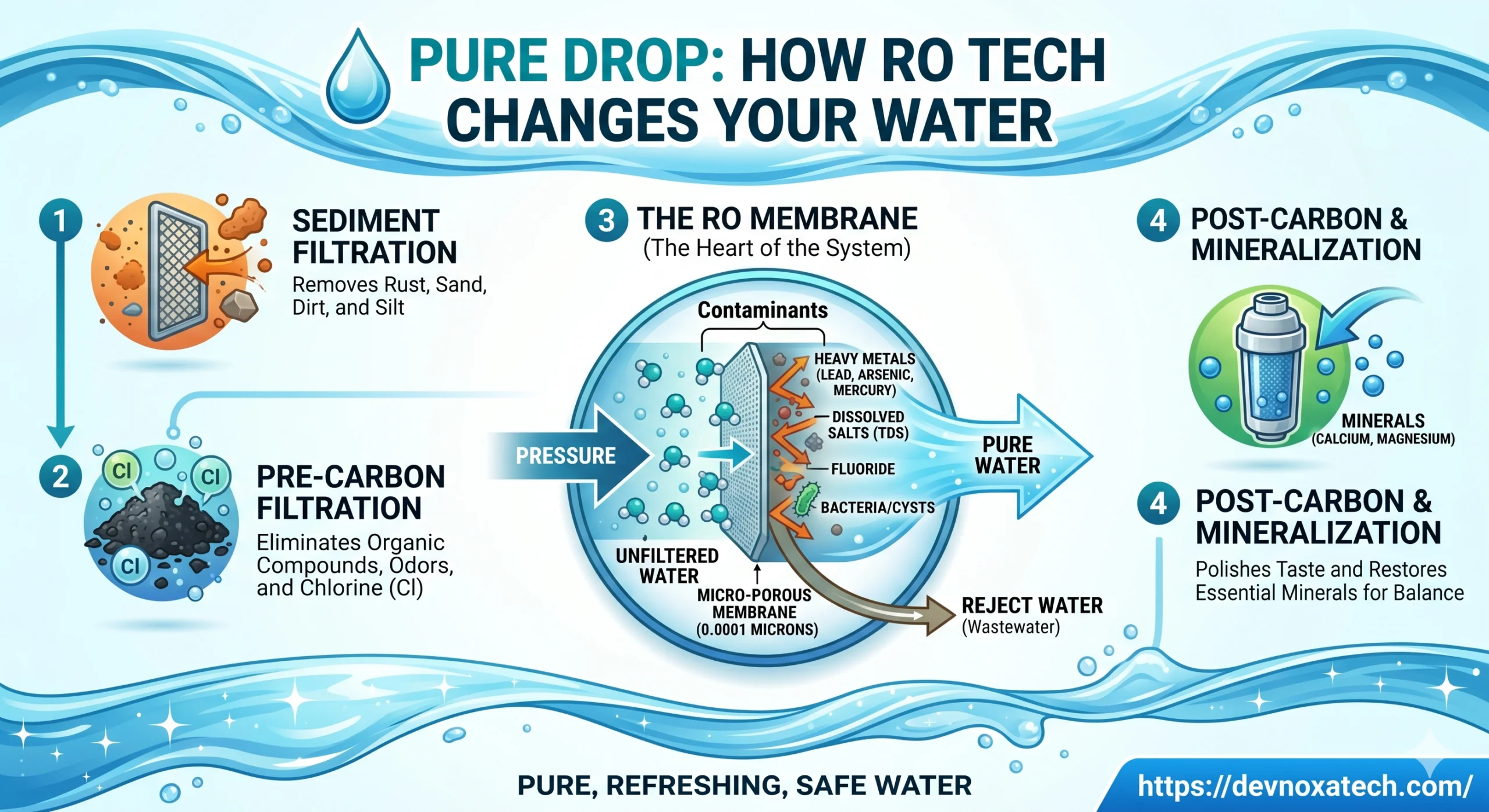
Stage One: Sediment Filtration
The journey begins here. The sediment filter acts as the first line of defense, catching large, visible particles like rust, sand, dirt, and silt. By trapping these coarse materials, it prevents physical damage and premature clogging of the subsequent, more delicate filters.
Stage Two: Pre-Carbon Filtration
Once the large debris is removed, the water passes through an activated carbon filter. This stage is crucial for removing organic compounds, bad tastes, odors, and chemical disinfectants like chlorine. Chlorine is commonly used by cities to kill bacteria, but it can chemically degrade and destroy an RO membrane if it is not filtered out beforehand.
Stage Three: The RO Membrane
This is the heart of the system. Water is forced under pressure through the 0.0001-micron membrane. It is during this stage that the most dangerous, invisible contaminants are separated. Heavy metals like lead, arsenic, and mercury, along with dissolved salts and fluorides, are stripped away from the water molecules.
Stage Four: Post-Carbon and Mineralization
After leaving the membrane, the water is pure but can sometimes taste a bit flat. It passes through a final post-carbon filter to polish the taste. Many modern systems also include an alkaline or mineralization cartridge at this stage, adding back healthy amounts of calcium and magnesium to balance the pH levels and improve the flavor profile.
What RO Filters Take Out
The primary reason households invest in RO technology is its unmatched ability to remove a massive spectrum of contaminants that standard pitcher or carbon filters simply cannot touch.
- Heavy Metals: Lead from old plumbing, arsenic from natural groundwater runoff, and chromium-6 are all effectively filtered out.
- Total Dissolved Solids: High TDS water tastes metallic, leaves scale buildup on appliances, and can cause digestive discomfort over time. RO drastically reduces TDS levels.
- Chemical Contaminants: It blocks synthetic chemicals, pesticides, pharmaceuticals, and industrial runoff that find their way into water tables.
- Microbial Pathogens: While UV light is often used alongside RO to kill living organisms, the physical barrier of an RO membrane is small enough to mechanically block bacteria, cysts, and viruses.
Balancing the Pros and Cons
While RO technology is arguably the most thorough filtration method available for consumers, it is important to look at the system as a whole, including its drawbacks.
The most notable critique of traditional RO systems is water wastage. Because the membrane separates pure water from contaminants, it requires a stream of water to constantly flush the rejected impurities down the drain. For every gallon of purified water produced, older systems could waste up to three gallons of reject water. However, modern engineering has made incredible strides. Today’s high-efficiency RO purifiers use advanced booster pumps and improved membrane designs to reduce this ratio significantly. Additionally, many eco-conscious homeowners collect this reject water to use for mopping floors, washing cars, or watering non-edible plants.
Another point of discussion is the removal of natural minerals. Because the membrane is non-selective, it removes beneficial minerals alongside the toxic ones. As mentioned earlier, the industry has solved this issue by integrating remineralization filters that restore the perfect balance of minerals, ensuring the water is both incredibly pure and highly nutritious.
The Verdict on Home Safety
Investing in an RO water purifier is ultimately an investment in long-term health and convenience. It eliminates the need to buy heavy, single-use plastic water jugs, reducing both your household expenses and your environmental footprint. It provides a reliable, chemical-free barrier against unpredictable fluctuations in municipal water quality or unexpected groundwater contamination.
When you pour a glass of water from a modern RO system, you are drinking water that has been refined by one of the most sophisticated filtration principles known to science. It is an efficient, reliable, and accessible way to guarantee that the fuel your body relies on most is as clean as nature intended.
For more information, visit devnoxa tech