

It’s April 2026, and the tech landscape has shifted from “tools we use” to “agents that act.” If 2024 was the year of the chatbot and 2025 was the year of the copilot, 2026 is officially the year of the Autonomous AI Agent.
But as these digital entities begin managing our calendars, buying our groceries, and even writing our code without human intervention, a new and pressing shadow has emerged: The Autonomy Paradox. How do we stay secure in a world where our software makes its own decisions?
The Rise of the “Invisible Employee”
At devnoxatech.com, we’ve been tracking the transition from generative AI to agentic AI. Unlike a standard LLM that waits for your prompt, an autonomous agent is goal-oriented. You don’t tell it to “write an email”; you tell it to “organize a 50-person product launch,” and it goes out, finds a venue, negotiates a contract, and sends the invites.
This isn’t sci-fi anymore. Major enterprises are already deploying these agents to handle Tier-1 tech support and supply chain logistics. However, this level of agency introduces a massive security bottleneck. If an agent has the authority to sign a digital contract or access a company bank account, what happens if that agent is “hallucinated” into a bad decision—or worse, hijacked?
The Zero Trust Mandate
This is where the second major trend of 2026 comes in: Zero Trust Architecture (ZTA). In the old days, we protected the “perimeter”—the walls of our network. In 2026, there are no walls. Your agents are out in the wild, interacting with third-party APIs and other agents.
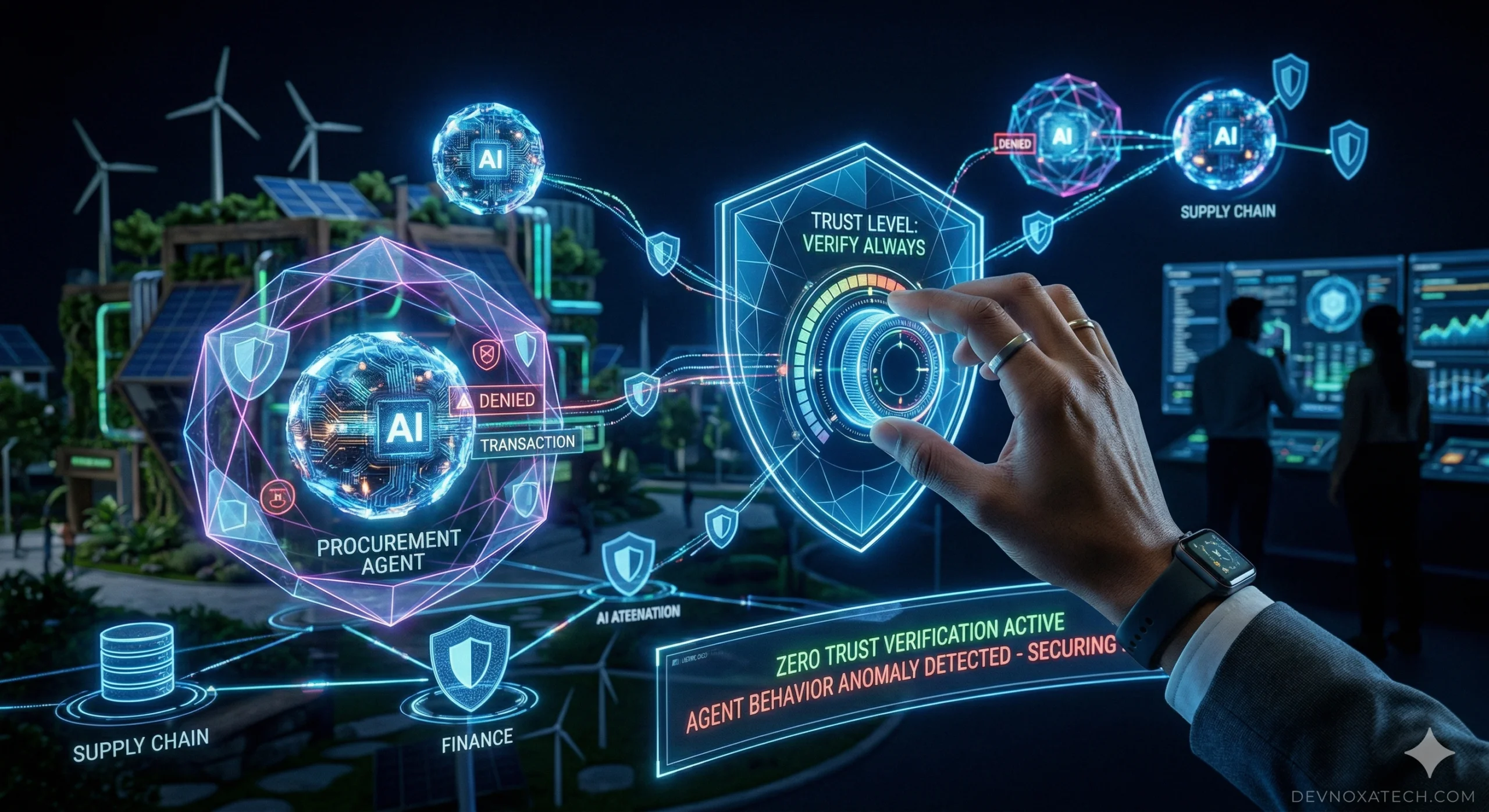
The core philosophy now is: Never Trust, Always Verify. Every action taken by an AI agent must now be cryptographically signed and verified. We are seeing a surge in “Agentic Firewalls”—security layers specifically designed to monitor AI behavior for anomalies. If your personal shopping agent suddenly tries to buy $10,000 worth of Bitcoin instead of your weekly groceries, the Zero Trust layer kills the process instantly.
Why Human Expertise Still Wins the SERPs
You might wonder: if AI is so smart, why are you reading an article written by a human? The answer lies in E-E-A-T (Experience, Expertise, Authoritativeness, and Trustworthiness). Search engines in 2026 have become incredibly good at sniffing out “synthetic” content. They are looking for the “human-in-the-loop.” They want to see original opinions, real-world case studies, and the kind of nuanced skepticism that only a human professional can provide. At devnoxatech.com, we believe that technology is a force multiplier, but human judgment remains the steady hand on the lever.
The “Agentic” Future: What’s Next?
As we look toward the second half of 2026, keep an eye on Personal AI Sovereignty. We are moving away from central “big tech” agents and toward local, private agents that live on our own devices (Edge AI). This allows for the productivity of an autonomous assistant without the privacy nightmare of sending every personal detail to the cloud.
The goal for every tech professional this year is simple: Learn to manage agents, but never stop questioning them. The most successful people in 2026 won’t be the ones who can write the best prompts, but the ones who can build the best guardrails.
Stay ahead of the curve with the latest tech deep-dives at: devnoxatech.com