
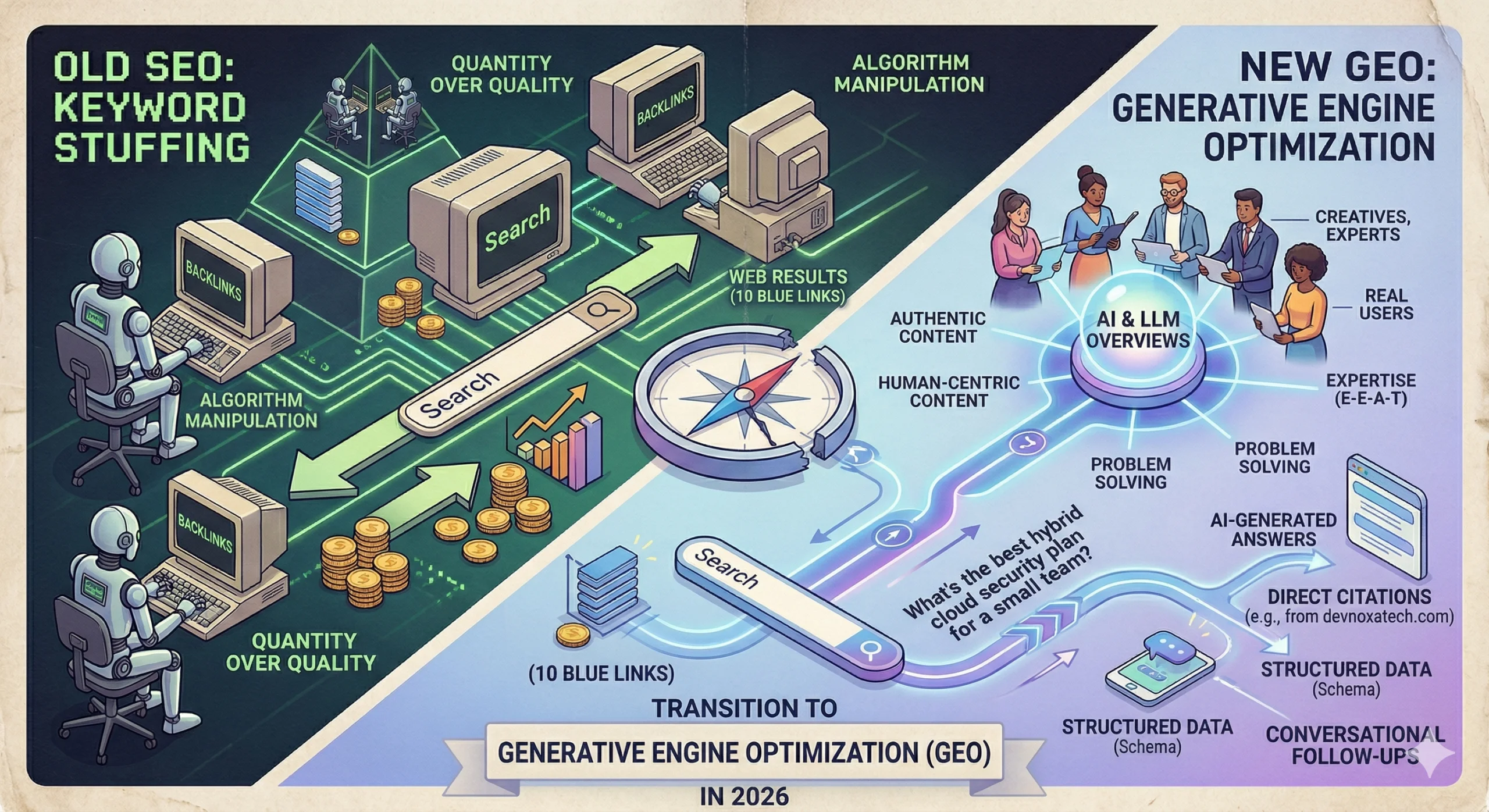

The search landscape has officially fractured. In 2026, we are no longer just optimizing for a search box; we are optimizing for a “Search Experience.” With over 60% of queries now ending in a “zero-click” result—where the AI provides the answer directly on the results page—the goal of the modern webmaster has shifted.
The question isn’t just “How do I rank #1?” It’s “How do I become the citation for the AI’s answer?”
1. The Death of the Long Intro
In the old days of SEO, we’d write a 300-word introduction to “set the stage.” In 2026, that’s a bounce-rate death sentence. AI models prioritize “Atomic Content.” To rank now, you must use the Inverted Pyramid style: give the absolute answer in the first 40–60 words, then provide the depth and data afterward.
This “Front-Loading” technique makes it easy for an AI agent to scrape your site and say, “According to DevnoxaTech, the best way to secure a hybrid cloud is…” If the AI can’t find the answer in your first two paragraphs, it will move to a competitor who gets straight to the point.
2. E-E-A-T is Now Your “Trust Token.”
Google’s focus on Experience, Expertise, Authoritativeness, and Trustworthiness has reached its peak. Since AI can generate generic technical guides, the algorithm is hunting for “Information Gain.”
What is Information Gain? It’s providing something new that isn’t already in the AI’s training data. For a tech site, this means:
- Unique Screenshots: Original UI/UX captures from your own testing.
- Failure Logs: Explaining what didn’t work in a setup, which AI rarely knows.
- First-Person Narratives: Using “I” and “We” to prove a human actually performed the task.
3. The Power of “Entity” Authority
In 2026, search engines don’t just see words; they see “Entities.” An entity is a recognized concept—like your brand, Devnoxatech.
To build entity authority, you need to move beyond your own domain. Mentions of your site on high-authority platforms like Reddit, GitHub, or specialized tech forums act as “digital votes” for your brand’s expertise. When an AI sees your brand mentioned across multiple trusted sources in association with a topic like “SEO automation,” it begins to treat your site as a primary authority for that topic.
4. Technical GEO: Schema and Semantic Clusters
Technical SEO hasn’t disappeared; it has just become more structured. Using Schema Markup (FAQ, How-To, and Organization schema) is now the equivalent of handing the AI a map of your content.
Furthermore, you should build Topic Clusters. Instead of writing one giant guide on “Cybersecurity,” you should have a pillar page linked to twenty smaller, highly specific articles (e.g., “Securing IoT Edge Nodes” or “Zero Trust for Remote Teams”). This semantic web tells search engines that you aren’t just a generalist; you are a topical specialist.
5. Optimizing for “Voice and Intent.”
With the rise of wearable AI and home assistants, search queries have become longer and more conversational. People aren’t typing “best laptop 2026”; they are asking, “What’s the best laptop for a developer who needs long battery life and runs Linux?”
To capture this traffic, your headings (H2s and H3s) should be phrased as questions. This mirrors exactly how users speak and how AI models retrieve information.
Conclusion: The Future belongs to the Useful
The “SEO “hacks of the past decade are gone. In 2026, visibility belongs to the sites that are the most citable, the most structured, and the most human. By focusing on GEO—Generative Engine Optimization—you aren’t just fighting for a spot on a list; you’re becoming part of the world’s collective knowledge base.
Stay Ahead of the Algorithm
The digital world moves fast, but your strategy can move faster. For deep dives into technical SEO, AI integration, and the future of the web, stay connected with the experts.
Explore more at: devnoxatech.com