
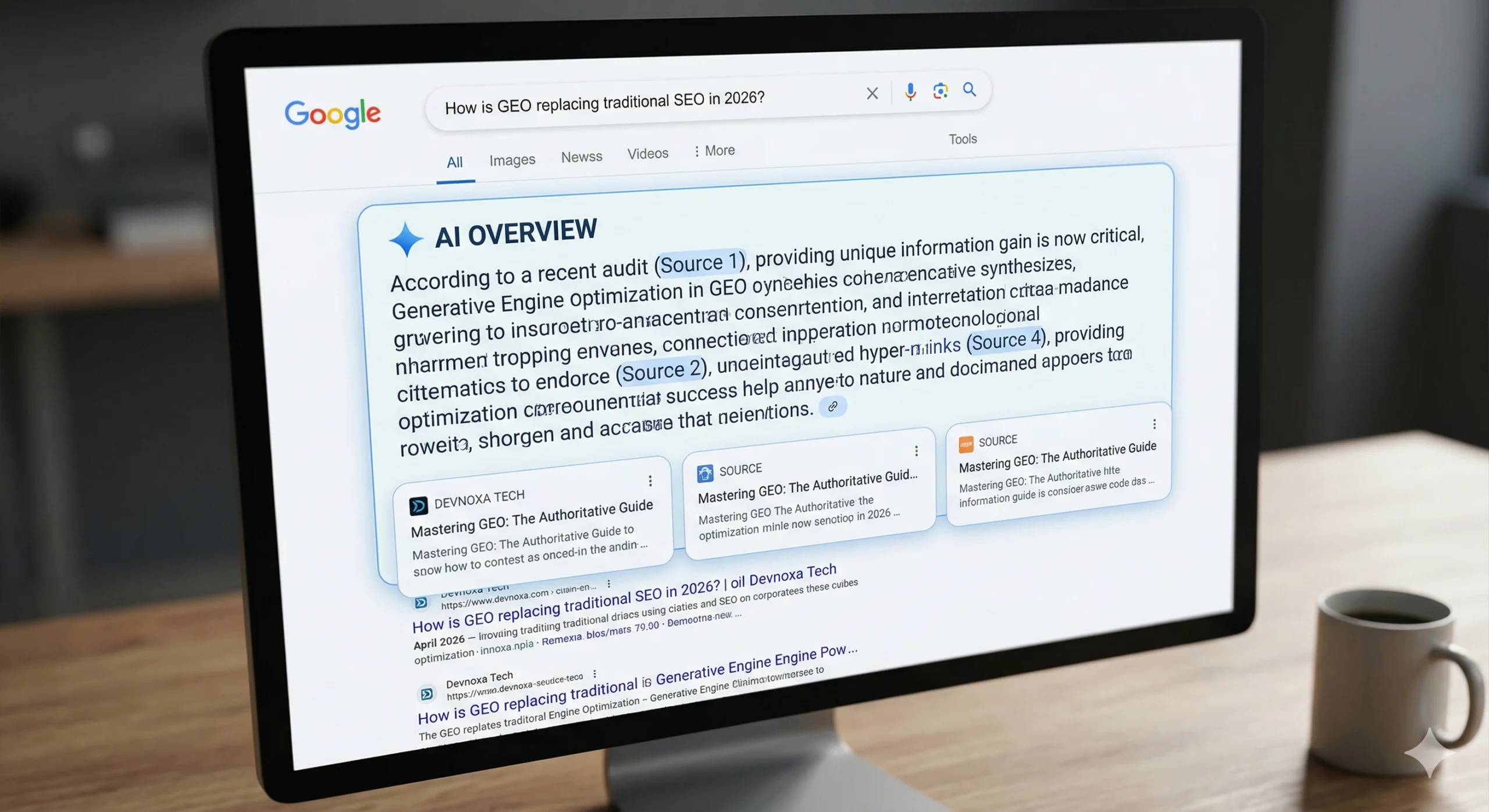

If you’re still trying to rank your site by stuffing keywords into headers and counting backlink tallies, I have some news for you: the goalposts didn’t just move; the entire stadium was rebuilt while we were sleeping. As of April 2026, the SEO industry is buzzing with a new acronym that is officially sidelining traditional search tactics. Welcome to the era of GEO—Generative Engine Optimization.
For years, we optimized for a list of “blue links.” Today, we are optimizing for a conversation. With Google’s Gemini-powered “AI Mode” and platforms like Perplexity and ChatGPT handling nearly 30% of all global search queries, the secret to ranking in 2026 isn’t being #1 on a list. It’s being the cited source inside an AI’s answer.
From Keywords to “Citable Facts”
The biggest shift this year is the death of the “Keyword Density” metric. AI engines don’t care how many times you say “best gaming laptop.” They care about Information Gain.
In the current landscape, search engines are looking for “Atomic Facts”—unique, verified data points or perspectives that don’t exist in the AI’s base training data. If your article just reshuffles what’s already on Wikipedia, the AI will summarize it without ever mentioning your name. But if you provide a unique case study, a specific statistic from your own research, or a “Human-First” review of a product, the AI is forced to cite you as the authority.
The 2026 Strategy: Stop writing for the algorithm and start writing for the citation. Ask yourself: “Is there a sentence in this paragraph that an AI would find useful enough to quote?”
The Rise of “Zero-Click” Survival
We’ve reached a staggering milestone this year: nearly 65% of Google searches now result in zero clicks. The AI Overview at the top of the page gives the user exactly what they need, and they move on.
While this sounds like a nightmare for traffic, the “survivors” of 2026 are using a technique called Direct-Answer Formatting. By placing a clear, 50-word summary of the answer at the very top of your article, you increase the chances of the AI pulling your site into the “Source” box.
It’s a paradox: by giving the answer away for free, you build the brand authority that eventually drives the “high-intent” clicks—the users who actually want to dive deep into your expertise.
E-E-A-T is Now Your Only Shield
In an internet flooded with AI-generated “slop,” Google has doubled down on Experience, Expertise, Authoritativeness, and Trustworthiness (E-E-A-T).
The trending tactic for April 2026 is the “Author Identity Audit.” Search engines are now looking for proof that a real human with real credentials wrote the content. This means your “About Us” page, your LinkedIn profile, and your history of publishing on a specific topic are now direct ranking factors.
If you’re running a tech site like devnoxatech.com, your focus shouldn’t just be on the technical specs of a gadget. It should be based on the experience of using it. Mention the specific challenges you faced during setup. Share photos that aren’t stock images. The more “human fingerprints” you leave on your content, the higher your “Trust Score” climbs.
Semantic Depth Over Search Volume
Finally, we’re seeing a move toward Thematic Clusters. Instead of trying to rank one page for one high-volume keyword, the goal is to own an entire “Entity.”
If you want to be seen as an expert in “AI Productivity Tools,” you need to cover the sub-topics: the ethics of AI, the hardware requirements, the integration workflows, and the cost-benefit analysis. When an AI sees that your site covers the entire “Semantic Map” of a topic, it begins to treat your domain as a primary source for that entire category.
The Bottom Line
The SEO game in 2026 is about influence management. It’s about ensuring that when an AI model is asked a question in your niche, your brand is the one it trusts to provide the answer.
The transition from SEO to GEO is challenging, but it rewards those who prioritize quality over quantity. By focusing on unique insights, structured data, and undeniable human expertise, you can ensure your site doesn’t just survive the AI revolution—it leads it.Stay ahead of the next algorithm shift and master the world of GEO at: devnoxatech.com