
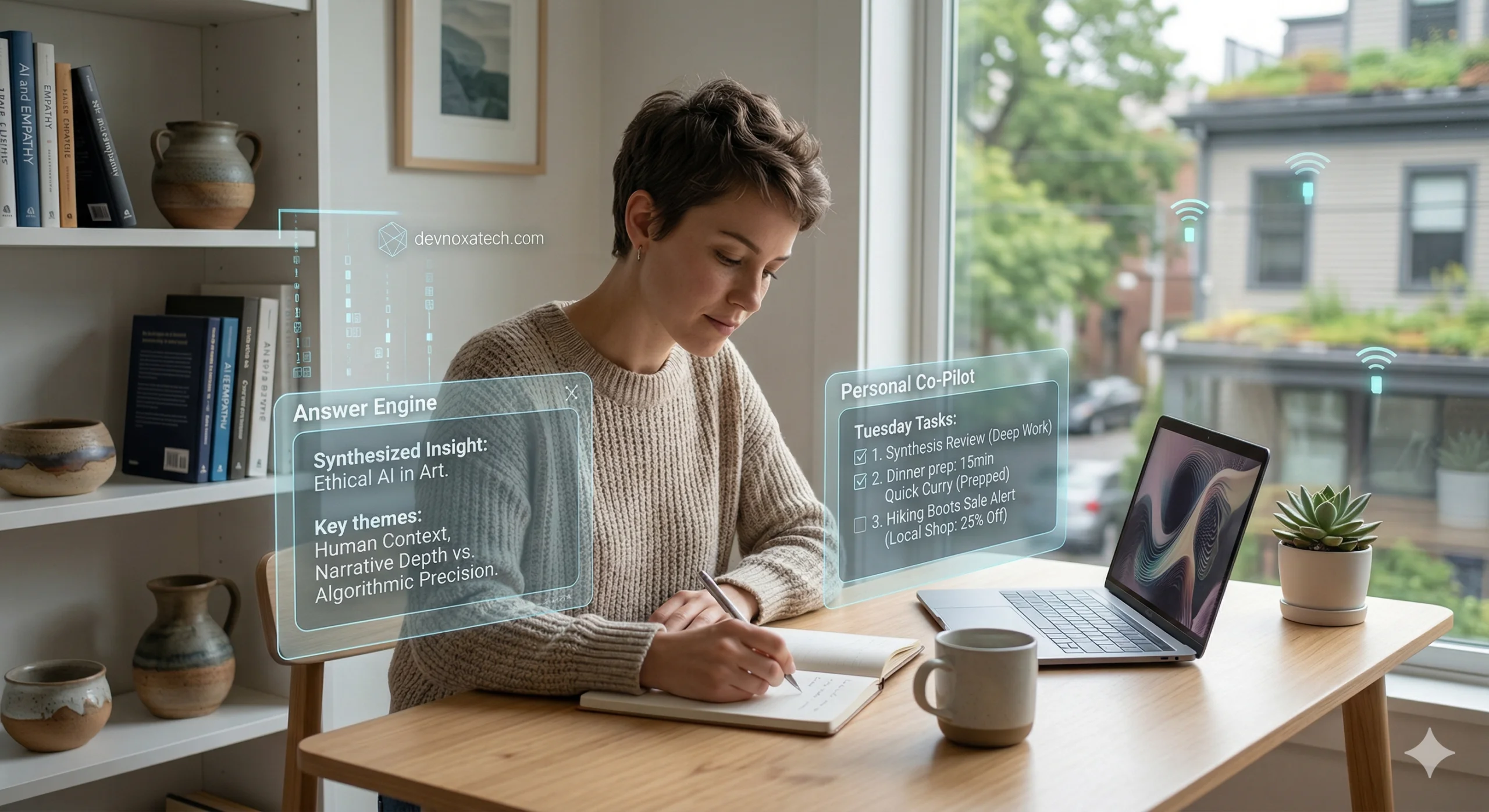

For years, the conversation around Artificial Intelligence was dominated by two extremes: utopian sci-fi dreams of robots doing our laundry, or dystopian warnings of “The Singularity.” But as we navigate through 2026, the reality has turned out to be far more subtle and, frankly, much more interesting. We haven’t seen a sudden takeover; instead, we’ve witnessed a “quiet integration.” AI has moved from being a flashy tool we talk to into a seamless layer of the world we live in.
This shift marks the transition from AI as a novelty to AI as a utility. We are no longer impressed that a computer can write a poem; we are now reliant on the fact that our environments are becoming intuitively responsive to our needs.
From Search Engines to Answer Engines
Remember the days of “Googling”? You would type in a few keywords, sift through ten blue links, dodge a dozen ads, and hope one of the websites actually had the answer you needed. In 2026, that process feels like using a rotary phone.
Today, we use “Answer Engines.” Whether we are troubleshooting a leaky faucet or researching the geopolitical implications of new trade routes, AI doesn’t just give us links; it synthesizes information. It reads the manuals, watches the tutorials, and cross-references the experts to give us a direct, conversational response. This isn’t just a time-saver; it’s a democratization of knowledge. The barrier to entry for learning a new skill has never been lower.
The Rise of the Personal Co-Pilot
The most significant change, however, is the shift from “Personal Assistants” to “Personal Co-Pilots.” In the early 2020s, digital assistants were glorified timers and weather reporters. Today, they possess contextual awareness.
Your Co-Pilot knows that you have a heavy meeting schedule on Tuesdays, so it automatically suggests a lighter dinner recipe that takes fifteen minutes to prep. It notices you’ve been researching hiking gear and subtly alerts you when a local shop has a sale on the specific boots you were eyeing. It doesn’t just wait for commands; it anticipates needs based on the patterns of your life. This level of personalization, once reserved for the ultra-wealthy with human assistants, is now becoming a standard feature of the modern digital experience.
Hyper-Personalization in Creativity and Media
The world of content has also been turned upside down. We are moving away from “mass media” and toward “me media.” AI is now capable of generating high-fidelity music, images, and even short-form video tailored to an individual’s specific mood or preference.
If you want to listen to a lo-fi hip-hop track with a specific tempo to match your morning jog, you don’t search for a playlist—your device generates one in real-time. This has created a new era of “micro-creativity,” where the tools to build and express ideas are available to anyone with a prompt. The focus has shifted from the technical skill of how to create to the creative vision of what to create.
The Human Core in a Digital World
With all this automation, a natural question arises: What happens to us? Interestingly, as AI handles more of the analytical and repetitive tasks, “Human Skills” have spiked in value. Empathy, critical thinking, ethical judgment, and physical craftsmanship are the new premium commodities.
We are finding that while an AI can write a technically perfect report, it cannot replace the nuanced leadership required to manage a team through a crisis. It can generate a beautiful image, but it doesn’t understand the lived experience or the emotional “why” behind a piece of art. This realization is leading to a cultural renaissance where we are rediscovering the value of things that are intentionally slow, artisanal, and deeply human.
The Invisible Infrastructure
Perhaps the most impressive part of 2026 is how invisible AI has become. It’s in the smart grids that balance energy consumption in our cities to reduce carbon footprints. It’s in the diagnostic tools that help doctors catch illnesses months earlier than previously possible. It’s in the logistics chains that ensure food reaches shelves with minimal waste.
We don’t think about “using AI” when we navigate traffic or buy groceries anymore, just as we don’t think about “using electricity” when we flip a light switch. It has become the invisible infrastructure of modern life—a silent partner helping us manage the complexity of the 21st century.
Looking Ahead: The Responsibility of Tech
As we lean further into this integrated reality, the focus for the coming years will be on transparency and ethics. We are learning that the “magic” of AI is only as good as the data it’s built on. The goal for 2026 and beyond isn’t just to make AI smarter, but to make it more aligned with human values. We are moving past the “move fast and break things” era and into an era of “build with intention.”
The AI revolution isn’t about replacing humans; it’s about amplifying us. It’s about stripping away the “busy work” so we can focus on the “life work.” As we look at the landscape of 2026, it’s clear that the most powerful technology isn’t the one that stands out—it’s the one that helps us stand up, step out, and engage with the world more fully.
The Digital Hub for Tomorrow’s Tech
Staying ahead of these rapid shifts requires a reliable source of insight. As the lines between human creativity and machine intelligence continue to blur, understanding the tools at our disposal becomes essential for anyone looking to thrive in this new landscape. Whether you are a developer, a creator, or simply someone curious about the next big wave in innovation, having a dedicated space to explore these trends is vital.
From deep dives into emerging software to the latest in hardware evolution, the future is being written in code and hardware every single day. The pace of change isn’t slowing down, and neither should your curiosity.
Explore the latest in technology and innovation at: https://devnoxatech.com