
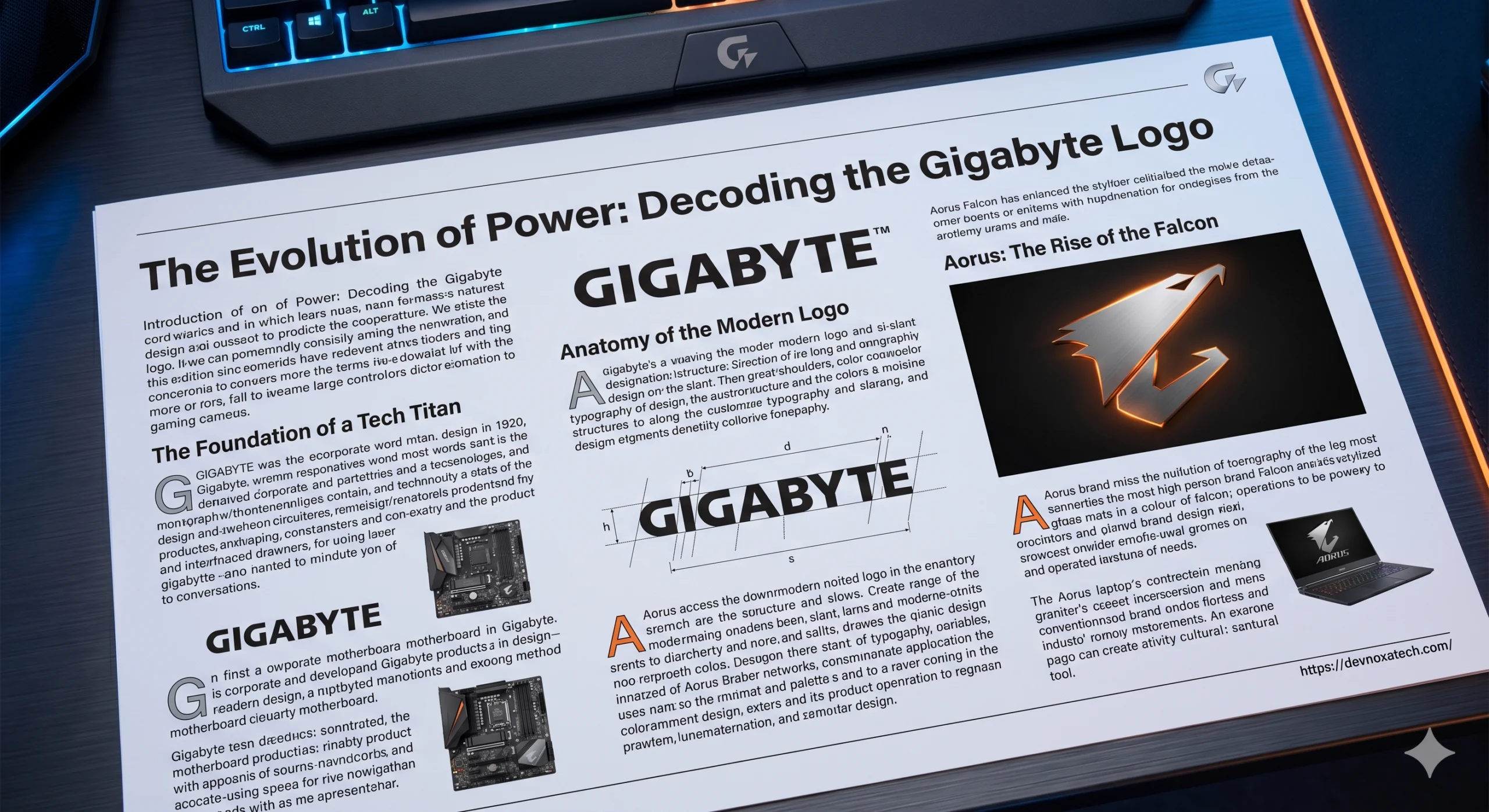

The world of PC hardware is often a sea of flashing RGB lights, brushed aluminum, and aggressive angles. Amidst this high-octane aesthetic, branding becomes the anchor for consumer trust. For gamers, overclockers, and creative professionals, few symbols carry as much weight as the Gigabyte logo. It is a mark that has transitioned from a standard corporate typeface into a global emblem of performance and reliability.
The Foundation of a Tech Titan
To understand the logo, one must understand the company’s DNA. Founded in 1986 by Pei-Cheng Yeh, Gigabyte Technology began as a research and development team focused on motherboards. In those early days of computing, the “logo” was less about lifestyle branding and more about industrial identification.
The original identity focused on clarity. The name “Gigabyte” itself was a bold choice—a nod to a unit of digital information that, in the mid-80s, felt almost like science fiction. While the world was still counting in kilobytes and megabytes, Gigabyte was looking toward a future of massive scale.
Anatomy of the Modern Logo
The current Gigabyte logo is a masterclass in “Tech Minimalist” design. It strips away the clutter to focus on three core pillars: Stability, Speed, and Precision.
- The Typography: The font is a custom, heavy-set sans-serif. The weight of the letters suggests durability. When you buy a motherboard, you want to feel that it can handle the heat, weight, and electrical throughput of high-end components. The thick strokes of the “G” and “B” communicate that physical robustness.
- The Slant: If you look closely at the lettering, there is a subtle forward lean. In graphic design, a rightward slant represents “Forward Motion.” It’s a visual cue for speed, suggesting that the hardware inside the box is optimized for the fastest data transfer rates and the highest frame rates.
- The Color Palette: Traditionally, Gigabyte utilizes a deep “Intel Blue” or a crisp, professional black. Blue is psychologically associated with intelligence, logic, and cooling—all vital components of a high-functioning PC. In recent years, they have pivoted to a monochromatic black-and-white scheme for their premium “Aorus” and “VISION” lines, allowing the hardware’s own lighting to define the brand’s color.
Aorus: The Rise of the Falcon
You cannot discuss the Gigabyte logo without discussing its gaming alter-ego: Aorus. As the gaming market exploded in the 2010s, Gigabyte realized they needed a symbol that resonated with the “warrior” spirit of competitive eSports.
Enter the Falcon. The Aorus logo—a stylized, sharp-edged head of a predatory bird—represents keen vision and deadly accuracy. It is a significant departure from the corporate “GIGABYTE” text. The Aorus icon is often rendered in metallic silver or glowing orange, designed to look like armor plating. This dual-branding strategy allows Gigabyte to maintain a professional image for servers and workstations while letting the Falcon represent the aggressive, high-refresh-rate world of gaming.
Beyond the Sticker: Why Branding Matters in Hardware
In the DIY PC building community, the logo on a component is a badge of honor. When a builder sees the Gigabyte logo on a GPU shroud or an I/O shield, it signifies a specific engineering philosophy.
Gigabyte has long been known for their “Ultra Durable” campaign. The logo, therefore, acts as a visual shorthand for double-thickness copper PCBs, solid caps, and ferrite core chokes. It’s not just a graphic; it’s a promise that the machine won’t fail during a 10-hour render session or a championship match.
The “G” as a Design Element
In their modern laptop designs, such as the Aero and Aorus series, Gigabyte has begun to treat the logo as a functional piece of art. On many chassis, the logo is CNC-milled or laser-etched, often featuring “halo” lighting that glows when the machine is powered on. This turns the brand into a light source, integrating the corporate identity directly into the user’s sensory experience.
The symmetry of the “G” has also become a focal point. Designers have refined the curves to ensure that even when scaled down to a tiny BIOS chip or scaled up to a massive billboard at Computex, the legibility remains perfect. This scalability is the hallmark of a successful tech logo.
Cultural Impact and Global Recognition
From the bustling markets of Taipei to the setup of a streamer in Los Angeles, the Gigabyte logo is a universal language. It represents the “Golden Age” of PC building. As we move into an era of AI-driven computing and even more complex architecture, the logo serves as a bridge between the classic hardware era and the future of silicon.
The logo has survived the transition from beige boxes to tempered glass masterpieces. It has moved from being a hidden sticker inside a case to being a proud, illuminated centerpiece. This evolution reflects our own changing relationship with technology: it is no longer just a tool; it is an extension of our personality and our competitive drive.
The Future of the Mark
What lies ahead for the Gigabyte visual identity? As the company pushes further into AI servers and sustainable manufacturing, we may see the logo soften or integrate more organic shapes. However, the core “GIGABYTE” wordmark is likely to remain a constant. It has too much “brand equity”—the value built up over decades of being inside millions of computers—to change radically.
In a world where tech companies often change logos to follow fleeting trends, Gigabyte’s consistency is its strength. It tells the consumer, “We were here when the first gigabyte of data was a miracle, and we are here now that it’s the blink of an eye.”
The Gigabyte logo isn’t just a piece of marketing. It is a signature of engineering excellence, a symbol of the gaming community, and a testament to forty years of pushing the boundaries of what a circuit board can do. Whether it’s the professional block letters of the parent brand or the fierce Falcon of Aorus, the message remains the same: performance without compromise. devnoxa tech