
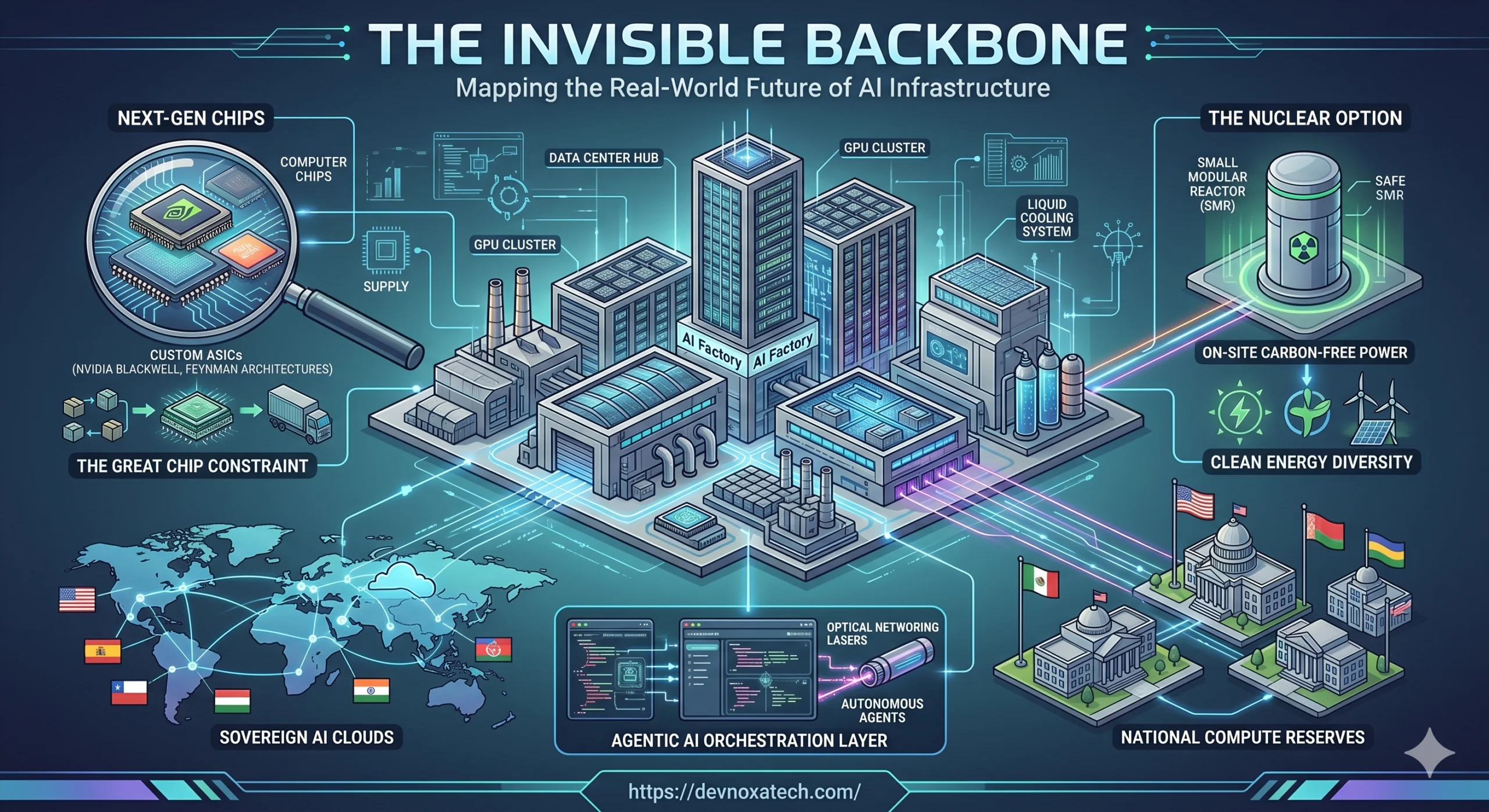

The digital landscape is currently witnessing a massive transformation. While the spotlight often shines on the latest AI chatbots or creative image generators, a much quieter but more significant revolution is happening in the physical world. This is the era of AI infrastructure news, where the focus has shifted from the software we use to the massive, power-hungry machines that make it all possible. As we move through 2026, the global race to build “AI factories” is reshaping economies, energy grids, and even international relations.
The Shift from Software to Steel
For years, the tech industry operated on the belief that software was the primary driver of innovation. However, the sheer scale of modern large language models has flipped that script. We are no longer just writing code; we are building physical ecosystems. The infrastructure required to train and run these models has become the most valuable real estate on the planet.
Data centers are evolving. They are no longer just warehouses for servers; they are becoming highly specialized “compute hubs.” These facilities are being redesigned from the ground up to handle the intense heat and power demands of modern AI chips. Traditional air cooling is being replaced by advanced liquid cooling systems, and the architectural footprint of these buildings is expanding to accommodate hundreds of megawatts of power. In places like the UK and New Zealand, we are seeing a “data center boom” where underused industrial sites are being repurposed into these high-tech powerhouses.
The Great Chip Constraint
If data centers are the body of AI, then chips are the brain. In 2026, the narrative around AI hardware has taken an interesting turn. For a long time, the primary bottleneck for AI growth was the availability of power. While energy remains a massive challenge, the industry is currently facing a “binding constraint” on the production of the chips themselves.
NVIDIA remains the dominant force, with its Blackwell architecture entering volume production and the upcoming “Feynman” generation already on the horizon. These chips are not just faster; they are more efficient at moving data. But even with NVIDIA’s massive lead, the demand is so high that the supply chain is struggling to keep up. This has led to a fascinating shift in the market.
Major tech giants like Alphabet, Meta, and OpenAI are no longer content to wait in line for third-party chips. They are increasingly developing their own custom silicon, known as ASICs (Application-Specific Integrated Circuits). By building their own hardware, these companies can tailor the silicon to their specific software needs, reducing their reliance on the broader market and potentially lowering their long-term costs. We are seeing a move toward “full-stack” control, where the company that writes the AI also designs the chip it runs on.
The Energy Dilemma and the Nuclear Option
Perhaps the most surprising headline in recent AI news is the industry’s sudden and intense interest in nuclear energy. The power demands of AI are so immense that traditional renewable sources like wind and solar—while important—often lack the “always-on” stability required to keep a massive GPU cluster running 24/7.
In May 2026, we’ve seen landmark agreements between infrastructure leaders and nuclear energy startups. Companies like Supermicro are partnering with advanced microreactor developers to explore on-site nuclear power for data centers. The idea is to create a “compute + power” bundle where a data center isn’t just connected to the grid, but actually generates its own carbon-free energy right on the premises.
This shift isn’t just about sustainability; it’s about survival. Without a reliable, scalable source of clean energy, the AI revolution hits a physical wall. Small Modular Reactors (SMRs) are being touted as the future, offering a way to deploy power in remote areas or directly alongside massive computing facilities.
The Rise of Sovereign AI
As AI becomes a central pillar of national security and economic growth, countries are starting to treat “compute” as a strategic national resource, similar to oil or grain reserves. This has given birth to the concept of Sovereign AI.
Governments are realizing that they cannot rely solely on foreign cloud providers to handle their most sensitive data. From India to the Netherlands, we are seeing the launch of national AI infrastructure programs. These initiatives involve building locally owned data centers, training models on local languages and cultural datasets, and ensuring that the physical hardware resides within national borders.
This movement is driven by a desire for digital independence. By owning the infrastructure, a nation ensures that its AI capabilities cannot be “switched off” by a foreign entity and that its citizens’ data remains protected under local laws. As of mid-2026, nearly fifty national governments have announced some form of sovereign AI project.
The Orchestration Layer
While GPUs get all the glory, there is a growing recognition that the “orchestration layer” is becoming a critical piece of the puzzle. As AI moves away from simple chatbots and toward “agentic” systems—AI agents that can browse the web, book flights, and manage workflows—the infrastructure needs to change.
These autonomous agents require a different kind of computing power. While GPUs handle the heavy lifting of “thinking,” CPUs and high-speed networking are required to manage the “doing.” We are seeing a resurgence of interest in high-performance CPUs and optical networking, which uses lasers instead of traditional wiring to move data between chips at lightning speeds. This “networking fabric” is what allows thousands of chips to work together as a single, massive brain.
Looking Ahead
The next few years will be defined by how well we can scale this invisible backbone. The challenges are significant: chip shortages, energy constraints, and geopolitical tensions. However, the investment levels are equally unprecedented. We are looking at a market that is projected to grow toward nearly a trillion dollars over the next decade.
The AI infrastructure story is no longer just about tech; it’s a story of civil engineering, global logistics, and energy policy. The companies and nations that successfully build and secure this backbone will be the ones that define the next century of human progress. It is a race for the physical foundation of the digital future. devnoxa tech