
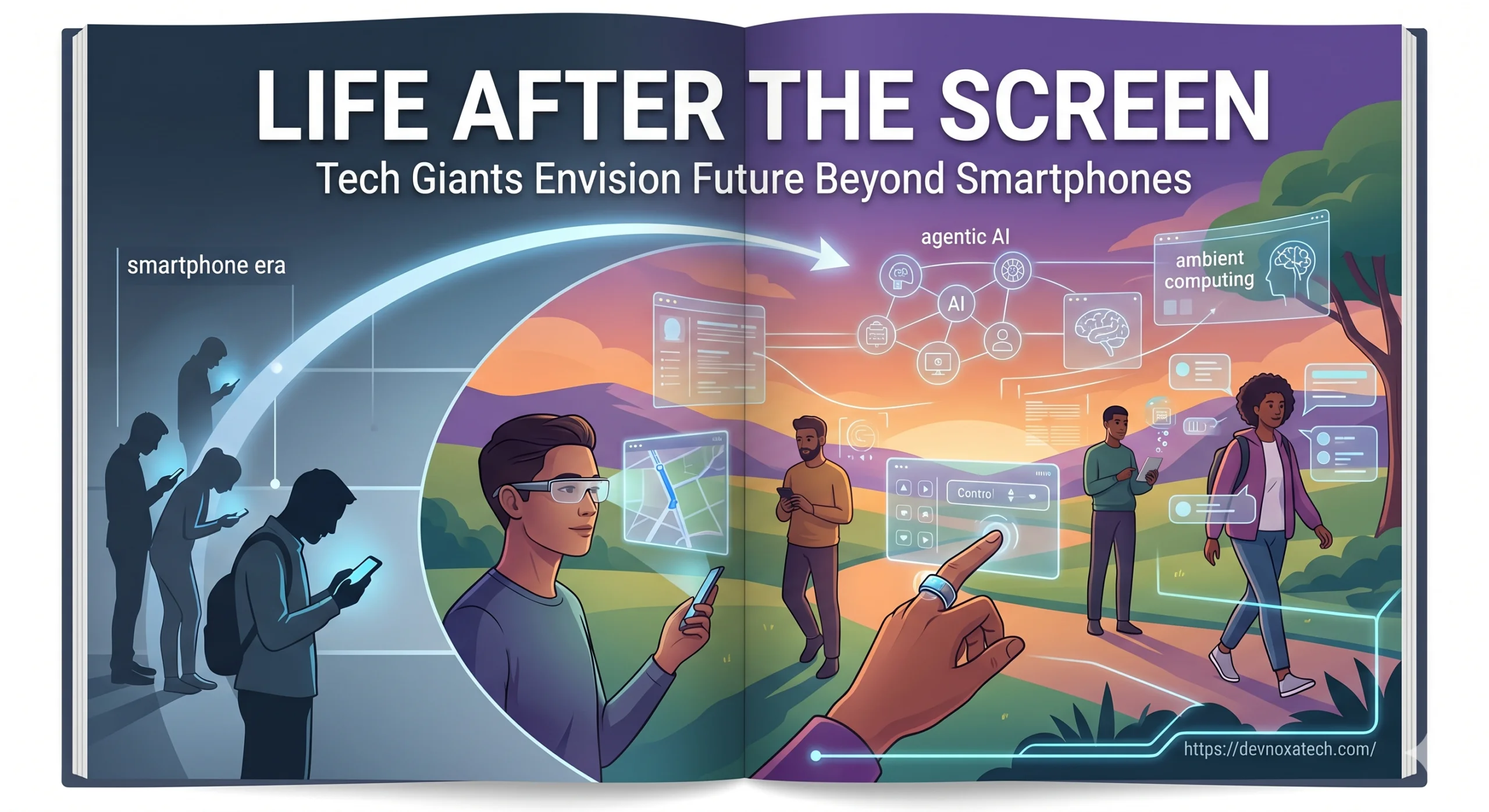

For nearly two decades, the smartphone has been the undisputed sun at the center of our digital solar system. We wake up to its alarm, navigate our world through its maps, and document our lives through its lenses. However, as we move through 2026, a quiet but profound shift is occurring. The world’s tech giants—Meta, Apple, Google, and Samsung—are no longer just building better phones. They are architecting a world where the phone eventually disappears entirely.
The vision is simple yet radical: technology should be something you experience, not something you hold. We are entering the era of “ambient computing,” where the internet isn’t a destination you reach by tapping a piece of glass, but a layer woven into the physical world around you.
The Eyes Have It: The Rise of Smart Glasses
The most visible front of this revolution is sitting right on our bridges. For years, smart glasses were the awkward cousins of the tech world, bulky and socially stigmatized. But in 2026, the tide has turned. Meta’s partnership with Ray-Ban proved that people will wear computers on their faces if they look like fashion icons rather than lab equipment.
These aren’t just cameras for social media anymore. With the release of devices like the Samsung Galaxy Glasses and Apple’s latest AR eyewear, we are seeing the “heads-up” lifestyle go mainstream. Instead of looking down at a screen to follow GPS directions, digital arrows are now projected onto the sidewalk in front of you. When you walk into a grocery store, your glasses can highlight the ingredients you need for a recipe while your hands stay free to grab the cart.
By shifting the interface from a handheld screen to a translucent display in our field of vision, tech giants are trying to solve “screen neck” and the social isolation that comes with staring into a palm-sized rectangle.
AI Agents: The Invisible Interface
If the glasses are the body of this new era, Artificial Intelligence is the soul. We are moving away from “apps” and toward “agents.”
In the smartphone era, if you wanted to book a flight, you opened an app, searched, compared, and clicked. In the post-smartphone vision, you simply tell your AI assistant—be it Google’s Gemini, Apple’s revamped Siri, or Meta AI—what you need. These agents are becoming “agentic,” meaning they can navigate the web and execute tasks on your behalf.
By 2026, processors have become powerful enough to run these complex AI tasks locally on wearable devices. This means your smart ring or lapel pin isn’t just a conduit to a cloud server; it’s a tiny, private brain that understands your context. It knows you’re in a meeting and should only interrupt for emergencies. It knows you’re at the gym and starts your favorite playlist without a single touch. When the interface is invisible and voice-activated, the need for a 6-inch screen begins to evaporate.
Wearables That Feel Like Us
Beyond glasses, the tech industry is exploring the “Body Internet.” We are seeing the rise of smart rings, like the Acer FreeSense, and neural wristbands that interpret muscle movements. Meta’s neural interface technology, for instance, allows users to control digital interfaces with subtle finger twitches that are almost imperceptible to others.
This is a move toward “frictionless” computing. The goal is to remove the barrier between thought and action. If you can send a text message just by thinking about a gesture, or check the weather via a haptic pulse on your wrist, the ritual of pulling a heavy glass slab out of your pocket starts to feel like a chore from a bygone era.
The Challenge of the Transition
Of course, the smartphone isn’t going to die tomorrow. It remains the most efficient “puck” of computing power we have. In fact, many of today’s most advanced glasses still rely on a phone in your pocket to do the heavy lifting via a wireless tether.
The hurdles are also significant. Privacy remains the elephant in the room. If everyone is wearing cameras and microphones, the concept of a “private space” changes forever. There is also the “ick factor” of early-stage neural interfaces, like Elon Musk’s Neuralink, which, while promising for medical applications, still feels like science fiction to the average consumer.
Furthermore, there is the issue of “digital claustrophobia.” Critics argue that by moving the internet from our pockets to our eyes and ears, we are making it impossible to ever truly “unplug.” Tech giants are counter-arguing that this shift actually helps us stay more present in the real world by removing the distracting “infinity pool” of the smartphone screen.
A World Unbound
The future beyond the smartphone is one where technology is felt but not seen. It is a world where information is available the moment you think of a question, and where the digital and physical realms are perfectly synchronized.
As we look toward the end of the decade, the “glass rectangle” will likely be remembered as a transitional tool—a necessary stepping stone that taught us how to be digital citizens before the internet finally dissolved into the air around us. The tech giants are betting hundreds of billions that the next great platform isn’t something we will carry, but something we will inhabit. devnoxa tech