

The days of guessing your skin type or buying a moisturizer just because the packaging looks nice are officially over. We have entered a period where the bathroom mirror is becoming just as smart as the smartphone in your pocket. Skincare Tips (AI) Technology has moved from science fiction into our daily routines, changing how we understand, treat, and maintain our skin. It is not just about cool gadgets; it is about precision. For the first time, we can stop the “trial and error” phase that has plagued skincare for decades and start using data to get the results we actually want.
Your Face as Data
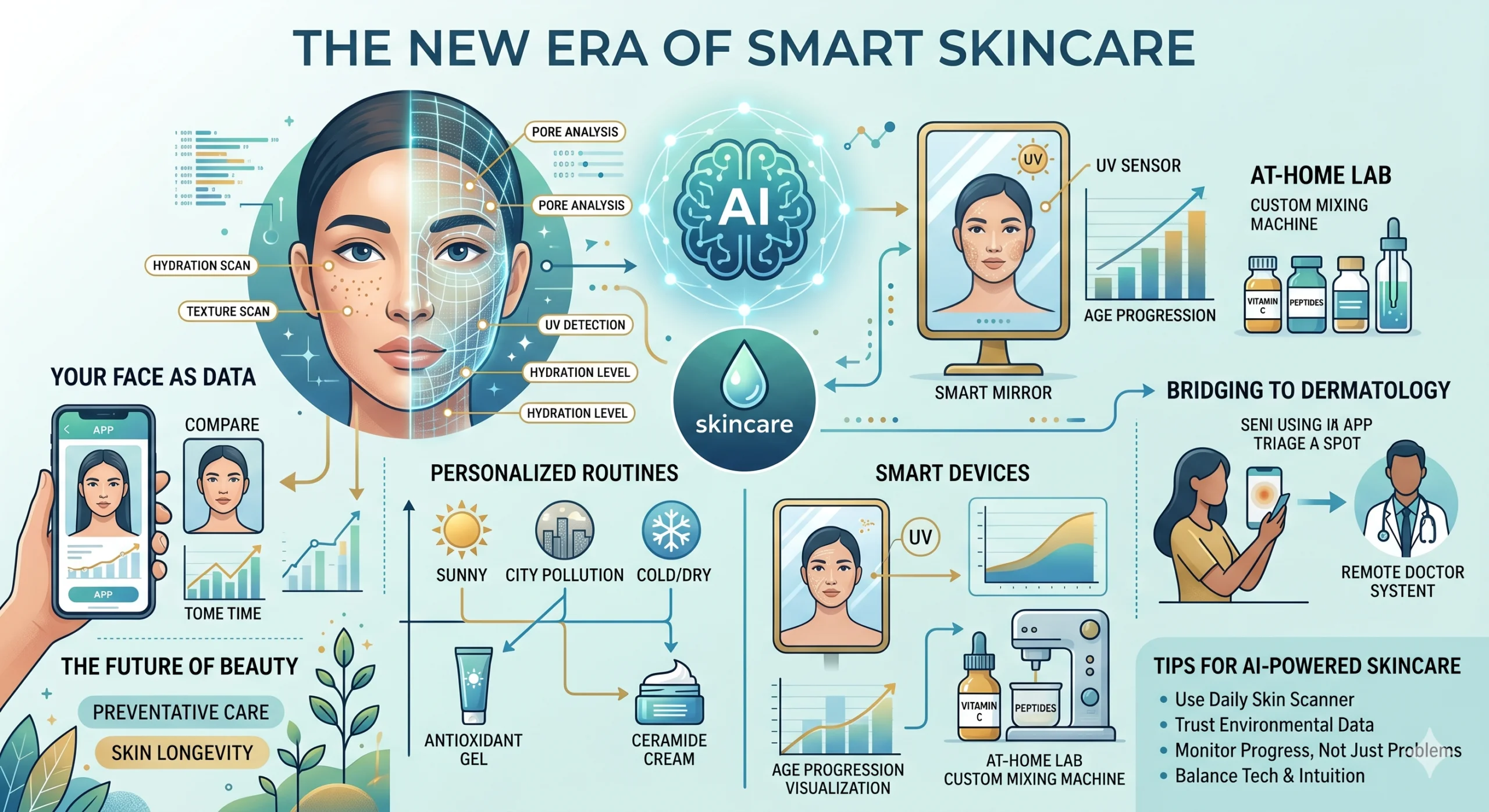
At the heart of this shift is the ability of AI to analyze the human face with incredible detail. Using high-resolution imaging and machine learning, modern apps and smart mirrors can detect things the naked eye simply misses. We might see a slight redness, but an AI algorithm sees a specific pattern of inflammation or the beginning of a barrier breakdown. By scanning for texture, pore size, pigmentation, and even subtle fine lines, these tools create a digital “map” of your skin.
This is revolutionary because your skin is dynamic. It changes based on the weather, your stress levels, and how much sleep you got last night. AI allows you to track these changes over time. Instead of wondering if that expensive vitamin C serum is actually working, you can look at a data-driven progress report that shows exactly how much your dark spots have faded over the last month.
Personalized Routines in Real Time
One of the biggest frustrations in skincare is the “one size fits all” approach. A product that works for your favorite influencer might cause a breakout for you. AI technology solves this by offering hyper-personalization. Modern platforms now take into account your “exposome”—a fancy word for all the environmental factors you face daily.
Imagine an app that checks the local weather and UV index in your city. If it’s a humid, high-pollution day in a city, the AI might suggest a lighter, antioxidant-rich gel. If you’re traveling to a cold, dry climate, it might prompt you to switch to a ceramide-heavy cream to protect your skin barrier. This real-time adaptation ensures that your routine is always optimized for your current environment, not just your general skin type.
The Rise of Smart Devices
The hardware in our homes is getting a major upgrade. Smart mirrors are now equipped with UV sensors that can show you exactly where you missed a spot with your sunscreen—a literal lifesaver when it comes to preventing sun damage. Some mirrors even use augmented reality to show you how your skin might age over the next ten years if you don’t start using preventative care now. It is a powerful motivator to stay consistent with your routine.
Beyond mirrors, we are seeing the rise of “at-home labs.” These are small devices that can mix custom doses of serum or moisturizer based on a daily scan of your face. Instead of using the same cream every morning, the device might add a bit more hydration on Monday and more active ingredients on Thursday, depending on what your skin needs at that exact moment.
Bridging the Gap to Dermatology
While AI is a powerful tool, it is not meant to replace professional dermatologists. Instead, it is acting as a bridge. Many of these tools are now developed in collaboration with doctors to ensure the advice is medically sound. AI can help you identify when a “spot” is just a blemish and when it is something that needs a professional medical opinion.
For many, this technology provides a level of “triage.” It helps people manage common issues like mild acne or dryness at home while providing a clear record of data to show a doctor if a more serious issue arises. This makes the conversation with a dermatologist much more productive because you aren’t just describing a feeling; you’re bringing a digital history of your skin’s behavior.
Ethics and the Future of Beauty
As we move forward, the focus is shifting toward “skin longevity.” The goal is no longer just to fix a problem once it appears, but to prevent it from happening in the first place. AI is the engine behind this preventative movement. By catching early signs of aging or damage before they are visible, we can maintain healthy skin for much longer.
However, with all this data comes a need for caution. Our faces are our identity, and the data collected by these apps is sensitive. As we embrace AI beauty tech, it is important to choose platforms that prioritize privacy and data security. The future of skincare is bright, but it should also be safe.
Essential AI-Powered Skincare Tips
To make the most of this technology, here are a few ways to integrate AI into your daily life:
- Use a Daily Skin Scanner: Many reputable brands now offer free web-based tools or apps. Taking a selfie every morning for a week can give you a baseline of how your skin reacts to your current products.
- Trust the Environmental Data: If your app suggests more hydration due to a drop in humidity, listen to it. Your skin often feels the change before you do.
- Monitor Progress, Not Just Problems: Use AI to celebrate your wins. Seeing a “smoothness score” go up can help you stay committed to your routine.
- Keep it Balanced: Technology is a guide, but don’t ignore your intuition. If a product feels wrong or causes irritation, your physical sensation is just as important as the digital scan.
The fusion of skincare and AI is making beauty more scientific, more effective, and more personal. We are moving away from the era of “beauty secrets” and into the era of “beauty data.” By embracing these tools, we can finally give our skin exactly what it needs, exactly when it needs it. devnoxa tech