
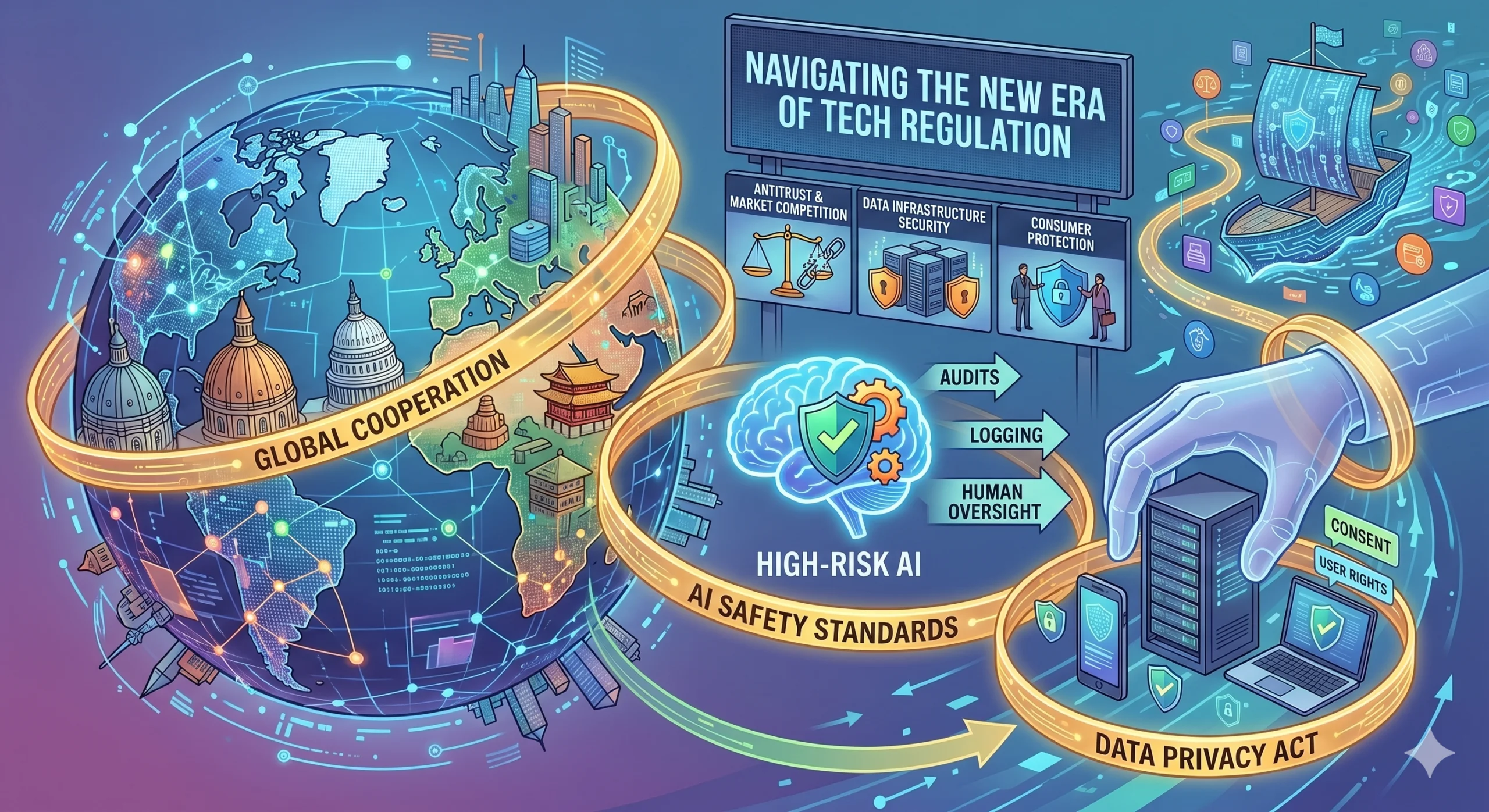

The digital landscape is undergoing its most profound transformation since the birth of the commercial tech regulation news today internet. For years, technology giants operated in a relatively loose regulatory environment where innovation outpaced oversight. Today, that dynamic has completely reversed. Governments worldwide are aggressively constructing guardrails around artificial intelligence, data privacy, cloud computing, and market competition. As these frameworks transition from theoretical proposals into binding laws, businesses and consumers find themselves navigating a complex compliance minefield.
The Global Crackdown on Artificial Intelligence
Artificial intelligence is the primary catalyst driving modern tech regulation. Leading the charge is the European Union with its landmark AI Act. While initial provisions banning unacceptable practices like untargeted facial scraping take effect early on, the broader compliance deadlines scheduled for late August 2026 are forcing companies to completely overhaul their operational strategies.
The framework classifies AI applications into distinct risk tiers. High risk systems, including software used for recruitment, credit scoring, or critical infrastructure management, face stringent standards before entering the market. Developers must implement rigorous data governance protocols, maintain detailed logs for traceability, and ensure continuous human oversight. Additionally, the upcoming transparency rules mean that generative AI content, particularly deepfakes and public informational texts, must be clearly and visibly labeled so users know they are interacting with a machine.
In the United States, the approach remains more fragmented but is rapidly gaining momentum. Congress is actively reviewing a wave of targeted bills designed to curb the dark sides of rapid automation. Recent legislative introductions highlight growing concern over AI powered surveillance pricing at grocery stores and third party delivery platforms, where dynamic pricing algorithms can manipulate consumer costs in real time. Simultaneously, federal risk management frameworks are expanding to require all government agencies to strictly audit their automated tools for bias and security vulnerabilities.
Antitrust Enforcement and Ecosystem Reshaping
The days of unchecked tech consolidation are drawing to a close as antitrust authorities redefine competitive harm. Regulators are moving away from traditional price centric metrics, focusing instead on data monopolies and platform lock in.
In the United States, landmark legal battles are testing the boundaries of structural remedies. Antitrust divisions are exploring how to address systemic monopoly power without dismantling core consumer utilities. While courts have shown hesitance toward extreme corporate divestitures, such as forcing the sale of popular browsers or operating systems, they are actively capping exclusionary distribution agreements.
The legal focus has also shifted heavily toward the next frontier: generative AI. Regulators are examining whether established tech incumbents are leveraging their cloud dominance and distribution networks to suppress emerging AI startups. Furthermore, regulatory eyes are turning to how foundation models are trained, investigating whether massive tech firms are illegally scraping creator content from public video and social platforms without fair compensation or opt out mechanisms.
Across the Atlantic, the European Commission continues to wield the Digital Markets Act to dismantle digital gatekeepers. In an unprecedented move, authorities have recently refined platform designations based on shifting user engagement trends, demonstrating that regulatory frameworks are becoming nimble enough to adapt to real time market changes.
Data Infrastructure and National Security
Data centers have emerged as the foundational backbone of the modern economy, sparking fresh concerns regarding resource consumption and physical security. The massive computational power required to train and run advanced AI models has placed an immense strain on global utility grids.
In response, new environmental oversight bills are moving through legislative chambers, requiring data infrastructure operators to formally report their total electricity and water consumption to central governments. Security is another critical pillar. Lawmakers are drafting national strategies to protect data facilities from external cyber breaches, recognizing that these physical sites hold the proprietary algorithms and sensitive information of the entire corporate world.
On an international level, cross border data flows are becoming key battlegrounds for geopolitical influence. Major global powers are tightening oversight on outbound investments and technology transfers. New strict regulations explicitly ban the unauthorized overseas transfer of export restricted technologies, source codes, and sensitive user data. These rules apply not just to corporate entities but to individual cross border personnel assignments, establishing national security reviews for any transaction that might compromise digital sovereignty.
Reengineering Digital Consumer Protection
Consumer privacy and online safety are being systematically rewritten to protect vulnerable populations and give individuals absolute ownership over their digital footprints. A wave of new consumer centric legislation seeks to affirm that users own their personal information by default. These proposals aim to prohibit platforms from forcing data monetization or third party contact collection in exchange for basic services.
Simultaneously, the legal landscape surrounding youth safety has shifted dramatically. Social media and advertising networks face intense pressure regarding algorithmic design. Major tech companies have recently been forced into massive settlements with public school districts over allegations of platform addiction.
To prevent further litigation, legislative bodies are implementing strict bans on targeted advertising to minors, particularly concerning high risk digital activities like online sports betting and gamified microtransactions. In the European market, online interfaces are also being legally mandated to include clear, accessible withdrawal mechanisms, ensuring that canceling a digital contract or subscription is just as easy as signing up for one.
The Road Ahead for Digital Ecosystems
The overwhelming message from today’s regulatory environment is clear: compliance is no longer a secondary corporate initiative. It is a core business requirement. As governments deploy advanced data analytics and AI tools of their own to detect algorithmic collusion and automated pricing violations, enforcement will only become more precise.
For businesses, adapting to this decentralized, high stakes regulatory web requires proactive architecture. Companies can no longer build products first and fix compliance later. Privacy, safety, and transparency must be engineered into the core code from day one. Navigating this new era requires deep technical expertise, robust data governance, and a forward looking strategy that treats regulatory alignment not as a hurdle, but as a competitive advantage.
To explore deeper insights into emerging technology trends and innovative digital solutions, visit devnoxa tech