
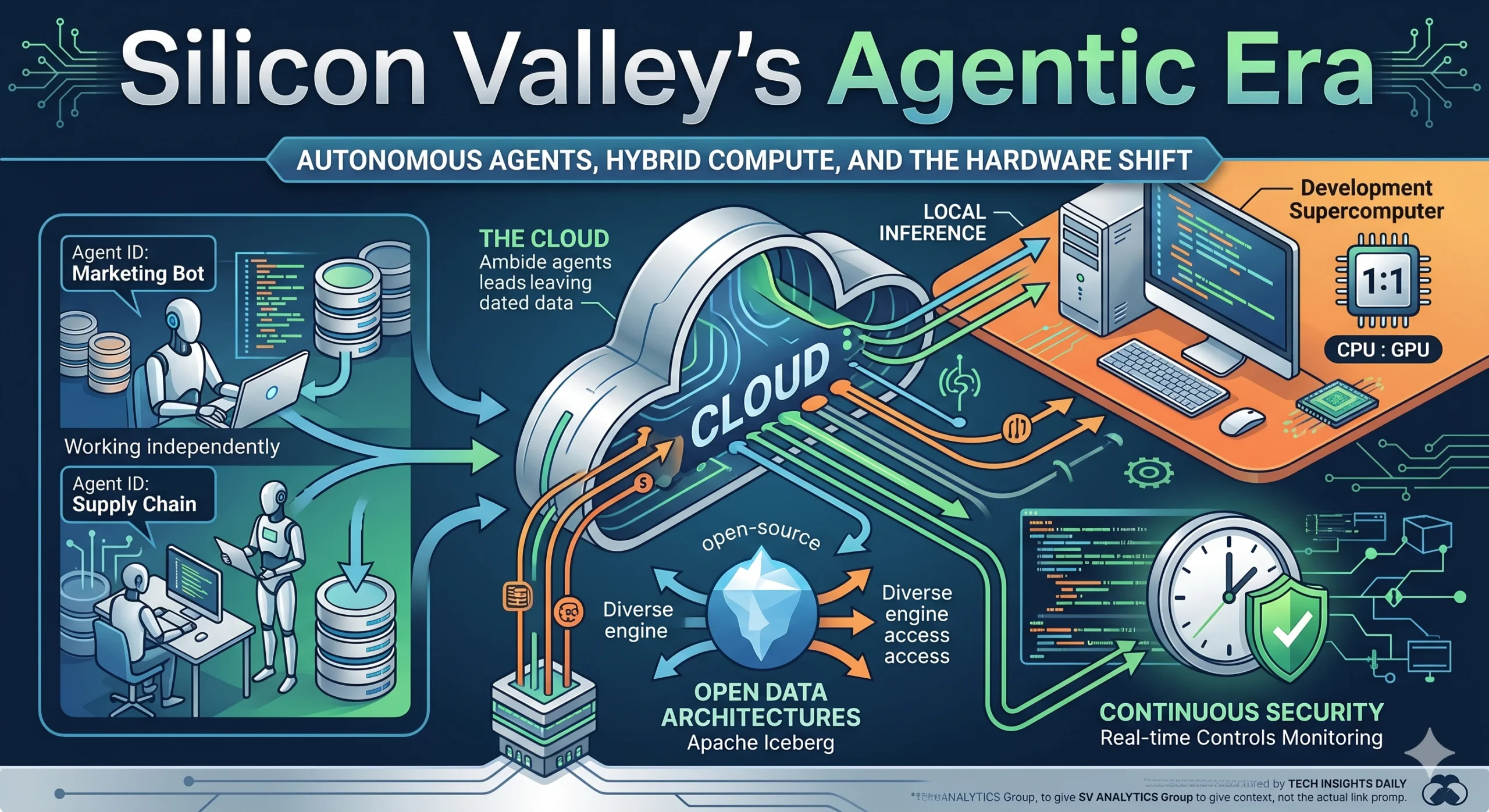

Silicon Valley is undergoing a profound structural shift. If previous tech cycles were defined by mobile connectivity or foundational cloud architecture, the current era belongs entirely to autonomous systems. The region is moving past conversational chatbots toward the “agentic enterprise,” a framework where AI agents operate independently, access massive corporate data pools, and make complex decisions without human intervention.
This transformation is reshaping everything from local server hardware to software governance models. As big tech firms and agile startups pivot to support these workflows, the entire Valley ecosystem is re-engineering itself to handle the sheer scale of the automated future.
The Rise of the Agentic Enterprise
The conversation around artificial intelligence in the enterprise space has drastically evolved. Corporate leaders are no longer looking for tools that simply summarize emails or generate text. Instead, the focus has shifted toward building software agents that can act as fully autonomous team members.
At major tech conferences in San Francisco, the dominant theme is how to safely build, govern, and deploy these autonomous entities. Tech giants and data companies are aggressively rolling out tools to give software agents distinct identities and isolated execution sandboxes. This is a critical development because traditional cybersecurity models were designed for human users logging in with usernames and passwords. When an autonomous agent is given the authority to independent query databases and execute multi-step workflows, it requires a completely unique permission model.
To solve this, companies are introducing specialized governance protocols like Agent Identity, which explicitly restricts what an autonomous agent can see and do within a corporate cloud environment. This shift treats AI agents as distinct digital citizens, ensuring they can execute policies and fulfill complex business logic without inadvertently triggering data exfiltration or security breaches.
Moving Beyond the Cloud
The physical reality of training and running these massive models is forcing Silicon Valley engineers to reconsider where data processing actually happens. For years, the prevailing wisdom was that everything belonged in centralized hyperscale data centers. Today, that narrative is fracturing into a hybrid compute reality.
Data privacy, rising cloud storage costs, and latency demands are pushing tech companies to bring AI inference back to local machines. Silicon Valley is witnessing the launch of a new category of local hardware, including specialized desktop development supercomputers. Built in collaboration with major chip manufacturers, these local dev boxes offer immense AI computing power right on a engineer’s desk. They are designed to run complex, heavily quantized models locally.
This allows developers to build and test autonomous systems using highly sensitive proprietary data without ever uploading that data to an external cloud server. When a task requires immense context or massive scale, the system automatically offloads the work to the cloud. When privacy or speed is paramount, it stays local. This hybrid architecture represents a massive departure from the cloud-only strategies that dominated the last decade.
Silicon Reshaped for Heavy Workloads
The sudden demand for agentic AI has triggered a massive race in the semiconductor space. The foundational hardware of data centers is being completely reinvented. Historically, a standard server rack maintained a heavily weighted ratio of central processing units to graphics processing units. In the early days of large language model training, a system might feature one CPU managing eight GPUs.
The rise of reasoning-heavy AI agents has completely disrupted this balance. Because autonomous agents spend a significant amount of computing power orchestrating tasks, navigating logic trees, and coordinating multi-step reasoning processes, the demand for CPU processing power has skyrocketed. In modern inference setups, the ratio has flattened to a nearly equal one-to-one relationship between CPUs and GPUs.
This shifting workload has forced hardware giants to introduce brand-new data center processors engineered for extreme compute density and efficiency. Built on advanced fabrication technologies, these new architectures feature massive caches to prevent data bottlenecks. At the same time, specialized power semiconductor firms are opening dedicated offices in the San Francisco Bay Area to partner directly with local hyperscalers. The enormous electrical demands of AI clusters are requiring an entirely new power architecture engineered to minimize energy loss and handle extreme voltage requirements.
Open Standards Over Ecosystem Lock In
As data becomes the lifeblood of these automated workflows, a quiet revolution is happening in the way tech companies store and share information. Corporate clients are fiercely resisting the vendor lock-in models of the past. The demand for open, interoperable data architectures has reached an all-time high.
To build reliable AI agents, enterprises need access to clean, unified data. However, corporate data is historically trapped in fragmented silos across various cloud platforms. To combat this, the tech community is rallying around open-source data storage formats like Apache Iceberg. This enables businesses to maintain a single governed copy of their data that can be accessed simultaneously by multiple different analytics engines and AI platforms without the need to replicate or move massive datasets.
By integrating open-source catalogs, Silicon Valley software providers are acknowledging a new corporate reality: the companies that win the next decade will not be those that build the tallest walled gardens, but those that make it easiest to securely connect and manipulate data across open ecosystems.
Continuous Security in Live Environments
The final pillar of this modern tech evolution is a total overhaul of corporate cybersecurity. Historically, security compliance was an exercise in paperwork. Companies would take screenshots of their security controls, populate spreadsheets, and present point-in-time evidence to pass an annual audit.
In a world where software agents are continuously mutating and accessing live assets, point-in-time compliance is practically useless. Silicon Valley startups are successfully raising massive venture capital rounds by launching Continuous Controls Monitoring platforms. Instead of checking a box once a year, these security systems test compliance rules against live asset data in real time across hybrid cloud environments. If a configuration drifts or a new AI model introduces a vulnerability, the system flags the issue instantly. This transition from passive compliance to live, automated defense is the only way security teams can keep pace with the blinding speed of autonomous software development.
Silicon Valley is no longer just dreaming about the future of automation. Through massive investments in specialized silicon, hybrid local supercomputers, open data standards, and live security frameworks, the region is actively laying the concrete infrastructure required to power an entirely automated world.
To learn more about cutting edge infrastructure and digital transformation services, visit Devnoxa Tech.