
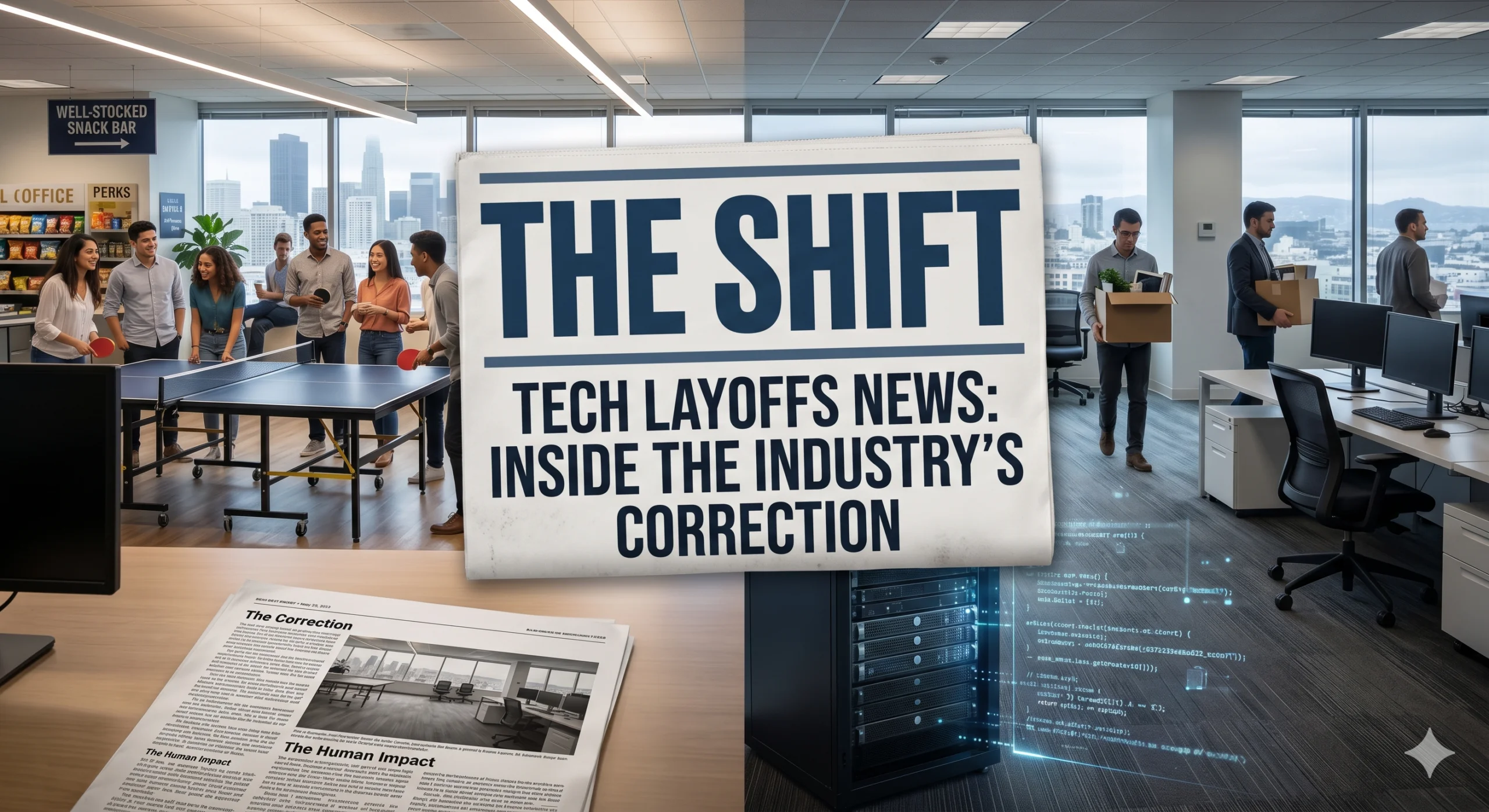

The global technology sector is undergoing an intense period of transition. For over a decade, working in tech layoffs news felt like holding a golden ticket. The industry was defined by massive signing bonuses, luxurious office perks, and an assumption that growth would never slow down. Today, the headlines tell a completely different story. Tens of thousands of engineers, recruiters, product managers, and designers have found themselves navigating sudden job losses.
This wave of workforce reductions is not just a temporary bump in the road. It represents a fundamental restructuring of how the modern digital economy operates. Understanding this shift requires looking beyond the raw statistics to explore why this happened, how it affects real people, and what the future looks like for the global workforce.
The Correction
To make sense of the recent headlines, we have to look back at the corporate behavior of the recent past. During the global pandemic, online activity surged dramatically. People shopped online, streamed endless content, worked from home, and relied heavily on digital tools for every aspect of daily life. Tech executives looked at this explosive surge and assumed it was a permanent acceleration of the digital economy.
Companies raced to hire as fast as possible to keep pace with this demand. Tech giants and small startups alike competed fiercely for talent, driving up salaries and expanding their headcounts by massive percentages.
However, as society reopened, consumer behavior normalized. People went back to physical stores, traveled, and spent less time glued to their screens. The anticipated revenue growth stalled, leaving companies with massive operational costs and too many employees. The resulting workforce reductions are, in essence, a severe course correction for years of overly optimistic corporate forecasting.
The Investor Pressure
Corporate strategy does not happen in a vacuum. Wall Street and venture capital firms play a massive role in shaping how tech companies behave. For years, investors rewarded raw growth. If a company could show that its user base was expanding and its team was growing, investors were happy to pour in millions of dollars, even if the business was not profitable.
That environment changed rapidly when central banks raised interest rates to combat inflation. Suddenly, money was no longer cheap to borrow. Investors stopped prioritizing growth at all costs and started demanding profitability, efficiency, and strong cash flow.
When major institutional investors began demanding leaner corporate structures, executives felt immense pressure to act. For many businesses, cutting the payroll was the quickest way to instantly slash expenses and reassure shareholders that they were serious about financial discipline. This created a domino effect across the industry. Once a few high profile companies initiated job cuts without suffering major public backlash, it became culturally easier for other tech firms to follow suit.
The Artificial Intelligence Factor
Beyond macroeconomic pressures, a technological shift is quietly driving many corporate restructuring plans. Artificial intelligence has moved from a futuristic concept to a practical tool that is actively transforming business operations.
Company leaders are actively looking for ways to integrate automation into their workflows. In many cases, executives are explicitly choosing to reallocate funds away from traditional engineering or administrative roles and redirecting those resources toward AI research and development.
Automation is also beginning to streamline tasks that used to require entire teams. Basic coding, software testing, customer support, and content generation can now be assisted or fully handled by automated systems. While AI is creating new highly specialized roles, it is simultaneously reducing the total number of general technical positions needed to maintain existing software systems.
The Human Impact
Behind the data points and corporate announcements are thousands of highly skilled workers facing sudden professional disruption. For many, the experience has been incredibly jarring. Employees who were courted with lavish promises just a year prior have found themselves locked out of their corporate email accounts on random mornings with little to no warning.
The competitive landscape of the job market has completely transformed. Job seekers who once had multiple competing offers are now competing against thousands of other qualified professionals for a limited pool of open positions. Interview processes have become longer, salary offers have compressed, and remote work opportunities are becoming harder to secure as employers push for a return to physical offices.
This shift has also heavily impacted international workers who rely on employment visas to remain in countries like the United States. Finding a new qualifying tech role within tight legal windows adds a layer of intense personal stress to an already difficult professional situation.
The Changing Narrative
The era of tech exceptionalism is drawing to a close. For a long time, tech companies marketed themselves not just as employers, but as communities or families. The colorful offices, free food, and workplace wellness programs were designed to blur the lines between personal life and professional duty.
The recent waves of corporate downsizing have broken that illusion. Workers are realizing that despite the friendly culture, tech companies are subject to the same cold economic realities as traditional manufacturing or retail corporations. This realization is driving a massive cultural shift toward professional pragmatism.
Tech professionals are increasingly viewing their jobs through a more transactional lens. There is a growing interest in workplace stability, clear boundaries, and even labor organizing, which was once a rare concept in the highly individualized tech sector.
The Path Forward
While the current landscape feels challenging, this transition does not mean the technology sector is dying. Demand for digital innovation, cybersecurity, cloud infrastructure, and data analytics remains incredibly high across the entire global economy.
What we are witnessing is the normalization of tech. It is evolving from a speculative, hyper growth industry into a mature sector focused on sustainable business models. For workers, adaptation is the primary requirement for long term success. Specializing in emerging fields, developing cross functional skills, and maintaining professional agility will be essential strategies for navigating this new chapter.
As the market stabilizes, the companies that emerge strongest will likely be those that prioritize sustainable growth over hype. The industry will continue to build the future, but it will do so with a much sharper focus on the bottom line.
To learn more about modern tech innovations and business solutions, visit Devnoxa Tech.