
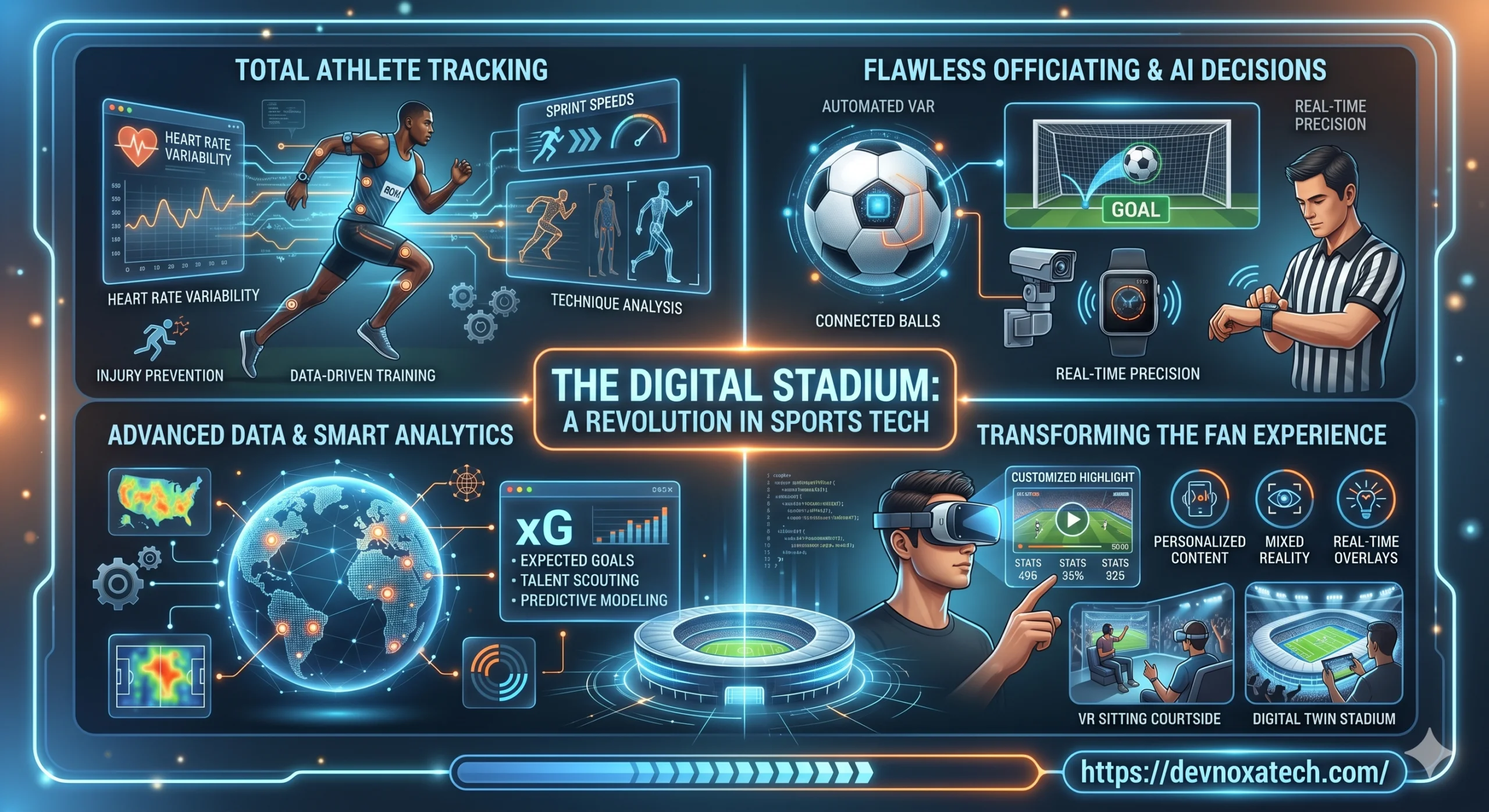

The world of sports is undergoing a quiet revolution. For decades, athletic excellence relied purely on raw talent, gut instincts, and grueling hours of practice. While those elements still matter, the modern playing field is now governed by digital data, advanced computer vision, and real time tracking systems. From localized youth academies to global tournaments like the FIFA World Cup, technology has shifted from a luxury tool into the single most important driving force in the industry.This evolution is fundamentally changing how athletes train, how officials make decisions, and how billions of fans experience their favorite games. The sports tech news ecosystem has expanded into a multi billion dollar marketplace where margins of victory are measured in bytes and milliseconds.
The Era of Total Athlete Tracking
The standard approach to monitoring athlete health and performance has transformed significantly. Traditional fitness trackers that simply count steps or check heart rates are now obsolete at the competitive level. Today, elite organizations use interconnected sensor networks that measure physical exertion down to the cellular level.
Wearable technologies now monitor heart rate variability, which tracks changes in time between heartbeats to gauge a person’s real recovery status and mental stress. These devices are combined with high frequency global positioning systems to monitor acceleration, deceleration, and absolute running speeds during intense training sessions. By analyzing these metrics collectively, sports scientists can accurately identify early warning signs of physical fatigue. This allows coaching staff to adjust practice loads before a tight muscle turns into a season ending ligament tear.
Beyond physical conditioning, computer vision has completely changed how technique is taught. Instead of coaches spending hours manually reviewing recorded video tapes, modern software automatically breaks down movement patterns using skeletal tracking. High speed cameras capture an athlete’s posture, limb alignment, and weight distribution dozens of times per second. Whether it is a tennis player perfecting a serve or a cricket bowler adjusting their stride, automated feedback dashboards highlight mechanical flaws instantly, giving players actionable cues to improve within hours of their session.
Flawless Officiating and Intelligent Decisions
Few areas of sports generate as much passionate debate as officiating, but the deployment of advanced software is rapidly removing human error from critical moments. The upcoming World Cup showcases how deeply integrated tech has become in modern refereeing, featuring connected match balls equipped with internal motion sensors.
These internal sensors transmit spatial coordinates multiple times per second, pairing with synchronized stadium cameras to track up to thirty distinct data points on an individual player’s body. This structural setup enables automated offside decisions and goal line confirmation within seconds, entirely removing the long, frustrating delays that used to plague video assistant referee reviews. The technology sends an immediate vibration to the referee’s smartwatch the exact moment a ball completely crosses the line, preventing ghost goals and ensuring absolute accuracy.
This level of precision is also expanding into other sports. In professional tennis, automated systems have almost entirely replaced human line judges, tracking ball trajectories with millimeter accuracy. In basketball, tracking networks capture every movement of the players and the ball, allowing coaching staff to pull up defensive coverage maps during a game to adjust their strategies dynamically before halftime.
Advanced Data and the Language of Play
The massive influx of tracking data has also birthed a new era of sports analytics. Simple statistical categories like points scored or passes completed are no longer enough to evaluate value. Advanced algorithmic modeling has taken over, turning complex spatial movements into readable trends.
In soccer, predictive metrics like expected goals assess the quality of a scoring chance based on historical data, shot angles, and defender proximity. Analytics teams now utilize deep clustering models to categorize entire team playing styles, mapping out an opponent’s pressing intensity and defensive line patterns long before a game begins. This data driven approach has transformed the global transfer market, allowing talent scouts to search deep database systems to find undervalued players who excel under high pressure but might be missed by traditional talent scouts.
Basketball has embraced a similar approach, utilizing structural frameworks that analyze a sequence of live game events much like linguistic software analyzes a sentence. By looking at how players move relative to one another off the ball, these systems discover highly effective lineup combinations that traditional coaching intuition might overlook. The resulting adjustments can improve a team’s overall defensive efficiency by double digit margins over the course of a competitive season.
Transforming the Modern Fan Experience
While technology optimizes performance on the pitch, it is simultaneously reinventing how fans consume sports from home or inside a stadium. Broadcasting has moved far beyond a basic video feed, evolving into an interactive, highly personalized media layer.
Artificial intelligence now automatically cuts custom highlight packages tailored to individual viewer preferences, prioritizing specific players or play styles. Real time analytics are layered directly onto live television broadcasts, displaying player sprint speeds, shot probabilities, and field coverage maps directly on screen as the action unfolds.
For fans seeking absolute immersion, mixed reality and digital twin environments are opening new doors. Virtual reality platforms allow viewers to experience a live game from the perspective of their favorite player or sit in a simulated front row seat from thousands of miles away. Augmented reality apps overlay live data onto mobile screens without removing the user from their physical surroundings, bridging the gap between digital statistics and the raw emotion of live attendance.
The Connected Future of Sports
The rapid digitalization of sports shows no signs of slowing down. As artificial intelligence models become more accessible, these advanced tools will continue to democratize, trickling down from elite professional franchises to local high schools and youth academies. The future of athletic competition belongs to those who can successfully marry human physical capability with data driven insights.
To stay ahead of the digital curve and explore how modern software engineering is shaping the future of global industries, discover the latest innovations at devnoxa tech