
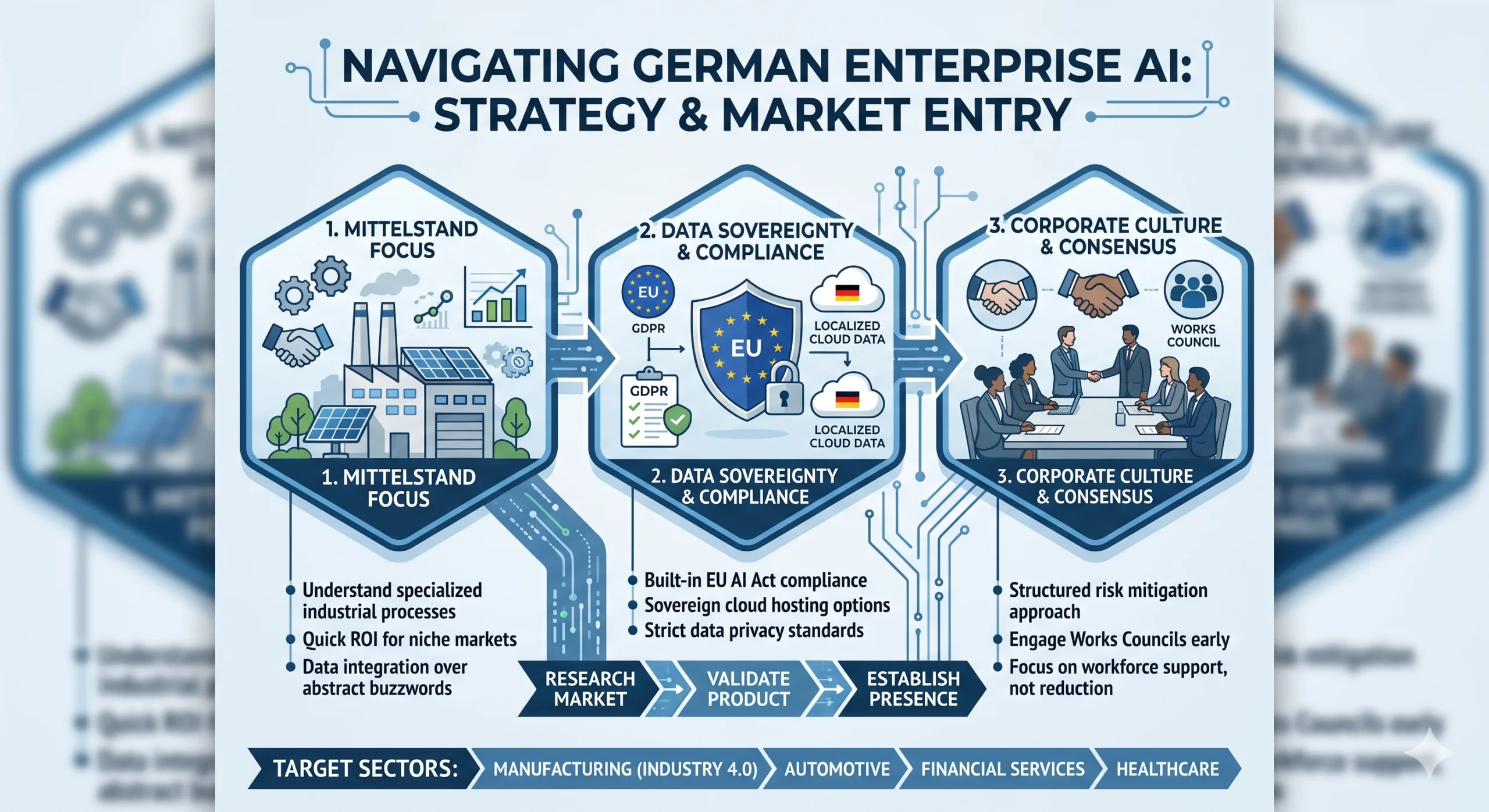

Entering the German market with an Artificial Intelligence strategy platform is one of the most lucrative yet demanding moves a technology provider can make. Germany represents the economic engine of Europe, boasting a massive industrial sector, a highly sophisticated financial services market, and a unique landscape of mid-sized global le Recent economic data indicates that the German ai market is experiencing an unprecedented surge. Over 95% of German business leaders now view AI as highly relevant to their business models. However, a major paradox defines the current landscape: while execution and strategy development are moving rapidly at the enterprise level, less than 1% of German companies have achieved full, systematic integration of AI across all core operational areas. The gap between strategic ambition and technical implementation is wide. This reality creates a massive window of opportunity for AI strategy platforms that can bridge the divide between top-tier planning and ground-level execution. Success requires a deep understanding of Germany’s unique industrial mechanics, corporate culture, and strict regulatory environment.
Cracking the Code of the Mittelstand
While global attention often focuses on corporate giants like Siemens, BASF, or Volkswagen, the true backbone of the German economy lies in its small and medium enterprises. These family-owned, highly specialized firms dominate global niche markets.
Entering the German market requires a strategy that directly addresses the specific challenges faced by the Mittelstand. These companies typically do not possess the vast internal data science departments found in Silicon Valley or multinational corporations. Instead, nearly 90% of German mid-sized firms rely heavily on external software solutions and vendor-neutral platforms to drive their digital transformation.
For an AI strategy platform, this means your value proposition must focus heavily on ease of integration and quick, measurable returns on investment. German decision-makers are notoriously pragmatic. They are less impressed by abstract promises of artificial general intelligence and highly focused on concrete metrics like reducing manufacturing defect rates, optimizing supply chain logistics, or lowering energy consumption. Your platform must speak the language of specialized industrial processes rather than tech-industry buzzwords.
Mastering Regulatory Compliance and Data Sovereignty
The single greatest hurdle for any foreign technology platform entering Germany is navigating the complex legal and cultural framework surrounding data privacy and governance. Germany is a global leader in advocating for ethical, transparent, and human-centric technology. This philosophy is deeply embedded in its corporate governance and legal structures.
The regulatory environment has shifted dramatically with the implementation of the European Union AI Act and Germany’s national legislative counterpart, the AI Market Surveillance and Innovation Promotion Act. This framework places immense pressure on businesses to ensure total algorithmic transparency, data privacy, and non-discriminatory outcomes.
+-------------------------------------------------------------------+
|               German AI Strategy Platform Essentials              |
+-----------------------------------------+-------------------------+
| Regulatory Core                         | Operational Value       |
+-----------------------------------------+-------------------------+
| Full EU AI Act compliance               | Direct Mittelstand ROI  |
| Localized cloud data sovereignty        | Clear legacy integration|
| Works council engagement frameworks     | Ethical transparency    |
+-----------------------------------------+-------------------------+
| Focus Area: Trust, Security, and Measurable Efficiency            |
+-------------------------------------------------------------------+
Foreign market entrants cannot treat compliance as an afterthought or a legal checkbox. It must be built directly into the product architecture. German enterprise buyers expect comprehensive data sovereignty. Large-scale cloud expansions across Germany highlight the intense corporate demand for localized, secure cloud infrastructure. If your strategy platform relies on transferring sensitive corporate data outside the borders of the European Union, you will face immediate resistance from legal teams and chief information security officers. Platforms that offer sovereign European cloud hosting, clear data-lineage tracking, and robust compliance auditing tools possess a massive competitive advantage.
Engaging the German Corporate Culture
To successfully sell an enterprise software platform in Germany, you must understand the collaborative nature of German corporate decision-making. Unlike the top-down management structures common in North American markets, German business culture values consensus, detailed planning, and structured risk mitigation.
A crucial factor that many foreign tech companies overlook is the role of the Works Council. Under German labor law, these employee-elected bodies possess significant co-determination rights regarding the introduction of new technologies in the workplace. Because AI strategies directly impact workflows, employee monitoring, and job descriptions, the Works Council must be engaged early in the software procurement process.
An effective AI strategy platform should include features designed to ease this transition. Providing built-in governance frameworks, clear explanations of how algorithms affect human roles, and educational training modules can transform the Works Council from a potential bottleneck into a powerful ally. Your sales and onboarding processes must demonstrate a clear commitment to supporting the human workforce rather than simply focusing on head-count reduction.
Positioning for High Growth Industrial Sectors
An effective entry strategy should prioritize the specific sectors where German industry is aggressively seeking AI solutions. The dominance of cross-industry applications is growing rapidly, but several vertical markets stand out as prime targets:
- Smart Manufacturing and Industry 4.0: German factories are rapidly integrating machine learning and computer vision into their production lines to drive predictive maintenance, automate quality control, and optimize resource allocation.
- Automotive and Mobility: As the home of automotive innovation, Germany is heavily invested in building advanced simulations, digital twins, and AI-driven supply chain ecosystems.
- Banking, Financial Services, and Insurance: Early adoption of predictive models for fraud detection, automated risk assessment, and complex compliance reporting is driving significant software and services revenue.
- Healthcare and Pharmaceuticals: The secondary use of healthcare data for accelerated diagnostics and drug discovery is expanding rapidly, supported by new federal frameworks for data interoperability.
Focusing your platform’s initial marketing and case studies on these core pillars will build immediate credibility within the local business ecosystem.
Building Strategic Local Alliances
Entering Germany cannot be done entirely from afar. Building a credible presence requires active participation in the local digital ecosystem. Tech hubs like Berlin, Munich, Frankfurt, and Hamburg boast thriving startup scenes and major research institutions that attract global venture capital and top-tier engineering talent.
Forming alliances with local implementation partners, specialized IT consulting firms, and academic competence centers can accelerate your market entry. Because services represent the largest and fastest-growing revenue segment within the broader German technology space, having local system integrators who understand how to configure and deploy your strategy platform is essential for scaling your operations. Major industry events, such as tech conferences in Berlin, serve as excellent launchpads for establishing these vital b2b connections, demonstrating your technology, and anchoring your brand within the European market.
By blending robust compliance architecture, deep respect for local corporate structures, and a laser focus on measurable operational efficiency, an AI strategy platform can successfully capture a significant share of Europe’s most dynamic digital economy.
For professional assistance in expanding your technology solutions into international enterprise markets, explore the strategic engineering and deployment services available at devnoxa tech