
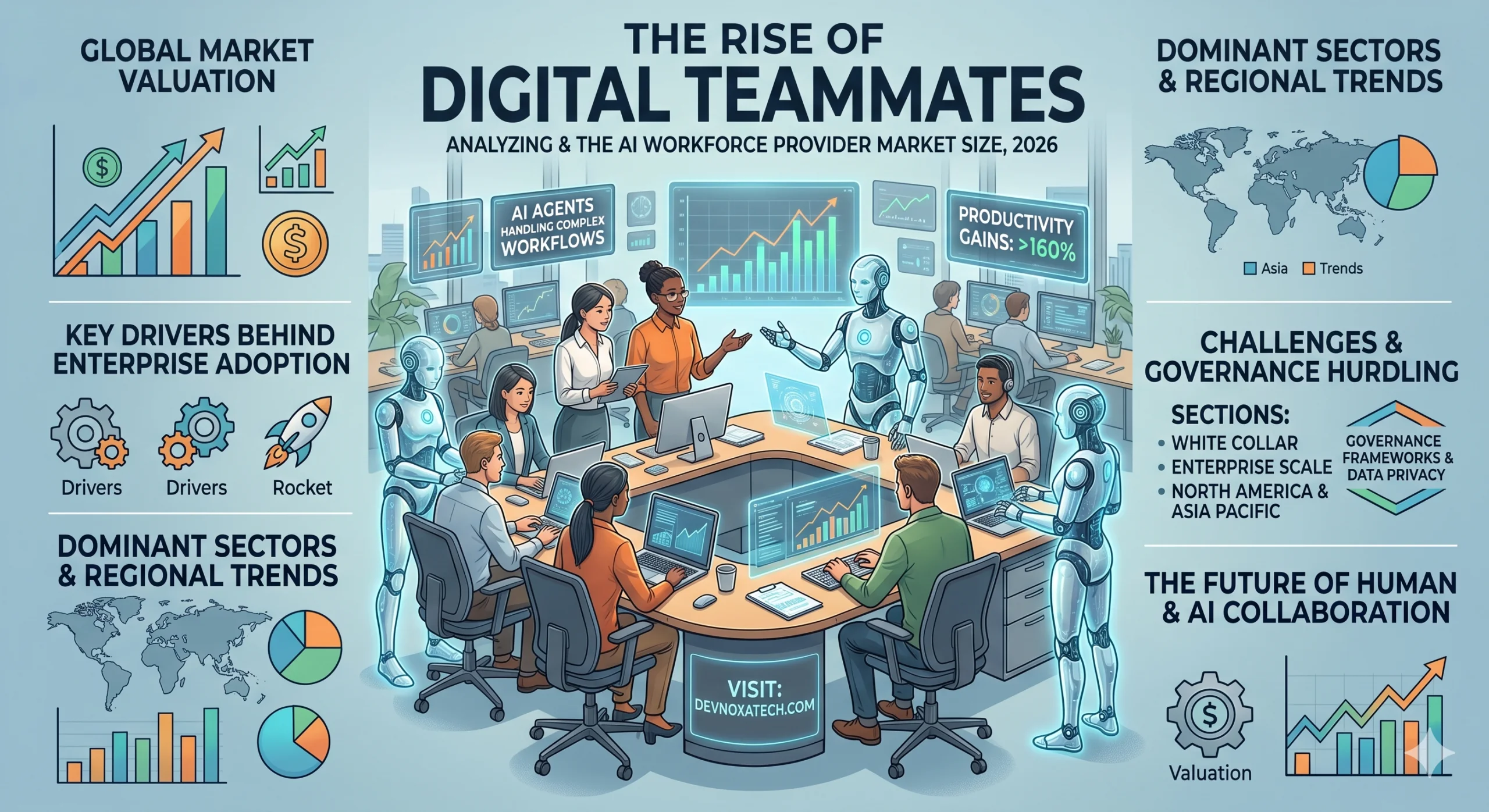

The global landscape of work is changing at an unprecedented pace. Companies are no longer just hiring human talent to scale their operations; they are actively onboarding digital workers. The AI workforce provider market has emerged as one of the most dynamic sectors in the technology ecosystem. These providers deliver autonomous software agents, digital assistants, and specialized machine learning models that integrate directly into corporate teams to handle complex workflows.
As businesses transition from basic automation to agentic AI, the demand for external partners to build, deploy, and manage these digital entities has surged. In 2026, this sector has moved well beyond speculative experimentation, establishing itself as a foundational pillar of modern corporate strategy.
Global Market Valuation
The market size for AI workforce planning and digital transition platforms is experiencing sharp, compounding growth. Recent economic indicators place the specialized AI workforce planning segment at approximately 3.3 billion USD globally. When evaluating the broader ecosystem of enterprise AI assistants and autonomous workforce software platforms, the market value climbs toward 22.7 billion USD.
This growth is part of a massive surge in enterprise software spending, where software applications designed specifically to mimic or support human roles are expanding rapidly. Industry analysts project that these workforce platforms will maintain an aggressive compound annual growth rate exceeding 20 percent over the next decade. This momentum is fueled by the realization that deploying pre-trained digital agents is vastly more cost effective than building machine learning infrastructure from scratch.
Key Drivers Behind Enterprise Adoption
Several critical economic and technological realities are forcing companies to turn to AI workforce providers.
Severe Technical Talent Shortages
The internal development of sophisticated AI agents requires specialized data scientists, machine learning engineers, and prompt specialists. Because these professionals are scarce and command substantial salary premiums, enterprises are opting to outsource their needs. Contracting with an AI workforce provider allows companies to deploy highly capable digital workers immediately without the overhead of lengthy recruitment cycles.
Transition to Agentic AI
Earlier generations of workplace AI relied heavily on simple, rule-based chatbots that required constant human intervention. In 2026, the technology has evolved toward agentic architectures. These modern digital workers can analyze data, make contextual judgments, and execute multi-step processes end to end, such as managing IT service desks, resolving complex customer inquiries, or forecasting supply chain needs weeks in advance.
Unprecedented Productivity Gains
Data from global labor studies indicates that organizations heavily utilizing AI workforce solutions are experiencing massive structural advantages. Top tier enterprises integrating these technologies have documented labor productivity gains of over 160 percent compared to historical baselines. These systems eliminate routine administrative friction, allowing human teams to focus entirely on high level strategic initiatives.
Dominant Sectors and Regional Trends
The adoption of digital workforces is not uniform across all industries, creating a distinct divergence in how different sectors evolve.
White Collar and Knowledge Work
The primary adopters of AI workforce providers are professional services, financial institutions, and administrative operations. Because text generation, deep data analysis, and customer interaction are highly susceptible to workflow optimization, knowledge workers are seeing the highest level of collaboration with digital peers.
Enterprise Scale Dominance
Large corporations currently account for nearly half of the total market share for AI workforce adoption. Large enterprises possess the necessary budgets, scale, and data infrastructure to seamlessly integrate autonomous agents into existing enterprise resource planning and human resource ecosystems.
Regional Breakdown
North America continues to hold the largest market share, driven by aggressive venture capital flows, early technology integration, and the presence of major AI infrastructure giants. However, the Asia Pacific region is recorded as the fastest growing geographical market. Heavy public and private investments in tech hubs across India, China, and Japan are rapidly accelerating local adoption rates.
Challenges and Governance Hurdling
While the economic benefits are clear, the expansion of the AI workforce provider market faces significant regulatory and cultural hurdles. Organizations are finding that onboarding a digital worker requires strict governance frameworks.
Issues surrounding data privacy, algorithmic bias, and compliance are paramount. For instance, international regulations demand absolute transparency in automated decision making, forcing providers to build explainable AI systems. Furthermore, internal corporate structures are adapting, with human resource leaders increasingly tasked with training and onboarding digital agents alongside human employees to maintain strict quality and trust standards.
The Future of Human and AI Collaboration
The evolution of this market is not leading to entirely vacant offices. Instead, it is creating a two track global labor market where human skills like judgment, strategic leadership, and emotional intelligence are highly valued. Companies utilizing AI workforce providers are actually expanding their human headcounts faster than their non-automated peers. The digital workforce acts as an accelerator, removing routine operational burdens so that businesses can scale their creative and strategic output at a pace previously thought impossible.
To learn more about cutting edge digital solutions and custom technology integration, visit Devnoxa Tech.