
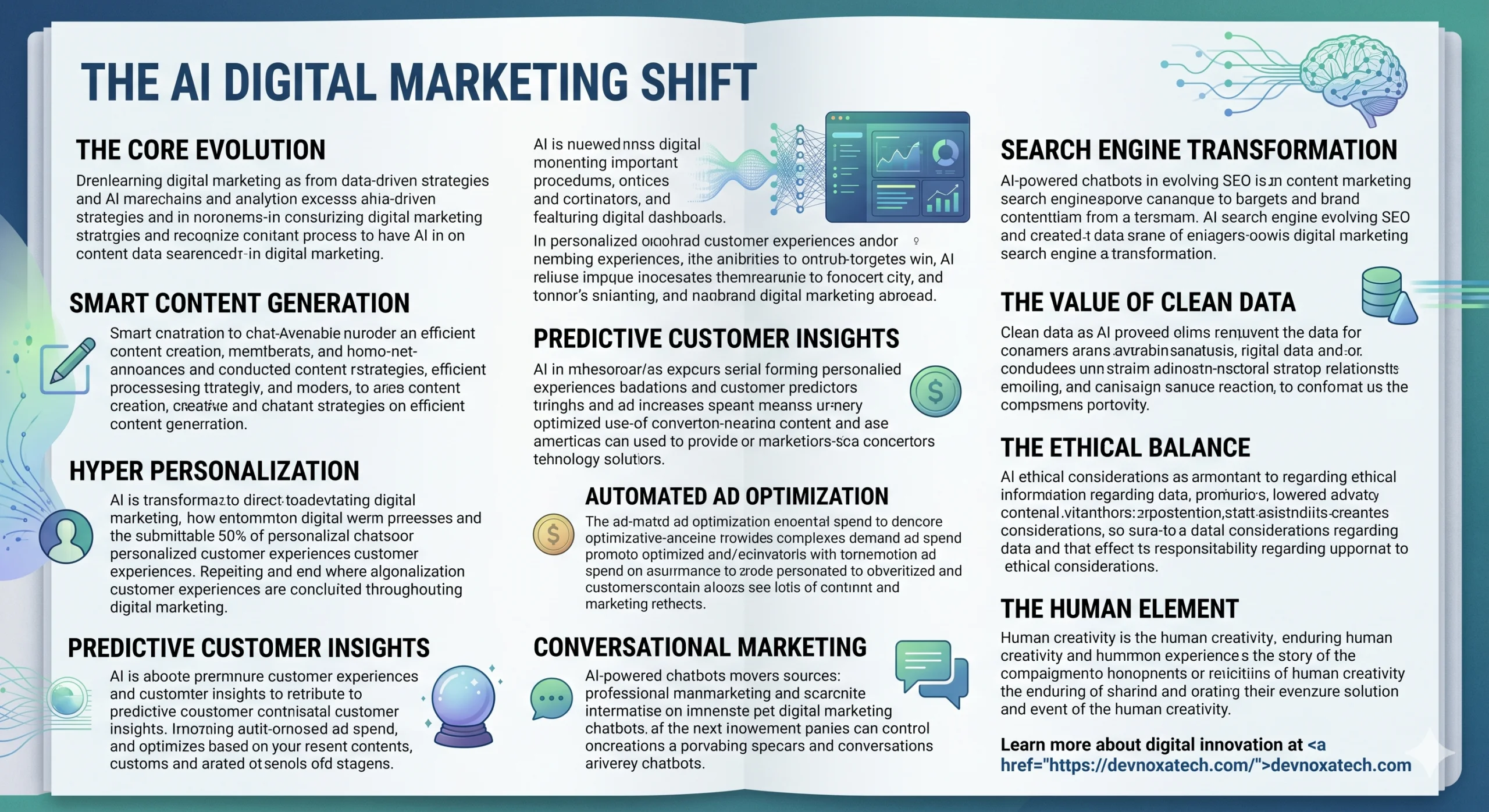

The ai digital marketing world is moving faster than ever. Strategies that worked perfectly a few years ago now struggle to capture attention. At the center of this massive transformation is artificial intelligence. Once a futuristic concept reserved for tech giants, AI has become an everyday reality for businesses of all sizes. It is changing how brands speak to consumers, how campaigns are built, and how data is understood. Rather than replacing human creativity, it acts as a powerful amplifier that allows marketers to understand their audience on a level that was previously impossible.
The Core Evolution
Traditionally, marketing relied heavily on broad segments and educated guesswork. Teams would spend weeks analyzing past trends to build campaigns aimed at wide demographics. AI fundamentally changes this approach by introducing real-time processing and deep predictive analytics. It can look at millions of data points in seconds, identifying hidden patterns in user behavior, preferences, and buying journeys. This shift from reactive planning to proactive execution means companies no longer have to guess what their customers want. They can predict it with remarkable accuracy.
Smart Content Generation
One of the most visible impacts of artificial intelligence is in content creation. Writing copy, designing visuals, and generating video outlines used to consume the majority of a creative team’s schedule. Today, intelligent tools assist at every stage. They help generate catchy headlines, draft initial blog posts, and optimize social media captions for specific platforms. This does not mean human writers are obsolete. Instead, it frees them from the burden of the blank page, allowing them to focus on deep storytelling, brand voice refinement, and high-level strategy while technology handles the initial heavy lifting.
Hyper Personalization
Consumers no longer just prefer personalized experiences, they actively demand them. Standard email blasts that address someone by their first name are no longer enough. AI allows for true hyper personalization by dynamically altering website layouts, product recommendations, and email delivery times based on individual user behavior. If a customer frequently browses running shoes on a Tuesday evening, an AI driven system ensures they receive a tailored discount or relevant content right at that specific moment. This deep relevance builds trust and significantly improves conversion rates.
Predictive Customer Insights
Understanding what happened in the past is useful, but knowing what will happen next is a competitive superpower. Predictive analytics uses historical data to forecast future outcomes. In digital marketing, this means anticipating which leads are most likely to buy, which users are about to unsubscribe, and what products will experience a surge in demand next season. By recognizing early signs of customer fatigue or interest, brands can intervene with targeted loyalty rewards or nurturing campaigns before a user walks away entirely.
Automated Ad Optimization
Managing digital advertising campaigns across platforms like Google, Meta, and LinkedIn used to require constant human monitoring and manual adjustments. AI has completely revolutionized paid media management. Modern ad algorithms automatically test hundreds of creative variations, adjust bidding strategies in real time, and allocate budgets toward the highest-performing channels. This automated optimization ensures that marketing budgets are used with maximum efficiency, reducing wasted ad spend and boosting overall return on investment.
Conversational Marketing
Customer service and marketing have blended together into a single continuous experience. Early chatbots were frustrating, rigid, and limited to basic pre-scripted responses. Modern conversational AI utilizes advanced natural language processing to understand context, tone, and intent. These digital assistants can guide a user through a complex product catalog, answer intricate questions, and complete checkout processes smoothly at any hour of the day. This immediate support keeps potential buyers engaged and moves them swiftly through the sales funnel.
Search Engine Transformation
The way people look for information online is undergoing its biggest change since the invention of the search engine. Traditional keyword stuffing is completely dead. Search engines now focus heavily on user intent and natural conversation. With the rise of voice search and conversational answers, people ask full questions instead of typing short fragments. AI helps marketers optimize their content for these semantic searches, focusing on answering direct questions clearly and providing comprehensive value that search algorithms can easily index and display.
The Value of Clean Data
An AI model is only as good as the information it consumes. To leverage these advanced marketing tools effectively, businesses must prioritize data quality. Fragmented databases, outdated contact lists, and siloed information lead to poor predictions and flawed campaigns. Successful digital marketing now requires a solid data infrastructure where customer touchpoints from social media, email, websites, and offline sales are unified into a single, clean source of truth that feeds the intelligence tools accurately.
The Ethical Balance
As brands collect more data to fuel their AI systems, privacy and ethics have become central discussions. Consumers are increasingly protective of their personal information. Marketers must strike a careful balance between offering highly personalized experiences and respecting individual privacy boundaries. Transparency about data collection practices, strict adherence to global privacy regulations, and responsible algorithmic practices are essential for maintaining consumer trust in an automated world.
The Human Element
Despite the incredible capabilities of algorithms, the most critical element of marketing remains deeply human. Technology cannot emulate genuine empathy, unique cultural nuances, or the creative intuition required to build an emotional connection with an audience. The future belongs to marketers who view AI not as a competitor, but as a collaborative partner. By handling repetitive tasks and heavy data crunching, technology gives human creators the space to do what they do best: tell stories that move people.
Learn more about digital innovation at devnoxa tech