
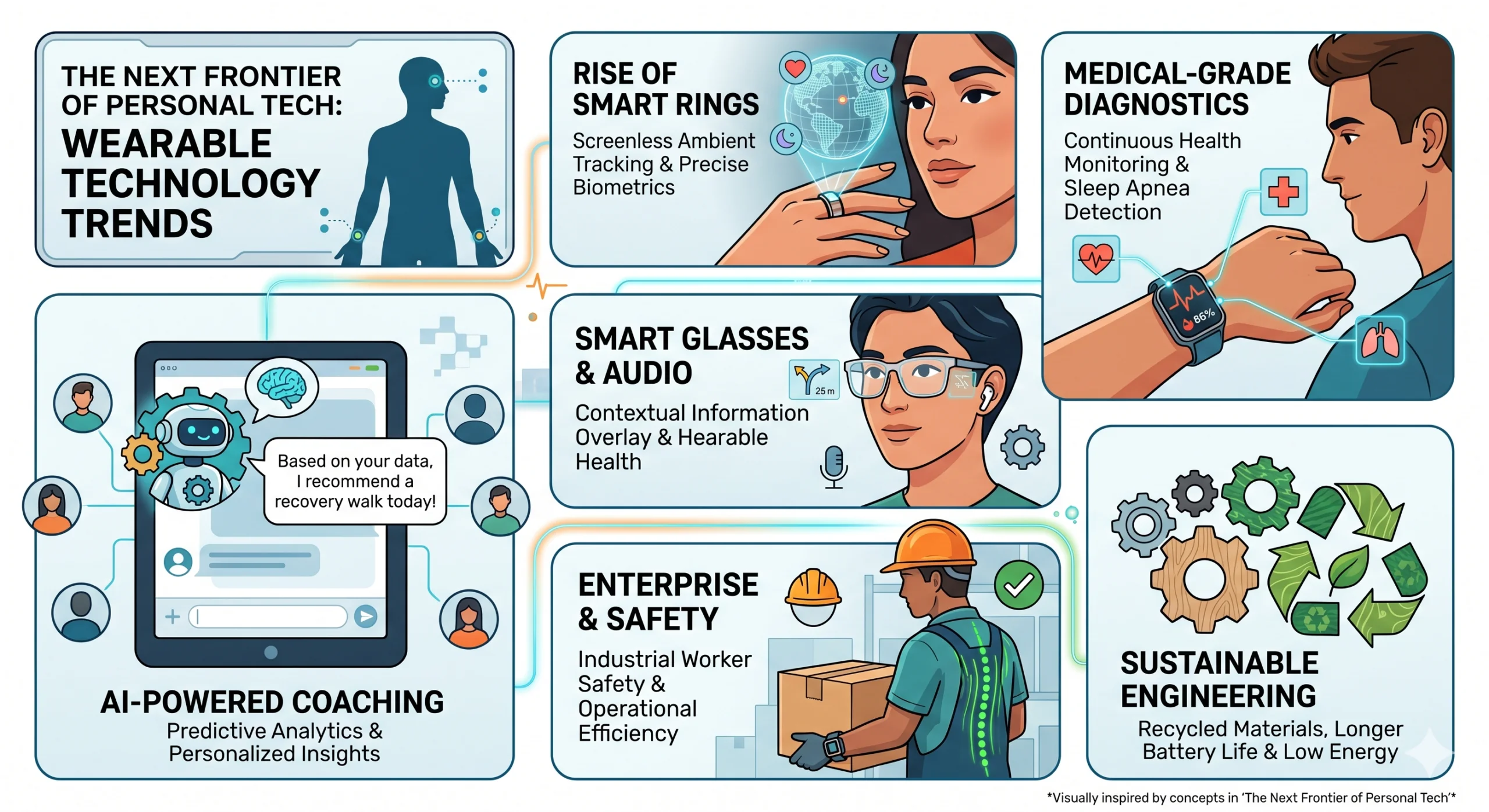

The world of wearable technology trends is changing faster than ever. What started as simple plastic bands that counted steps has evolved into a sophisticated ecosystem of devices integrated into daily life. Today, wearables are shifting from reactive fitness accessories to proactive, intelligent companions. Driven by massive leaps in artificial intelligence, sensor miniature design, and a shifting consumer demand for deeper health data, the latest trends are reshaping how humans interact with technology.
From smart rings that discreetly monitor sleep to augmented glasses that blend digital information into the physical view, the wearable space is expanding beyond the wrist. Understanding these major shifts offers a clear look at where personal consumer technology is heading.
The Rise of Smart Rings and Stealth Tracking
For years, the smartwatch has been the undisputed king of wearables. However, a major trend is the explosive growth of smart rings. Consumers are increasingly suffering from screen fatigue and the constant buzz of wrist notifications. Smart rings provide a screenless alternative that prioritizes ambient tracking.
These compact rings house advanced biometric sensors that press firmly against the finger, where blood vessels sit close to the skin surface. This positioning offers incredibly precise data, particularly for heart rate variability, blood oxygen tracking, and skin temperature changes. Because they are lightweight and lack bright displays, they have become the gold standard for sleep optimization. Users who find wearing a bulky watch to bed uncomfortable are readily switching to rings to track recovery metrics without disruptions.
Medical Grade Diagnostics at Home
The line between lifestyle fitness trackers and clinical medical devices is officially disappearing. Early wearables gave general estimations of active minutes or heart rate ranges. Current devices are securing regulatory clearances for highly advanced health monitoring capabilities.
Sleep apnea detection, atrial fibrillation notifications, and detailed electrocardiogram readings are becoming standard features on consumer electronics. Rather than waiting for an annual checkup, individuals use continuous monitoring to catch early warning signs of cardiovascular anomalies or respiratory stress. Additionally, the integration of continuous glucose monitoring ecosystems into mainstream consumer apps is expanding. While once reserved exclusively for diabetic management, metabolic tracking is being adopted by general wellness enthusiasts looking to understand how specific foods and stress levels impact their daily energy.
Smart Glasses and Contextual Audio
Audio and visual wearables, often called hearables and smart glasses, are undergoing a massive design revolution. Early iterations of smart eyewear failed because they looked awkward and felt heavy. The latest wave fixes the style dilemma by building advanced tech directly into classic, recognizable frame designs.
Modern smart glasses utilize ultra lightweight micro displays and open ear audio systems. Instead of forcing a user to stare down at a mobile screen, these glasses project subtle navigation cues, real time translations, or text notifications directly into the visual field. Concurrently, wireless earbuds are transforming into health devices. By taking advantage of the rich blood flow inside the ear canal, high tech earbuds can track core body temperature and heart rate with extreme reliability, all while delivering active noise cancellation.
Artificial Intelligence Becomes the Personal Coach
Hardware improvements are only half of the story. The true magic behind current wearables lies in software, specifically the implementation of predictive artificial intelligence. In the past, fitness trackers were essentially data dumps. They presented charts of sleep stages, step counts, and caloric burns, leaving the user to figure out what it all meant.
Generative AI companion apps act as personal health coaches. Instead of looking at a low recovery score and guessing the cause, users can ask their app conversational questions. The AI synthesizes multi modal data points, combining sleep metrics, recent training loads, dietary logs, and even local weather conditions, to deliver specific advice. It might suggest a lighter workout because your resting heart rate rose slightly overnight, or recommend a specific wind down routine to combat elevated stress levels. This shifts wearables from historical data logs into forward looking engines for behavioral change.
Enterprise and Industrial Deployment
While consumer adoption dominates headlines, wearables are quietly transforming the modern workplace. Logistics, manufacturing, and healthcare sectors are deploying specialized bodywear to improve worker safety and operational efficiency.
In heavy industrial environments, wearable posture correction sensors and biometric patches track physical strain among workers, flagging high risk lifting movements before musculoskeletal injuries occur. In fulfillment centers, hands free scanning rings and wrist mounted displays streamline inventory management, shaving seconds off processing tasks while keeping workers safe. For medical professionals, wearable patches and smart garments enable robust remote patient monitoring. Hospital systems can discharge patients earlier, knowing that automated systems will immediately alert doctors if a patient’s vital signs deteriorate at home.
The Push for Sustainable Engineering
As the sheer volume of global wearable shipments climbs into hundreds of millions of units annually, environmental sustainability has moved to the forefront of product design. Consumers are actively demanding that the technology they wear on their bodies features a low environmental footprint.
Hardware manufacturers are responding by redesigning the product lifecycle. Newer generations of premium smartwatches and rings utilize high percentages of recycled aluminum, gold, and plastics. Inside the devices, the implementation of ultra low power chipsets and energy efficient displays drastically reduces battery drain, extending the physical lifespan of the hardware. By creating modular designs that allow components like straps and batteries to be replaced easily, the industry is slowly pushing back against the culture of planned obsolescence.
Looking Toward the Future
The evolution of wearable technology is ultimately a story of human empowerment. By bringing sophisticated sensors off laboratory shelves and placing them into rings, glasses, and clothing, technology has become more human centric. It no longer requires people to adapt to rigid machines. Instead, the machines are adapting to the contours of human bodies and lifestyles.
As these trends continue to develop, the relationship with personal health will become more proactive, preventative, and deeply personalized. The devices worn today are paving the way for a healthier, more connected tomorrow.
To explore more about innovative digital solutions and technology development, visit devnoxa tech