

Building a business without market research is like driving at night with the headlights turned off. You might know your destination, but you cannot see the obstacles in front of you. Every day, companies launch products that nobody actually wants simply because they relied on guesswork instead of concrete data.
Market research removes the guesswork. It is the systematic process of gathering, analyzing, and interpreting information about a specific market. This includes studying potential customers, evaluating competitors, and understanding the broader industry landscape. By using the right mix of research methods, you can uncover hidden patterns, identify new opportunities, and minimize the financial risks associated with launching new ventures.
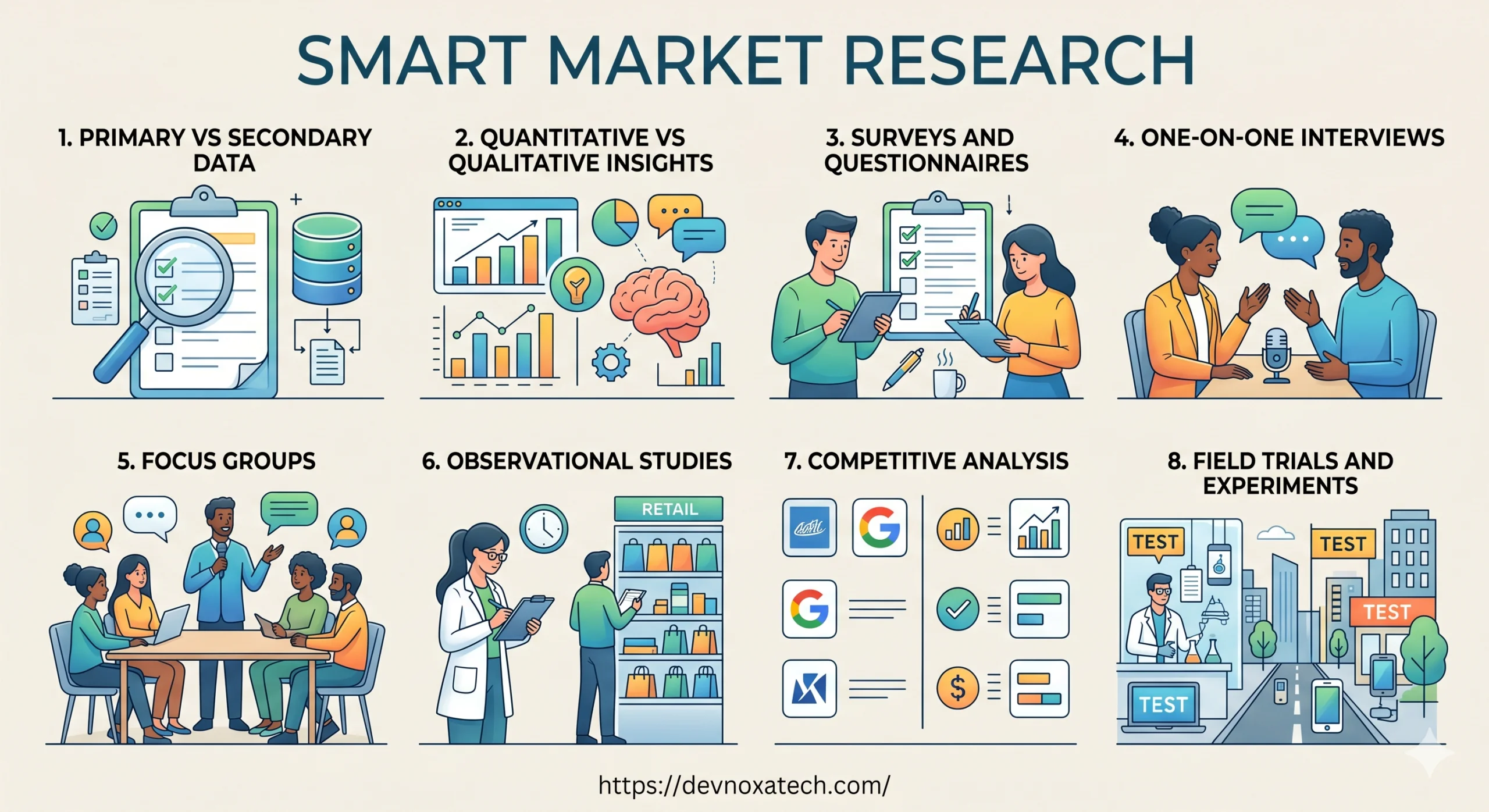
Primary vs Secondary Data
Before exploring specific techniques, it helps to understand the two main categories of data collections.
Primary research involves gathering brand new information directly from the source. You are the one designing the surveys, conducting the interviews, or observing the customer behavior. This data is highly specific to your business needs, though it generally requires more time and money to collect.
Secondary research relies on existing data that someone else has already gathered, analyzed, and published. This includes industry reports, government census data, and academic studies. It is highly accessible, often free or low cost, and serves as an excellent starting point for understanding broad market trends.
Quantitative vs Qualitative Insights
Research methods also divide into two distinct flavors based on the type of insights they generate.
Quantitative research focuses on numbers, math, and statistical analysis. It answers questions like “How many?” or “What percentage?” By collecting measurable data from a large group of people, you can identify broad patterns and confidently predict market behavior.
Qualitative research explores human emotions, motivations, and opinions. It answers the “Why?” and “How?” behind consumer actions. Instead of counting responses, you are listening to stories and reading between the lines to find out what truly drives your audience.
Surveys and Questionnaires
Surveys are the absolute workhorse of quantitative market research. Thanks to modern digital tools, you can distribute a questionnaire to thousands of target customers with the click of a button. They are incredibly cost effective and allow you to gather structured data quickly.
The secret to a successful survey lies in how you design the questions. Closed ended questions, where participants choose from a predetermined list of options or a rating scale, are easy to analyze mathematically. Open ended questions allow people to type out their thoughts in their own words, giving you deeper context. Balancing both formats ensures you get clean numbers alongside nuanced feedback.
One on One Interviews
If surveys give you the big picture, personal interviews provide the close up detail. An interview is a structured or semi structured conversation with an individual from your target demographic. Because it is a conversational format, you can probe deeper whenever the participant mentions something interesting.
Interviews are perfect for exploring complex decision making processes or sensitive topics where people might not be fully honest on a public forum. The biggest downside is scalability. Conducting, transcribing, and analyzing dozens of individual hour long interviews takes a massive investment of time.
Focus Groups
A focus group brings together a small, diverse handful of people, usually between six and ten individuals, to discuss a product, service, or marketing campaign. A trained moderator guides the conversation, ensuring everyone gets a chance to speak while keeping the dialogue on track.
The magic of a focus group is the social interaction. One person’s comment often triggers a completely different idea from someone else, leading to unexpected insights that you might never get in an isolated interview. However, focus groups are vulnerable to groupthink, a psychological phenomenon where participants change their true opinions just to agree with a dominant voice in the room.
Observational Studies
Sometimes, what people say in a survey does not match how they actually behave in real life. That is where observational research comes in. Instead of asking consumers about their habits, researchers quietly watch them interact with products or environments in real time.
This can happen in a physical space, like tracking the path shoppers take through a grocery store to see which aisles they ignore. It can also happen digitally, using heatmaps to see exactly where users click, scroll, or get confused on an e commerce website. Observation provides pure, unbiased behavioral data because the subjects are simply acting naturally.
Competitive Analysis
You do not exist in a vacuum. Your customers are constantly weighing your offers against your rivals. Competitive analysis is a targeted form of secondary research where you dissect the strengths, weaknesses, marketing strategies, and product features of your direct competitors.
By reading their customer reviews, analyzing their pricing structures, and studying their social media presence, you can identify gaps in the market that they are failing to fill. If customers consistently complain about a specific flaw in a competitor’s app, you can build your entire marketing strategy around the fact that your product solves that exact problem.
Field Trials and Experiments
Before investing millions into a full scale product rollout, smart companies run experiments to test the waters. In the digital world, this often takes the form of AB testing, where you show two different versions of a webpage or advertisement to different segments of your audience to see which one converts better.
In the physical world, this might look like a limited location test. A fast food chain might introduce a new menu item in just one city for three months. If the sales numbers are strong and the operational bottlenecks are minimal, they can confidently scale the product nationally.
Finding the Right Mix
No single research method is perfect. The most successful strategies blend multiple approaches to create a complete picture of the market. You might start with secondary research to understand the size of your industry, run a survey to spot a specific customer frustration, and follow up with a few focus groups to test your potential solution.
By taking the time to listen to the data, you protect your capital, respect your audience, and give your business the absolute best chance to grow.
To discover how tailored digital strategies can help scale your business insights, visit devnoxa tech