
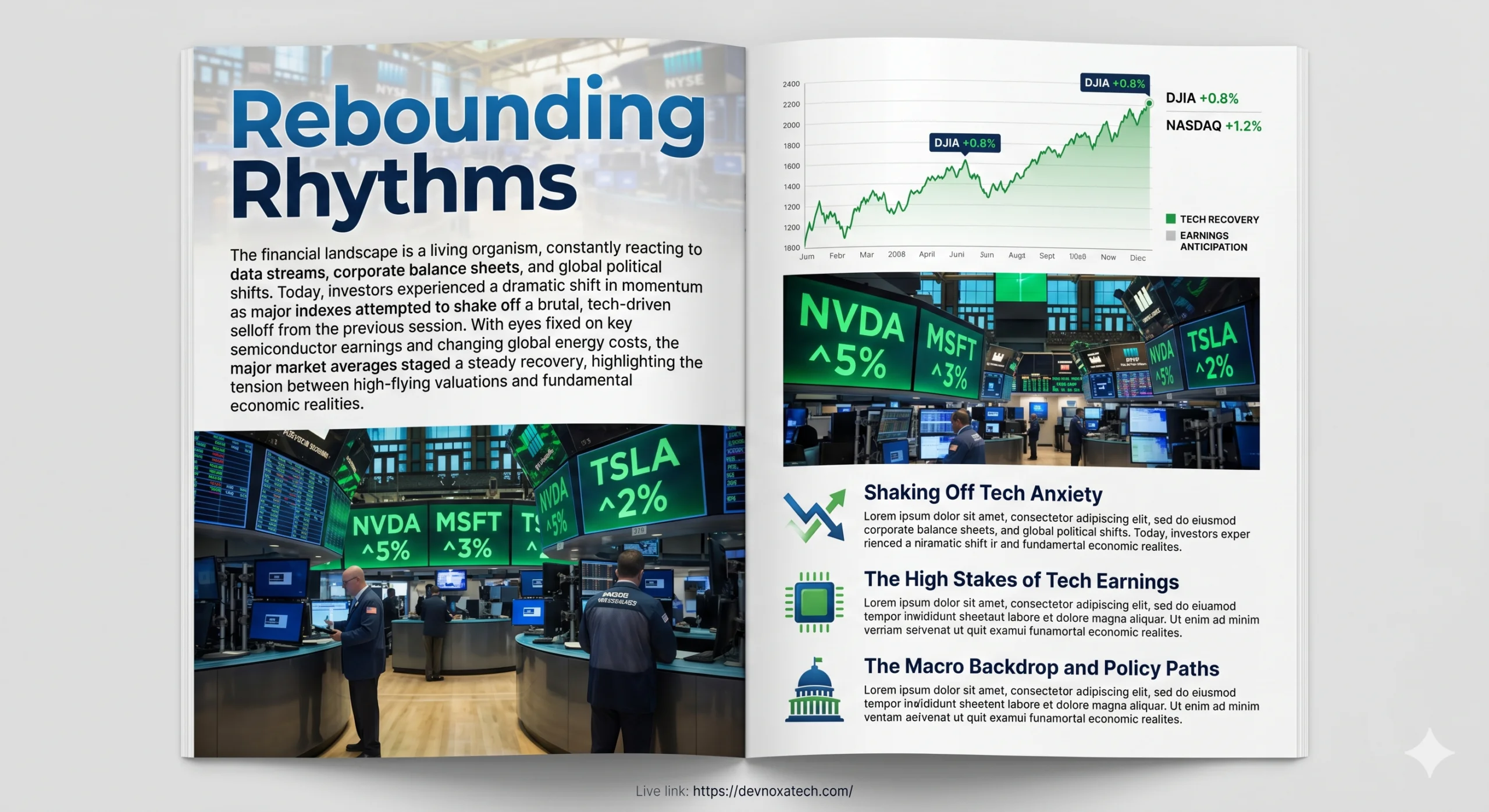

The financial landscape is a living organism, constantly reacting to data streams, corporate balance sheets, and global political shifts. Today, investors experienced a dramatic shift in momentum as major indexes attempted to shake off a brutal, tech-driven selloff from the previous session. With eyes fixed on key semiconductor earnings and changing global energy costs, the major market averages staged a steady recovery, highlighting the tension between high-flying valuations and fundamental economic realities.
Understanding stock market today requires looking at the delicate balance between investor enthusiasm for next-generation technology and the stubborn realities of corporate execution. While the broader indices showed green at the midday mark, beneath the surface lay a complex web of sector rotations, retail investor frenzies, and macroeconomic shifts.
Shaking Off Tech Anxiety
The primary narrative driving today’s early trading action was a collective sigh of relief following a severe bruising in the semiconductor space. The previous session saw a steep decline across tech heavyweights, fueled by growing anxiety that capital expenditures for artificial intelligence infrastructure may be outstripping actual commercial adoption. When major tech indices shed significant value in a single day, the ripple effects tend to freeze broader market participation.
Today, however, a sense of equilibrium returned. Investors shifted from panic selling to selective bargain hunting. This stabilization underscores a recurring theme in the modern market cycle: short term pullbacks are increasingly viewed by institutional desks as entries rather than exit signs, provided the underlying economic backdrop remains sturdy. The tech sector managed to reclaim a portion of its lost ground, serving as the main anchor pulling the broader indices into positive territory.
The High Stakes of Tech Earnings
The calm hovering over the trading floor carried an undercurrent of intense anticipation. Much of the afternoon trading volume focused directly on upcoming corporate financial reports, specifically from major memory-chip producers. In an era where hardware supply lines dictate the pace of digital transformation, a single company’s quarterly guidance can reshape global portfolio allocations overnight.
Analysts set extraordinarily high bars for revenue and profit growth, reflecting the massive capital that has flowed into data infrastructure over the past year. The core question lingering in investors’ minds is no longer just whether these companies can beat current estimates, but whether their projections can justify the massive valuation multiples assigned to them. Today’s defensive, upward drift shows that while optimism remains the dominant force, it is tempered by a strict demand for operational proof.
Energy Relief and Global Catalysts
Beyond the technology board, broader market sectors received a unexpected lift from the commodities complex. International crude oil prices slid notably, touching levels not seen in months. Lower energy costs act as an immediate cooling agent for industrial overhead and transport expenses, providing an organic boost to consumer-facing equities and traditional manufacturing firms.
When energy prices ease, it directly influences how traders perceive the path of inflation. Cheaper input costs mean corporations can maintain healthier margins without necessarily raising prices on the end consumer. This dynamic helped spark a broad-based buying effort that extended far beyond Silicon Valley favorites, lifting financials, consumer staples, and industrial components that had previously lagged during the morning session.
Retail Sparks and Short Squeezes
While institutional capital quietly repositioned around macroeconomic trends, retail trading desks injected their own brand of volatility into the session. In a classic reminder of the power of decentralized retail trading communities, select consumer brands and restaurant chains witnessed massive, sudden spikes in trading volume.
Driven by coordinated momentum on digital forums, these sudden surges triggered classic short squeezes, forcing bearish bettors to rapidly buy back shares to limit losses. This behavior drove individual equity prices up by double-digit percentages within mere hours. These sudden pockets of extreme volatility demonstrate that the market remains highly fragmented, where massive institutional trends run parallel to highly unpredictable, retail-driven micro-trends.
International Market Echoes
The upbeat tone on Wall Street mirrored positive developments across international trading hubs. Emerging markets staged an impressive comeback, driven by localized policy changes and easing global oil pressures. For instance, major South Asian indices reclaimed critical psychological benchmarks, lifted by regulatory changes that expanded lending capabilities and sparked renewed interest from foreign institutional funds.
European bourses also displayed resilience, with major insurers and retailers managing active share buyback programs to support equity values even as competitive pressures mount. The interconnected nature of these global movements confirms that localized market stabilization rarely happens in a vacuum; it is almost always supported by a synchronized global flow of liquidity.
The Macro Backdrop and Policy Paths
Framing all of today’s action is the broader question of monetary policy. Central banking committees have kept interest rates in a steady, elevated range to ensure that lingering inflationary pressures are fully neutralized. While economic expansion continues at a solid pace, the shadow of higher borrowing costs forces investors to be far more discerning with their capital than they were during the era of near-zero interest rates.
With productivity gains remaining robust and the labor market holding its ground, the economy appears resilient enough to withstand these higher rates for longer. This realization has altered the investment playbook. Growth is no longer bought blindly; instead, companies displaying true pricing power, clean balance sheets, and explicit paths to profitability are winning the lion’s share of long-term capital.
Navigating the Forward Horizon
As the closing bell approaches, today’s market action serves as an excellent case study in resilience. The quick transition from a steep tech selloff to an orderly, broad-based recovery indicates an underlying structural health across global equities. Investors are proving that while they are highly sensitive to valuation risks, they are equally quick to step back into the market when macroeconomic indicators provide a stable foundation.
Moving forward, the primary challenge for market participants will be managing expectations. The easy gains derived from pure multiple expansion are largely in the rearview mirror. Success in the current environment demands a granular approach, focusing on specific sector rotations, monitoring global supply constraints, and keeping a watchful eye on energy markets. Today showed that the market can take a punch and keep moving forward, but it also signaled that the road ahead will require navigating plenty of sharp turns.
For deeper insights into emerging digital infrastructure and modern business trends shaping these market sectors, visit Devnoxa Tech.