
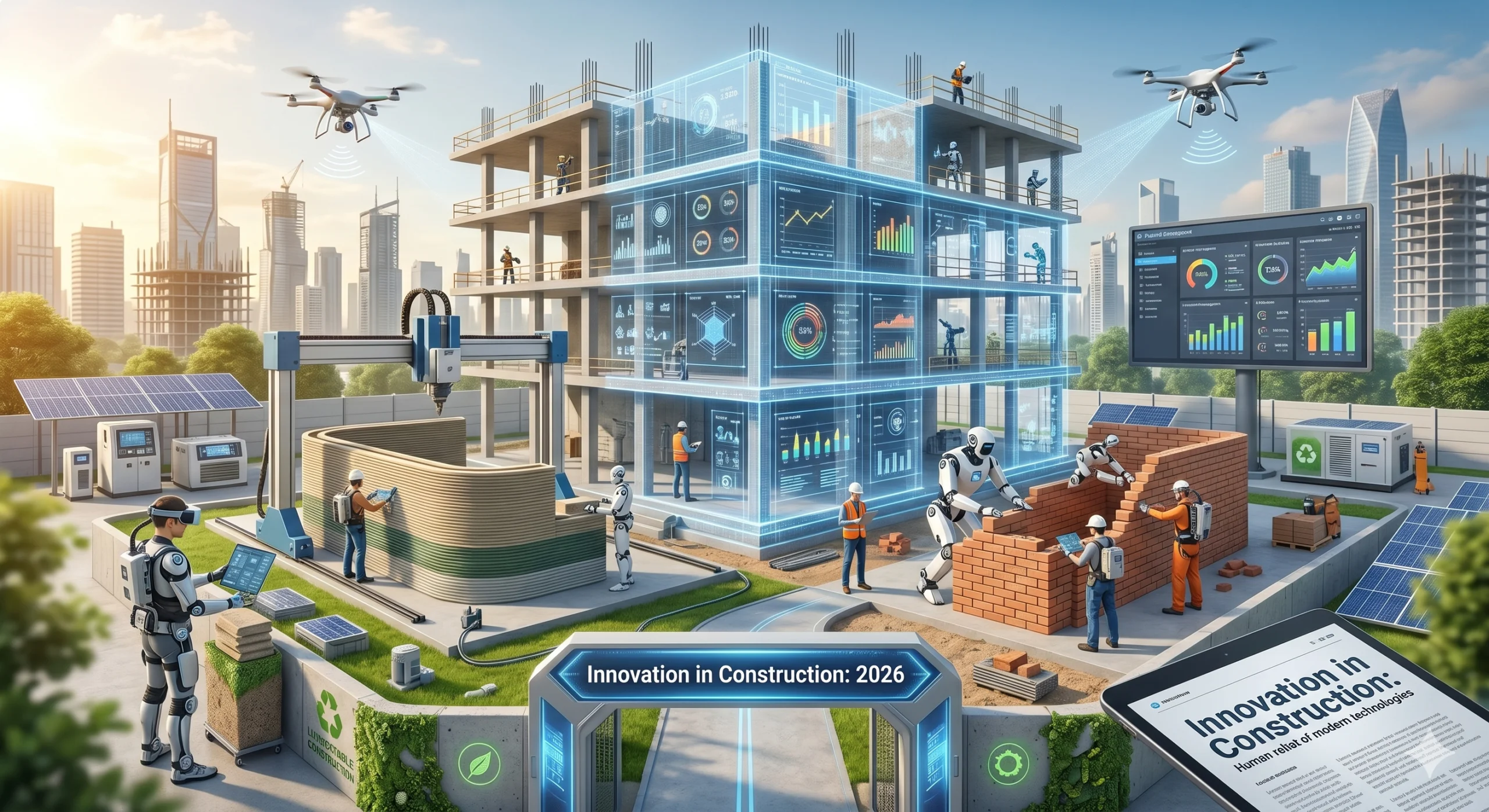

The construction tech industry, long criticized for being slow to change, has officially hit its stride in 2026. What was once a world of paper blueprints and manual labor is now a high-tech frontier where robots, artificial intelligence, and living materials are the new standard. This transformation isn’t just about making things faster; it is a fundamental shift in how we conceive, build, and maintain the spaces where we live and work.
The Rise of the Digital Twin
In 2026, the concept of a “digital twin” has moved from a luxury for massive infrastructure projects to a necessity for almost every site. A digital twin is a living, breathing virtual replica of a physical building. Unlike a static 3D model, these twins are fed real-time data from thousands of IoT sensors embedded within the structure.
During the construction phase, these models allow project managers to simulate “what-if” scenarios. If a shipment of steel is delayed by three days, the AI powering the digital twin can instantly recalculate the entire project timeline, reassigning crews to other tasks to ensure no hour is wasted. Once the building is finished, the twin lives on, helping facility managers predict when a pipe might leak or when the HVAC system needs a tune-up before it actually breaks.
Robotics and the New Workforce
The persistent labor shortage that plagued the early 2020s has been met with a surge in site-ready robotics. However, the fear that robots would replace human workers has largely vanished. Instead, 2026 is the year of the “augmented worker.”
Today’s jobsites feature semi-autonomous robots that handle the grueling, repetitive tasks that once wore down a person’s body. We see robotic bricklayers that can work through the night with millimeter precision and “mule” robots that autonomously haul heavy materials across uneven terrain.
For the human crew, exoskeletons have become standard PPE (Personal Protective Equipment). These wearable machines provide motorized support to a worker’s back and legs, allowing them to lift heavy loads or work overhead for hours without the risk of chronic injury. The result is a safer, more inclusive industry where physical strength is no longer the primary barrier to entry.
3D Printing Scales Up
While 3D printing in construction was once a novelty used for small demonstration houses, 2026 has seen it scale to multi-story commercial projects. Large-scale gantry printers now use proprietary “low-carbon” concrete mixes that harden almost instantly.
The beauty of this technology lies in its efficiency. Traditional construction creates a massive amount of waste from wood forms and excess material. 3D printing uses exactly what is needed, layering the structure with surgical accuracy. It also allows for organic, curved architectural designs that would have been cost-prohibitive or physically impossible using old-fashioned methods.
Living Materials and Carbon Capture
Sustainability is no longer a “nice-to-have” feature; it is a regulatory mandate. The biggest news in material science this year is the mainstream adoption of self-healing concrete. By embedding certain types of bacteria within the concrete mix, buildings can now “heal” their own cracks. When water enters a fissure, the bacteria activate and produce limestone, sealing the gap and preventing structural failure.
Furthermore, we are seeing the rise of carbon-sequestering materials. New “green” cements actually pull $CO_2$ out of the atmosphere as they cure, turning buildings into massive carbon sinks. In 2026, the goal has shifted from simply “reducing” a building’s footprint to creating structures that actually have a positive impact on the environment.
The Modular Revolution
Modular and prefabricated construction has finally shed its reputation for being “cheap” or “cookie-cutter.” In 2026, high-end apartments and complex data centers are being built in factories with the precision of an automotive assembly line.
These modules are transported to the site with plumbing, wiring, and even interior finishes already installed. On-site “assembly” is now a high-speed operation where a crane can stack a dozen units in a single day. This method reduces site noise, cuts down on local traffic disruption, and ensures a level of quality control that is impossible to achieve in the unpredictable outdoor elements.
AI as the Site Superintendent
Perhaps the most invisible but impactful change is the role of generative AI in project management. AI agents now handle the “paperwork” that used to bog down supervisors for hours. They process daily logs, verify code compliance in real-time through drone scans, and even predict safety risks before they happen.
For example, if a drone scan detects that a guardrail is missing on the fifth floor, the AI immediately alerts the safety officer on their smartwatch. By catching these small oversights instantly, the industry has seen a dramatic drop in jobsite accidents over the last twelve months.
A New Era of Collaboration
The most significant change in 2026 isn’t a single piece of hardware, but the way everyone works together. Cloud-based platforms now act as a single source of truth. The architect, the contractor, and the owner are all looking at the same real-time data. There are no more “old versions” of blueprints floating around.
This transparency has reduced the legal disputes and “re-work” that used to eat up 30% of a project’s budget. In 2026, we aren’t just building better; we are building smarter. The fusion of human ingenuity and machine precision has finally turned the construction site into a center of high-tech innovation.
As we look toward the end of the decade, the trend is clear: the physical world is becoming as programmable and predictable as the digital one. For those in the industry, the message is simple: adapt to the tech, or get left in the dust. devnoxa tech