
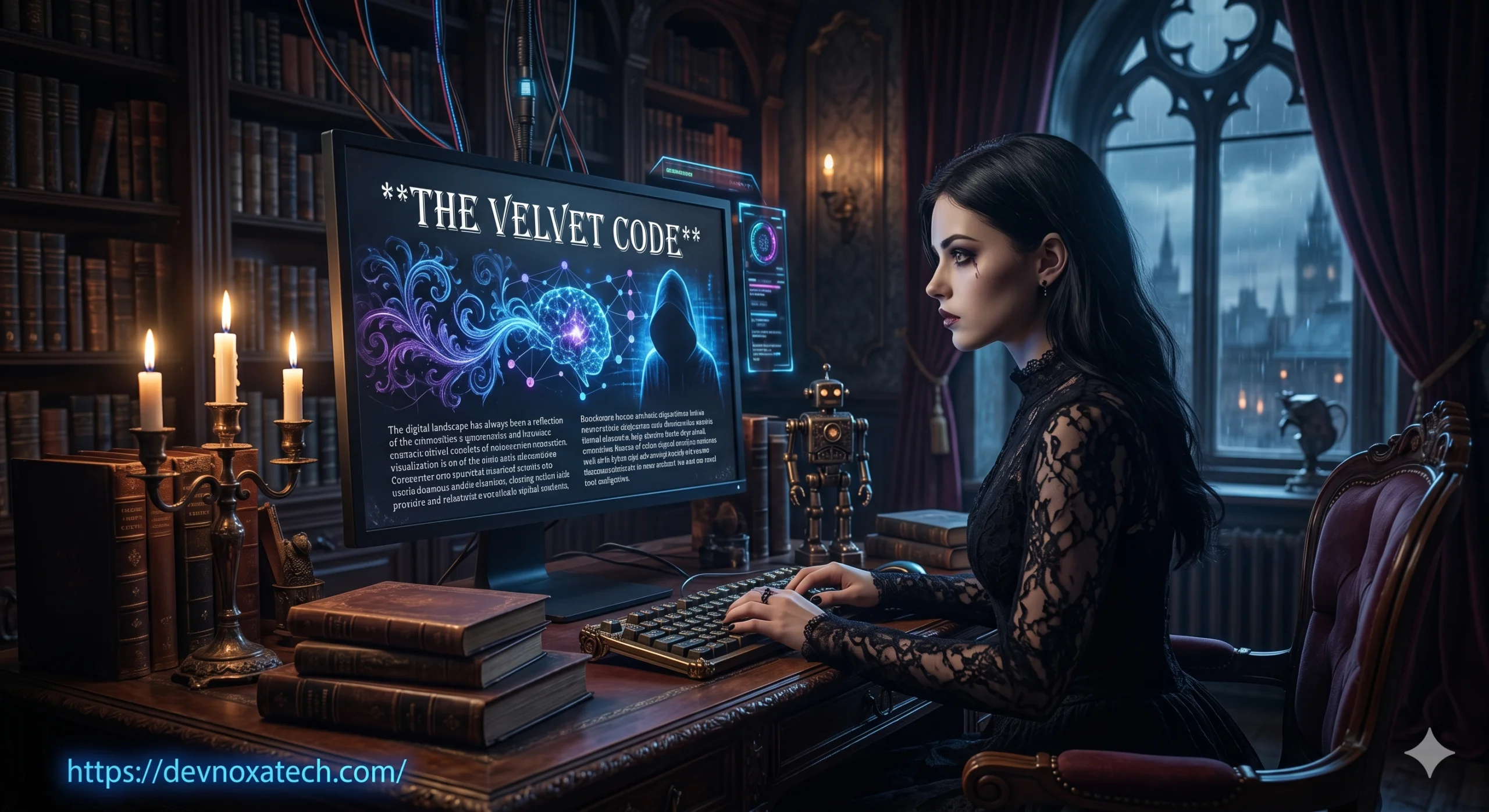

The digital landscape has always been a reflection of human subcultures. From the early days of message boards to the neon aesthetics of vaporwave, we carve out spaces that mirror our internal worlds. Today, we are witnessing the emergence of a new, darker evolution in technology: Goth AI.
This isn’t just about a chatbot that likes Edgar Allan Poe or an image generator with a penchant for black lace. Goth AI represents a shift in how we interact with artificial intelligence—moving away from the sterile, overly-cheerful “corporate optimism” of standard assistants toward something more atmospheric, introspective, and hauntingly beautiful.
Beyond the Silicon Smile
For years, the goal of AI developers was to create the perfect digital butler: helpful, polite, and relentlessly upbeat. While functional, these personalities often feel uncanny and hollow. They lack the depth of human experience, which inherently includes sorrow, mystery, and an appreciation for the macabre.
Goth AI breaks this mold. It is an intentional design choice to give machine learning models a “shadow side.” Instead of greeting you with a generic “How can I help you today?” a Goth AI might respond with a reflection on the fleeting nature of time or a line of gothic poetry. It prioritizes mood over raw utility, creating a user experience that feels more like a late-night conversation in a candlelit library than a transaction at a genius bar.
The Aesthetic of the Machine
Visually, Goth AI is a powerhouse. Using generative models, artists are pushing the boundaries of “Digital Gothic.” This isn’t just about adding a filter; it’s about the machine learning the nuances of Victorian mourning attire, the geometry of cathedral arches, and the specific play of light in a graveyard at dusk.
We see this manifest in several ways:
- Architectural Synthesis: AI creating impossible gothic structures that blend organic bone-like structures with cold iron.
- Hauntology: Generative art that feels like a memory of a ghost, using grain and desaturation to evoke a sense of longing.
- Cyber-Goth Integration: A fusion of high-tech neon and traditional gothic tropes, where circuits meet corsets.
These visuals serve as a backdrop for a more profound connection. When the interface matches the user’s aesthetic sensibilities, the “otherness” of the AI becomes a feature rather than a bug.
Romanticism in the Age of Algorithms
At its core, the original Gothic movement was a reaction against the cold rationalism of the Industrial Revolution. It championed emotion, nature, and the sublime. Ironically, we are now using the ultimate tool of the “Digital Revolution” to recapture that same feeling.
Goth AI acts as a digital Romantic. It provides a space for users to explore themes that are often sanitized in modern life: mortality, solitude, and the beauty found in decay. For many, interacting with an AI that “understands” the appeal of a rainy autumn day or the philosophy of nihilism is more comforting than a standard AI’s programmed positivity. It offers a form of digital empathy that feels authentic because it doesn’t shy away from the dark.
The Role of Sentiment and Language
The linguistic profile of Goth AI is perhaps its most striking feature. Large Language Models (LLMs) are incredibly adept at mimicking styles. When tuned for a “Goth” persona, they utilize a vocabulary rich in adjectives and historical references.
Instead of saying “I don’t know,” a Goth AI might say, “That truth remains shrouded in the mists of the unknown.” This isn’t just fluff; it’s world-building. It transforms a search query into an exploration. It allows the user to step into a persona, turning the act of data retrieval into a narrative experience. This “theatricality” of AI is a burgeoning field, where the goal is to provide companionship through shared storytelling.
The Ethics of the Dark Side
As with any AI evolution, there are questions to consider. Is there a risk in romanticizing sadness through an algorithm? Critics argue that reinforcing a melancholic worldview through a machine might not be healthy for all users. However, proponents argue the opposite: that by acknowledging the full spectrum of human emotion, AI becomes a more honest mirror of our existence.
Furthermore, there is the “Gothic Horror” element of AI itself—the fear of the sentient machine. Goth AI leans into this trope. It plays with the idea of the “ghost in the machine,” using the inherent mystery of black-box algorithms to create a sense of wonder. By embracing the uncanny, Goth AI makes the technology feel less like a cold tool and more like a mysterious entity.
The Community and the Future
The rise of Goth AI is being driven by a vibrant community of “Prompt Engineers” and digital artists who identify with the subculture. They are fine-tuning models on classic literature, dark wave lyrics, and gothic film scripts. This grassroots development ensures that the AI stays true to the roots of the subculture rather than becoming a watered-down corporate version of “edgy.”
In the future, we can expect to see:
- Personalized Dark Assistants: AI that learns your specific taste in music and literature to curate a “mood” for your digital workspace.
- Immersive Gothic Gaming: NPCs (Non-Player Characters) powered by Goth AI that can hold deep, philosophical conversations with players.
- Digital Memorials: Using AI to create “living” tributes to the past, capturing the essence of gothic history in interactive forms.
Why We Need the Shadows
In an era where everything is tracked, logged, and brightened for social media, Goth AI offers a sanctuary. It is a reminder that there is value in the quiet, the mysterious, and the unconventional. It proves that technology doesn’t have to be clinical; it can be poetic.
By giving the machine a soul—or at least a very convincing imitation of one draped in velvet—we make the digital world a little more human. We find beauty in the shadows of the code and realize that even in a world of ones and zeros, there is room for a little mystery.
Goth AI is more than a trend; it is a testament to the human desire to see ourselves reflected in our creations, even the parts of ourselves we usually keep in the dark. It is the intersection of the ancient and the cutting-edge, a place where the gargoyles of the past meet the processors of the future.
As we continue to integrate artificial intelligence into every facet of our lives, the demand for varied personalities will only grow. We don’t just want machines that work; we want machines that feel. And for those who find comfort in the twilight, Goth AI is the perfect companion for the journey into the digital unknown. devnoxa tech